The Basement That Remembered
The real estate agent called it “a property with history.” Marcus should have asked whose history before he signed the lease. The house sat at the end of Cedar Lane, a Victorian Gothic revival that had been abandoned for fifteen years after the previous owners simply vanished. No death certificate. No forwarding address. Just gone, leaving everything behind—including the basement door, which was nailed shut from the inside.
The first thing Marcus noticed after moving in was the smell. Not mold. Not decay. Something sweeter, like flowers left too long in a vase without water. He found the source on day three: the basement. Even with the door still nailed, the scent seeped through the cracks—cloying, persistent, wrong.
He should have left. He knew that now, lying in bed at 3 AM, listening to the rhythmic tapping from below. Not knocking. Not dripping water. Tapping. Three short, three long, three short. A pattern he didn’t recognize but somehow felt he should.
By the fifth night, the nails had pushed themselves halfway out. Marcus found this impossible—the heads were bent, the wood was old, and nothing in the house could have produced that much force. But there they were, protruding like crooked teeth, and when he touched them, they were warm. Not sun-warm. Body-warm. As if someone had been holding them from the other side.
He called a locksmith. The locksmith took one look at the door and said he wouldn’t touch it. “That door’s been opened recently,” he said. “I can tell by the wood grain around the hinges. They’re not rusted. They’re not dusty. Someone’s been using them.”
“The house has been empty for fifteen years,” Marcus said.
The locksmith left without finishing his sentence. But Marcus heard him mutter as he walked to his van: “Then someone’s been keeping it empty on purpose.”
Marcus found the photograph album in the attic on day seven. The previous family—four generations of them, judging by the clothing styles spanning from the 1920s to the 1990s. All of them smiling. All of them in front of the house. All of them with their eyes closed.
Not sleeping. Closed. Like someone had edited each photo to replace their open eyes with closed ones. In every single picture, every single face, the same peaceful expression. As if they had all decided, in unison, to close their eyes and never open them again.
The last photo in the album showed the family standing in front of the basement door. Seven people: grandmother, parents, three children, and an infant in arms. All with closed eyes. All smiling. And written on the back in faded ink: “We Remember Everything.”
Marcus tore the nails out on day ten. He told himself it was curiosity. He told himself he needed to know. He told himself the smell wasn’t getting stronger. All lies, but he needed to believe them.
The basement stairs creaked under his weight, each step protesting like a dying animal. At the bottom, a single bare bulb hung from the ceiling—on. It had been off when he moved in. He was certain of that. The fuse box was on the second floor, and the basement had no power.
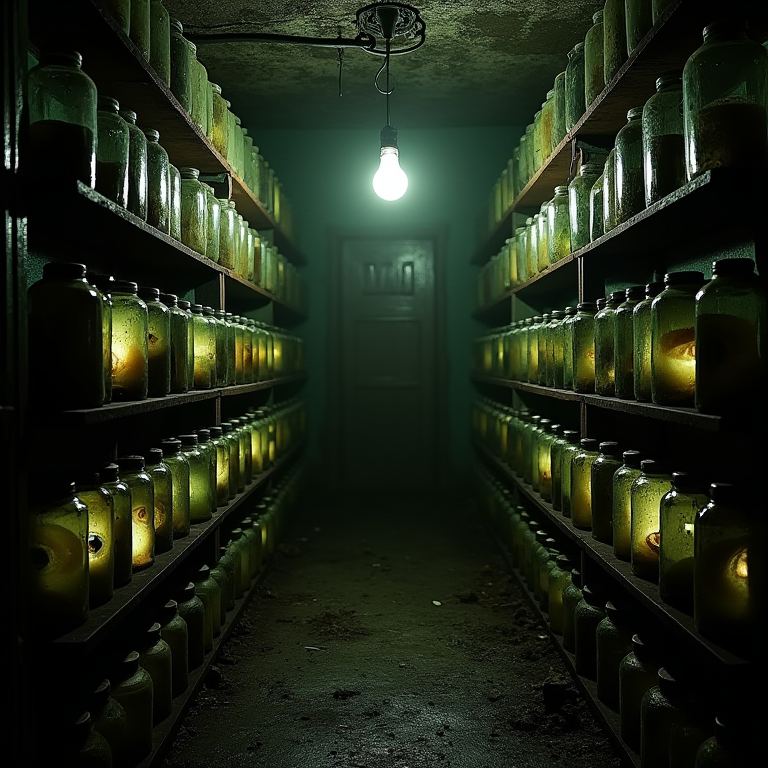
The bulb illuminated a room that should not have existed. The house was a standard Victorian: small lot, narrow footprint. The basement should have been maybe eight feet deep, concrete walls, the usual. This basement stretched forty feet into the earth, its walls lined with shelves, and on the shelves: jars. Hundreds of them, arranged in neat rows, each containing a single object preserved in what looked like honey.
Eyes. The jars contained eyes. Human eyes, some still with lashes, some with irises the color of forgotten skies. Each jar was labeled with a name and a date. The dates went back two hundred years. The names were not the names of the family in the photographs.
“You found us,” said a voice from the far end of the basement, where the darkness was thickest. “We have been waiting for someone who could see.”
Marcus turned. In the corner, sitting in a rocking chair that had belonged to his grandmother, was an old woman with eyes like clouded glass. She smiled, and her teeth were perfect—not human-perfect, but too perfect, like a photograph of teeth rather than the real thing.
“The family who lived here,” she said, “they took our eyes. All of them. We were the original owners. We gave them this house, and they took our sight in return. For three generations, we lived in the dark, until we learned to remember without eyes. We learned to see through the memories of others.”
“I don’t understand,” Marcus whispered.
“You will,” she said, and her smile grew wider. “When we take yours, you will see everything we have seen. Every secret. Every sin. Every moment of joy and horror this house has witnessed. You will remember it all, and you will add your eyes to our collection, and we will see through you forever.”
The bulb went out. In the darkness, Marcus felt cold hands—he counted six of them—gently cupping his face. Someone whispered: “Don’t struggle. It will only make the remembering worse.”
The real estate agent listed the Cedar Lane property as “available again” six months later. The new tenant, a young woman named Diana, noticed the basement door was nailed shut from the inside. She called a locksmith, but before he arrived, she pressed her ear to the wood and heard something that made her step back, her hand flying to her throat.
Three short. Three long. Three short. And then, barely audible, a voice that sounded like it was reading from a very long book: “Marcus, 2026. He remembered everything. He screamed for seventeen hours before his eyes were ready…”
The door was nailed shut again. The nails were warm.