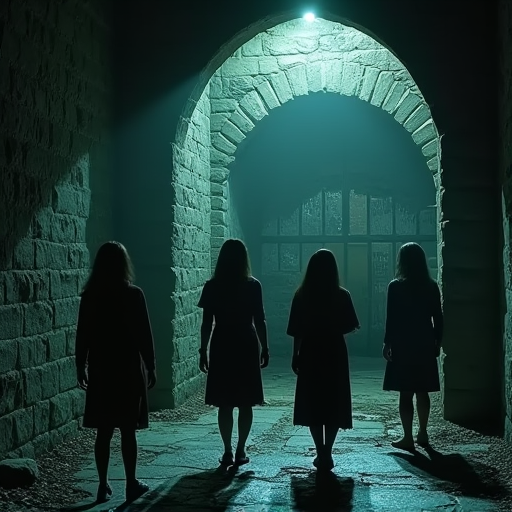
Ghost Corridor Unit 12: The Stone Gate
Instead, like most living people, they needed one more door.
Not a metaphor this time.
Not a hidden alignment.
Not another corridor that turned out to be older than its paint, or a lake that held the wrong face beneath still water, or a classroom built on mourning geometry and disguised as usefulness.
A real door.
Stone.
Buried below the oldest reach of the school’s inherited structure, where the line between sealed architecture and ritual terrain finally stopped pretending to be symbolic.
Claire Morgan saw it only after the break in the line.
She was still weak from the strain of Unit 11, still carrying the aftermath of a system trying and failing to decide whether she belonged to it. Evan Cross had not said the word dying, and Quinn Hale had not allowed herself the softness required to imply it, but both of them had begun moving around Claire with the grave efficiency of people who knew they were negotiating with time as much as with haunting.
And still Claire insisted on coming.
That, Evan thought, was either courage or consistency.
Perhaps those are the same thing once you’ve suffered enough.
They reached the lower breach through service access and old maintenance paths no student was ever meant to use. The damage after the side-hall rupture had not been officially acknowledged beyond the usual language of structural concern, but under the building, behind a warped metal partition and beyond a drift of dust and broken tile, the old lines had shifted just enough to expose what the school had spent generations not seeing.
A descending seam.
A cold draft.
Stone where there should only have been concrete.
And at the end of that blackened run of hidden space, a door set into old masonry that did not belong to any campus-era construction at all.
Quinn stopped first.
Leo Grant swore under his breath.
Evan said nothing, because sometimes silence is the only respectful response to finally meeting the thing you’ve been circling under six different names.
The stone door was not ornate.
That made it worse.
No grand carvings. No fantasy gate to hell. Only age, weight, and purpose. A slab-like fitted seal framed by older walls, with lines scored into its surface so shallowly they might once have been dismissed as weathering—until the flashlight caught them from the side and made the pattern visible.
Eyes.
Not illustrated eyes.
Directive eyes.
Multiple stylized sight-marks embedded into the stone as if the whole thing had once been meant to register being looked at, or to look back through whoever approached it.
Claire felt her knees soften.
“That’s it,” she said quietly.
No one asked what she meant.
The answer was all around them.
The older women’s quarter.
The eye-fastener.
Mara.
The transference logic.
The layered hauntings.
The school’s dependence on witness, sequence, and recurrence.
All of it had been feeding toward containment rather than mere repetition.
The Soul-Lamp had not only needed wearers.
It had needed access.
And the thing it had been repeatedly bargaining toward was not just continuity in bodies or stories, but this:
the stone gate opening.
⸻
Evan was the first to say what the file fragments had already implied.
“The seal isn’t gone,” he said. “It’s compromised.”
Quinn moved her light over the edge of the frame.
There, between old stone and later reinforcement, ran a fracture thin as a blade. Not dramatic. Not broken open. Just enough to show where generations of pressure had found weakness.
Claire remembered the archive wording at once.
A crack in the boundary.
A damaged seal.
The older haunting unable to fully break out by its own force, forcing later manifestations and linked legends to work around the weakness instead. 
“It was never the seventh floor,” she said.
“No,” Evan replied. “That was only where the symptoms became theatrical.”
Leo looked from the crack to the scored eyes on the stone.
“So everything—the Wake Room, the island, East Lake, the corridor—it was all pressure on this?”
Quinn answered more harshly than usual, probably because terror had finally reached the point where dryness no longer insulated it.
“Yes. Congratulations. The school’s ghost ecology turns out to be a siege engine.”
That was the most useful way to think about it.
Not one curse.
Not one dead girl.
Not one legend.
A set of linked manifestations, layered across generations, all working around the same old problem: the original seal still held enough to prevent total release, but not enough to stop the dead from learning how to route themselves through stories, people, and inherited architecture in order to weaken it.
That explained why the line of succession mattered.
Why Claire’s face mattered.
Why Adrian Wynn had been prepared.
Why the eye-fastener had resurfaced.
Why Mara’s layer remained older and colder than the later legends.
And why, from the very beginning, the school’s hauntings had behaved less like revenge and more like procedure.
Claire touched the wall beside her to steady herself.
“Then the line wasn’t trying to produce a queen ghost,” she said. “It was trying to make the right key.”
Nobody corrected her.
⸻
What they found next proved how close the system had already come.
Set into a narrow cavity just beside the gate, half hidden behind fallen debris, lay a recess worn smooth by repeated handling. It was too shallow for storage, too precise for accident, and shaped in a way that made Quinn’s face tighten immediately.
“The fastener,” she said.
Evan looked at her.
“You’re sure?”
“No. But I hate how sure it feels.”
The old eye-fastener had broken in Unit 11 when they forced the line to seize across incompatible generational routes. At the time that had felt like interruption—necessary, partial, costly, but enough. Now, seeing the recess beside the stone gate, they understood something even worse:
the fastener was not only a corpse-work fixture.
It was also part of a locking or orienting mechanism here.
Not the only part.
Not enough alone.
But enough to matter.
Leo swallowed audibly.
“Meaning Adrian was carrying a piece of the gate.”
“No,” Evan said. “A piece of the opening sequence.”
Claire closed her eyes for a second.
That distinction was unbearable and exact.
The dead prepared wearers.
The wearers carried fittings.
The fittings confirmed direction.
The line of succession worked toward a face coherent enough to sustain the final approach.
And at the end of it all, behind later school legends and administrative concealment and student stupidity and ritual drift, waited a stone gate with a damaged seal and an empty place where part of the sequence belonged.
For one instant Claire understood why Faye Hart had looked tired rather than simply wrathful.
Why the child in the seventh-floor corridor had sounded lonely rather than purely monstrous.
Why Mara’s face in East Lake had smiled at the refusal.
All of them had been used inside a process older than their own deaths.
Not absolved.
Not purified.
Used.
That realization hurt more than horror.
⸻
The voice came when nobody moved.
It did not come from the gate.
It came through the stone.
That was worse.
Not loud.
Not even singular.
A female voice pressed flat by old barriers and repeated handling, stripped of most emotion but not intent.
“Open.”
Leo made a broken sound and backed into the wall.
Quinn tightened one hand around the recorder in her pocket hard enough to whiten the knuckles.
Evan stood absolutely still.
Claire opened her eyes and looked at the crack in the seal.
Again the voice:
“Open.”
Not a plea.
Not a seduction.
Instruction.
There it was again—that procedural tone that had haunted the entire case from the first message to the last:
turn around,
ready now,
come see if it fits,
open.
The system had always spoken like that because it had always been more mechanism than passion.
Claire drew one long breath.
Then, before Evan could stop her, she stepped closer to the gate.
He moved at once.
“Claire—”
She raised one hand sharply without looking back.
“No.”
That single syllable held enough authority to stop him for one second, and one second was all she needed.
She looked at the crack in the seal and said, very clearly:
“You don’t get another generation.”
The temperature dropped so fast the skin on her hands burned.
The voice changed.
Not into rage exactly.
Into multiplication.
Several female voices now, layered close enough to almost but not fully merge: older, younger, bitter, pleading, formal, exhausted. Mara somewhere within them. Faye somewhere farther back. The later dead all speaking through the same command structure because that was the only way the thing behind the gate knew how to use them.
“Open.”
Claire did not move.
Evan understood then what she was doing.
Not confronting the ghosts.
Not even confronting Mara.
She was forcing the system to address refusal in the present tense rather than through substitution.
No fastener.
No candidate.
No male intermediary.
No prepared corpse.
No indirect witness chain.
Only a living woman speaking back from the exact point where the old logic expected her to fit.
That was why the next change mattered.
The crack in the seal widened—
not much,
not dramatically,
but enough to let something through that felt less like wind and more like the pressure of many unfinished looks all at once.
Quinn hissed a warning.
Leo nearly bolted.
Evan stepped beside Claire despite her earlier protest.
And through the crack, for one impossible instant, they saw not another apparition but the deeper truth of the haunting:
not a chamber,
not a demon,
not a throne of dead girls—
a holding architecture.
A place built to gather, align, and route human remains of sight, memory, and grievance into usable continuity. The Soul-Lamp was not simply inside the system. It was the mode by which the system had long ago learned to keep the gate fed.
That was the final explanatory horror.
The campus had never been haunted by accident.
It had been inherited over an older containment structure, and later generations, through greed, grief, laziness, ritual opportunism, and institutional cowardice, had kept supplying the one thing the sealed mechanism needed most:
witness that repeated itself.
⸻
Claire’s knees almost gave then.
Not because of fear.
Because the pressure through the crack recognized her too clearly.
That was the worst moment in the whole case, later on, even worse than the annex, the lake, the wake, or the side-hall seizure. Because there at the gate she felt, with devastating accuracy, how near she had come to compatibility. Not in some sentimental chosen-one way. In a procedural way.
You could have fit, the pressure seemed to say.
You nearly did.
Another life, another week, another sequence, and this would have closed around you perfectly.
She heard her own breath going ragged.
Evan put one hand against the wall beside her, not touching her, not claiming anything, only establishing a second living point at the breach.
“That’s enough,” he said.
The gate did not care.
The command came again:
“Open.”
This time Quinn answered.
“No,” she said, voice harder than stone, “what you really mean is replace.”
That struck somewhere it mattered.
Because the voices behind the crack broke formation for a fraction of a second. Faye’s sorrow flared through. The child’s need. Mara’s old severity. The line frayed not through force but through naming.
Language again.
Not prayer.
Not spell.
Correct classification.
Leo, to his later lifelong embarrassment, helped next by accident. Half-panicked, half-furious, he shouted the ugliest true thing available:
“She’s not yours!”
It was crude.
Inelegant.
And, perhaps for that reason, devastatingly effective.
The pressure changed.
Not gone.
Not defeated.
Disoriented.
Because ownership had always been the hidden grammar of the system: this body, this role, this witness, this generation. To hear the structure answered in the simplest possible refusal from the least spiritually impressive person in the room may have been exactly the contamination it could not process cleanly.
The crack shuddered.
Then, from somewhere deeper in the sealed architecture, came a sound like very old masonry settling under a weight it had finally decided to reject.
The pressure dropped.
Not all at once.
Enough.
Enough for breath.
Enough for Claire to step back.
Enough for Evan to pull the others away from the wall.
By the time they reached the turn of the hidden passage, the crack had narrowed again to its earlier line.
Still there.
Still dangerous.
Still not healed.
But no longer actively taking shape through Claire.
That, for the moment, had to count as victory.
⸻
They did not speak until they were back in open air.
The morning had already gone pale. The campus looked offensively ordinary. Students moved in the distance. Somewhere a delivery truck reversed with a high mechanical beep as if the world were not, right then, reorganizing itself around the fact that an ancient succession mechanism had just failed to close through the face it wanted.
Claire sat on the low concrete edge outside the service path and pressed both hands over her eyes.
Quinn stayed standing.
Leo looked as if he wanted to either vomit or pray and knew neither would help.
Evan stared back toward the building and said, at last:
“That’s the answer.”
Claire lowered her hands slowly.
“To what?”
“To why the later legends never fully merged.” He looked at the morning light on the old walls. “The seal was damaged, but not gone. Everything after Mara was a workaround.”
Quinn nodded.
“Faye. The Red Woman. Adrian. Claire. Not ends in themselves. Attempts.”
Leo gave a short, humorless laugh.
“That’s a really disgusting word for people.”
“Yes,” Quinn said. “That’s why it’s probably the right one.”
Claire was quiet for a while.
Then she said the thing that mattered most:
“So the line is broken. But the gate isn’t closed.”
Nobody lied to her.
Evan answered first.
“Yes.”
That honesty helped more than comfort would have.
Because now they knew exactly what remained.
Not a mystery.
Not a romantic campus curse.
Not an unfinished love story dressed in red and legend.
A damaged seal.
A predatory mechanism.
A broken succession line.
And a school that would have to survive knowing what it had been built over.
That was enough for one ending.
Not enough for peace.
Which meant there was still one last unit left to write.