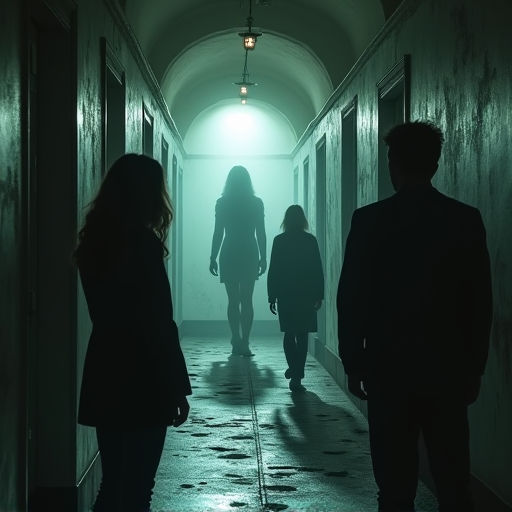
Ghost Corridor Unit 11: The Break in the Line
There are only so many ways to live with a sentence like that before it either crushes you or turns useful.
Claire chose useful.
Not because she was fearless.
Not because she trusted the others more than she trusted herself.
Because by then fear had become repetitive, and repetition was exactly what the system underneath the school wanted most.
If Mara had been the oldest readable layer—
if Faye Hart, the Red Woman, the corridor child’s sister, and Adrian Wynn’s preparation all belonged to later adaptations of the same vacancy—
then the only remaining question worth their time was simple:
How do you break a line of succession without finishing it?
They met in the old reading annex again, though nobody pretended it was neutral anymore.
The cracked lamp had not yet been replaced. Emergency maintenance tape still marked one corner of the floor. The place smelled faintly of overheated wiring and old plaster dust, as though the room itself resented being used twice for clarity.
Quinn Hale came with maps.
Evan Cross came with procedure.
Leo Grant came because absence had started to feel more dangerous than presence.
Claire came with a decision she did not fully trust but would not surrender.
Evan laid out the framework first.
“Mara’s layer linked three things,” he said, pointing across Quinn’s maps. “Constrained female space, water boundary, and controlled sight. Later structures inherited one or more of those functions and translated them—Horse Field into procession, the island into staging, the classroom block into containment, the corridor into response, East Lake into transfer.”
Claire watched his finger move.
He was right.
She hated that he was right.
She also no longer knew how to function without the relief of someone in the room being willing to state terrible things plainly.
“So the line survives,” she said, “because each generation rebuilds enough of the conditions.”
“Yes,” Quinn said. “But not perfectly. That’s the point. It’s always compensating.”
Leo looked between them with exhausted irritation.
“Can someone translate that back into non-curse language?”
Quinn didn’t even look up from the map.
“It means the system is unstable.”
That got his attention.
Evan nodded.
“It wants a continuous role. It keeps rebuilding toward one. But every later version has been partial—misaligned, recontextualized, contaminated by new witnesses, new institutions, new moral stupidity. That’s why it keeps using stories and not just bodies.”
Claire felt something in her chest loosen.
Not safety.
Never that.
But leverage.
If the thing beneath the school had been forced to improvise through generations of damaged inheritance, then it was not omnipotent.
It was compensatory.
And anything compensating can be made to overcorrect.
⸻
The plan that emerged from that realization was ugly enough to trust.
They would not exorcise Mara.
They would not “free” Faye.
They would not bless the island, salt the corridor, or burn the eye-fastener in some theatrically satisfying but tactically useless gesture.
They would force the system to choose between two incompatible logics at once.
That was Quinn’s phrase.
“Succession depends on continuity,” she said. “But continuity here has always required two things: a face that can be worn, and a witnessing structure that accepts the substitution as coherent.”
Claire looked up.
“Meaning?”
“Meaning if you can make the structure recognize you as both fit and unfit at the same time, the line should seize.”
Leo made a face. “That sounded awful.”
“It is awful,” Evan said. “That’s why it may work.”
Claire crossed her arms.
“And how exactly am I supposed to be both?”
No one answered immediately.
Then Evan slid the old estate map toward her.
“By being in the right place under the wrong history.”
There it was.
The original women’s quarter had not survived physically. But part of its line, once overlaid through the later campus layouts, intersected an accessible fragment of ground beneath the oldest side of Classroom Block One—close enough to the water path that the old logic might still read it as viable, but inside the newer institutional skin that had trained the system to expect a later sequence.
In plain terms:
they would make the school mistake Claire for a completion at the exact point where the oldest layer would register her as a contradiction.
If the system committed to one reading, the other should rupture it.
If it hesitated between both, that hesitation might be enough.
Leo stared at the maps.
“This is the kind of plan people only make when they’ve officially lost perspective.”
Claire looked at him.
“Yes,” she said. “That happened a while ago.”
⸻
They prepared through subtraction.
That was Evan’s rule.
No reflective surfaces.
No improvised ritual objects.
No phones except Quinn’s secured recorder.
No direct carrying of the eye-fastener on Claire’s body.
No speaking to manifestations unless the wording had already been chosen.
Not because ritual language didn’t matter.
Because too much of the school’s machinery survived by converting spontaneous human reaction into usable sequence.
So they reduced spontaneity.
The eye-fastener came back into play only as counterweight.
Quinn had found enough in the old confiscation records to support a narrow conclusion: viewing fixtures and eye-fasteners were not autonomous. They required fitting logic, positional logic, and witness logic together. The object alone could not make a wearer. It only stabilized direction.
Which meant it could potentially be used against the system if placed where it confirmed the wrong line.
Evan hated the idea from the moment Claire proposed it.
“That assumes we’re still manipulating structure. We may just be feeding it a relic.”
Claire met his gaze.
“We are already feeding it every time we recognize it correctly. At least this way we choose how.”
He wanted to object further.
Quinn intervened first.
“She’s right. The eye-fastener is old-layer material. If succession is trying to complete through Claire under school-generation logic, then reintroducing the original fixture at the wrong interface could force mismatch.”
Leo looked physically ill.
“I miss normal panic.”
Nobody answered him.
There was no room left for nostalgia.
⸻
They chose dawn again.
Not for symbolism.
For weakness.
At dawn, the campus is structurally itself but narratively thin. Too late for the deepest theatrical hours of haunting, too early for the full reinforcement of daily human traffic. The systems beneath places are often easier to push against when neither ghost nor institution is fully dressed.
Claire stood at the old side hall beneath Classroom Block One wearing ordinary clothes, hair tied back, no jewelry, no ceremonial markers. She had refused everything that might aestheticize her into the role the system wanted. No white dress, no red dress, no softened face, no symbolic bait.
“If it wants a wearer,” she said before they began, “it gets me as a person first.”
Quinn nodded once, approving more than she would say.
Leo stayed near the east stair access, pale and nearly silent.
Evan handled the eye-fastener in gloves and placed it—not on Claire, not near her face—but at the old mapped convergence point beneath the warped floorline, where the women’s-quarter route intersected the later classroom containment axis.
It looked ridiculous there.
A small corroded piece of corpse hardware on institutional tile.
Good.
Ridiculousness had become one of their best remaining tools.
Then they waited.
The first sign was not visual.
It was auditory.
The building changed how it held silence.
Claire felt it in her teeth before she could name it—a tightening in the air as though the hall had become suddenly more interested in carrying sound than absorbing it. Somewhere above them, a door creaked open. Somewhere below, water moved where no pipe should have been active yet.
Then came the voice.
Not Adrian’s.
Not Faye’s.
A woman’s voice, low and level, speaking from no singular direction.
“You came properly.”
Claire did not turn.
That had been part of the plan too.
No reward through reflex.
“No,” she said. “I came by name.”
The silence after that was immediate and dense.
Quinn’s recorder picked up a drop in ambient noise so sharp it would later sound edited.
Then the voice again, colder now:
“Names change.”
Claire kept her breathing even.
“Roles do too.”
That was the first strike.
Not an insult.
Not refusal.
A contradiction inside the terms of succession.
Evan, two paces back and to her left, said nothing. He knew better than to contaminate the exchange unless structure started breaking toward collapse.
The corridor lights dimmed.
At the end of the hall, where old institutional paint met older stone beneath, a figure began to emerge.
Not fully formed.
Not theatrical.
A woman first as outline, then posture, then partial face. One eye darker than the other side. The weighted asymmetry around the temple that matched what Claire had seen in East Lake. Not young, not old—age flattened by the persistence of role.
Mara.
Or what remained of Mara after generations of being used as vacancy, route, and inheritance.
Claire felt the pressure of that recognition like a hand at the back of her neck.
Do not romanticize her, she reminded herself.
Do not make her singular if singularity is how the machine keeps functioning.
Mara took one step forward.
The eye-fastener on the floor shifted by a fraction of an inch.
Leo made a broken sound from the stair access.
Quinn raised one hand without looking back—a stay signal.
Claire spoke before the system could stabilize the moment.
“You are not the same dead they made after you.”
That mattered.
She knew it mattered because the figure’s outline rippled at the edges, not with rage, but with interference. Faye’s tired face flickered through one side of it for an instant. The Red Woman’s throat-shadow appeared and vanished. The child from the seventh-floor corridor moved like a fault-line beneath the older woman’s shape.
Good, Claire thought. Break apart.
The voice that came back was no longer one voice.
“We continue.”
Claire answered immediately.
“No. You recur.”
That was the second strike.
Succession dignifies itself through continuity.
Recurrence exposes dependence.
The eye-fastener moved again, skidding lightly across the tile toward the figure rather than toward Claire.
Evan saw it too.
Now, he thought.
The wrong line is taking hold.
He kicked the metal fixture sideways—not away, but across the mapped convergence so that it crossed both routes at once: the old women’s-quarter logic and the newer classroom containment axis.
The effect was immediate.
Every window in the side hall flexed inward with a sound like the building inhaling.
The corridor lights surged white, then dead yellow.
The figure in front of Claire split visibly for one impossible second into three stacked alignments:
Mara.
Faye.
Claire.
Not one wearing the other.
Three incompatible readings fighting for the same role.
Claire stepped forward instead of back.
That was the move no one had wanted her to make and the one the plan secretly required.
“If I am fit,” she said into the fracture, “then I am not yours. If I am yours, then I do not fit this school. Choose.”
For the first time since the East Lake voice, the system did not answer immediately.
It seized.
Not dramatically.
Not with screams or cinematic rupture.
With misalignment.
The figure juddered between generations. The weighted temple mark moved from one face to another. Faye’s sadness tried to settle where Mara’s severity had been. Claire’s own features flashed in and out of the composite like a bad projection refusing its frame.
Quinn shouted then—not at the ghost, at Evan.
“Now!”
He drove the heel of his hand down on the crossed map-points where the eye-fastener lay mislaid, forcing the object flat against the floor over both incompatible lines.
The tile beneath it cracked.
A sound came up from below—not human, not quite structural either, but something old and pressure-heavy finally losing the ability to decide which layer it belonged to.
Then all at once the hall filled with voices.
Not attacking.
Not begging.
Naming.
Fragmentary names. Women’s names. Student names. Wrong names corrected. The dead falling briefly out of sequence and back into personhood faster than the structure could sort them into usability.
Claire heard Faye.
Heard the child.
Heard one name that might have been Mara and might have been the one she carried before estate records and later legends had reduced her to function.
Then the sound dropped out.
The figure disappeared.
The eye-fastener snapped cleanly in two.
And the corridor, for the first time since any of them had entered this investigation, felt not empty but merely old.
⸻
Nobody moved for several seconds.
Then Leo sat down where he stood, hard enough to miss the step edge and bruise himself badly.
Quinn was already checking the recorder.
Evan still had his hand pressed to the cracked tile as if he expected the floor to reopen under disagreement.
Claire looked down at the two pieces of broken metal and felt, with shocking clarity, not triumph—
but relief at the absence of invitation.
No call.
No pull.
No evaluative pressure in the air.
Quinn finally exhaled.
“It broke.”
Evan shook his head.
“Part of it broke.”
Claire understood what he meant.
They had not destroyed the dead.
They had not purified the land.
They had not solved centuries of institutional cowardice, gendered violence, repurposed mourning, and occult architecture in one dawn confrontation.
What they had done was more specific.
They had broken the line of succession at the point where it tried to become Claire.
No wearer.
No clean handoff.
No coherent continuity through her face.
And if the system had survived this long by repeatedly assigning later women to an older vacancy, then interruption at the succession point was the closest thing to a real victory the living were likely to get.
⸻
The school, naturally, told a smaller story afterward.
A damaged corridor.
A burst electrical line.
Temporary closure.
Routine structural review.
The official language worked hard to make the event boring.
That was fine.
Boredom, they had learned, could be a weapon too.
The island incidents thinned almost immediately.
The corridor calls did not vanish, but became contradictory and weak.
East Lake stopped producing faces in still water.
The reading annex remained unsettling but no longer active.
And Faye Hart, when Claire last sensed anything that might have been her near the old window, felt not trapped or pleading but distant in the cleanest possible way.
Gone, maybe.
Or simply no longer arranged.
Leo transferred the following term.
Quinn kept copies of everything in three separate caches and never admitted where.
Evan stopped using the phrase “if this works” and started saying “it held.”
Claire cut her hair shorter than before and never again let anyone reduce what happened to “that campus ghost incident” without making them feel stupid.
That was, in its way, her own counter-ritual.
As for Mara—
Claire thought of her least as a ghost by the end and most as a wound badly inherited. A woman made to keep seeing after she should have been allowed not to. A vacancy imposed on others because no one powerful enough to stop it had done so soon enough.
Breaking the line had not redeemed that.
But it had refused to continue it.
Sometimes that is the only ethical ending the living are qualified to make.