Ghost Corridor Unit 10: Before the School
Not because she lacked imagination.
Because it was administrative in the worst possible way.
It implied filing error.
Misclassification.
A later system stacked on top of an earlier one without ever fully replacing it.
That, Quinn understood, was exactly how institutions create hauntings big enough to survive their founders.
By the time she said this aloud, the others were too tired to argue.
They were back in the dorm again, damp from lake air, carrying the smell of algae and cold metal into a room already saturated with paper, copied records, and the uneasy discipline of people who had run out of ways to pretend they were still improvising.
Claire Morgan sat on the bed with her shoes still on, staring at the notebook page where Quinn had underlined the words from the lake.
WRONG GENERATION.
Leo Grant had not moved much since they got back. He sat nearest the door, elbows on knees, hands hanging loose as though whatever remained of his courage had been spent on surviving the evening.
Evan Cross stood at the desk.
That was always the bad sign.
When he paced, he was thinking.
When he stood still, the thinking had hardened into shape.
“So,” Claire said at last, “we’ve been solving the right pattern at the wrong layer.”
“Yes,” Quinn replied.
Evan nodded once.
Leo looked up miserably. “Can one of you please say something that sounds less like a final exam from hell?”
Quinn gave him a flat glance.
“It means the school didn’t invent the mechanism. It inherited it.”
That landed cleanly.
The old classroom block.
The island.
Horse Field.
The corridor.
East Lake.
Faye Hart.
Adrian Wynn.
All of them still mattered.
But now they looked less like origins and more like renovations.
Layers built over an older claim.
Claire let that settle.
“If that face in the lake belonged to an earlier layer,” she said, “then we’re not chasing one dead woman being reused by multiple stories. We’re chasing a structure that keeps assigning new women to an older vacancy.”
No one corrected her.
Because that was exactly how ugly it felt.
⸻
The only useful next step was history.
Not campus history.
Not student-union history.
Not even the conveniently fragmented legend history the school had spent decades trying to distribute across committees and rumor channels.
Older than that.
Land history.
Quinn was the one who got them there.
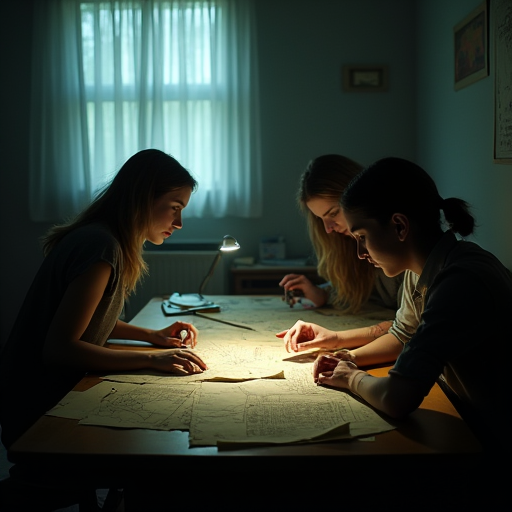
She spent the next day in the municipal records building three bus stops off campus, where the city kept its dead paperwork in a concrete annex that smelled like mildew, carbon copies, and state indifference. It was the sort of place where the truth survives mostly because nobody can afford the boredom required to destroy it thoroughly.
By late afternoon she had returned with photocopies, maps, and the particular expression she only wore when she was both vindicated and furious.
“Before the school,” she said, dropping the papers on the desk, “there was no Horse Field.”
Evan looked up at once.
Claire sat straighter.
Leo only closed his eyes briefly, as if the universe had once again failed to produce any version of events simple enough to survive.
Quinn spread the maps.
One showed the area during the late expansion of the district.
Another, older and less precise, showed the same ground before municipal drainage and modern road planning.
The land beneath the school had once belonged to an estate perimeter.
Not a grand house in the sense of wealth exactly.
Something older.
Walled, ritualized, and repeatedly repurposed.
There had been burial use on one side.
Water use on another.
A women’s quarter recorded in one estate inventory and erased in the next.
Claire read that line twice.
“A women’s quarter.”
Quinn nodded.
“Separate quarters. Female household staff, junior wives, daughters, maybe dependents. The records get vague exactly where they become morally interesting.”
Evan traced the perimeter line with one finger.
“And after that?”
“The estate dissolved. Part of the land was sold. Part requisitioned. Part sat unused long enough for local people to rename pieces of it according to function rather than ownership.” She tapped the map. “That’s where Horse Field comes later. Not because horses belonged to the original layout, but because one reused section became open ground and people forgot what stood there first.”
Claire felt a cold tightening across her shoulders.
A women’s quarter.
Later open ground.
Later school.
And under all of it, a mechanism old enough to treat each reuse not as erasure, but as opportunity.
⸻
The older female layer began to take form through absence more than through record.
That was the part Claire hated most.
Not because the woman was hidden.
Because she had been systematically thinned.
No single file named her cleanly.
No preserved local legend centered her.
No official document admitted the sequence that followed from her death.
Instead she appeared as residue:
a complaint about contamination near the water boundary,
an estate expense for replacement locks in the women’s side hall,
a physician note copied into family accounting records listing “eye injury and declining coherence” in a young woman whose name was partially torn away,
a later civic dispute over whether exhumation had been completed correctly on “all female remains in the east quarter.”
Evan read the physician note three times.
Then once more.
“Eye injury,” he said.
Quinn handed him another page.
It was not a medical file.
It was worse.
An inventory of ritual objects confiscated during a local crackdown generations before the school existed, listing among otherwise familiar items—binding cords, copper nails, mourning veils—one phrase that made the whole room narrow around it:
one viewing fixture, female use, damaged
Leo stared.
“Viewing fixture?”
Quinn nodded grimly.
“Which is the bureaucratic way to avoid writing ‘eye-fastener’ when you don’t want later clerks to understand what they’re cataloguing.”
That was enough to connect the lake face to the old object in a way none of them had wanted but all of them had expected.
Not random corpse-work.
Not one-off improvisation.
An older female dead had once been fitted,
handled,
or prepared by means related to the same apparatus later resurfacing through Adrian’s sequence.
Claire leaned against the desk.
“So she’s the vacancy.”
Evan answered quietly.
“Yes.”
The room stayed silent after that.
Because vacancy is a more terrible word than ghost.
A ghost implies persistence of person.
A vacancy implies role.
And if the school’s later legends had all kept circling women—Faye, the Red Woman, the corridor child’s sister, Claire now—then the older structure beneath them may never have cared who filled the role so long as the form stayed usable.
⸻
They named her only after midnight.
Not because they knew her with certainty.
Because they could no longer endure speaking around her.
The torn estate records gave them three possible readings.
The physician’s fragment reduced that to two.
A drainage petition from much later, filed by local residents complaining of “the wrong woman still being counted at the water edge,” gave them enough context to choose.
“Mara,” Quinn said.
Claire looked up.
“That’s really it?”
“As close as we’re getting. The original language is damaged, but yes. Closest clean rendering.”
Mara.
Once spoken, the name altered the entire investigation.
Not magically.
Not with any cheap symbolic power.
But the human mind handles systems differently once it can address the oldest suffering as a person instead of a concept.
Leo whispered it once, as if testing whether the room would object.
Nothing happened.
That, somehow, was worse.
Claire sat down slowly.
“So Mara dies in the women’s quarter, or near it. There’s an eye injury or eye-work component. Something about the water boundary matters. Then the estate structure goes away, the land keeps being reused, and every later system builds over hers instead of removing it.”
“Not exactly over,” Evan said. “With.”
Claire looked at him.
He tapped the maps.
“If the original pattern linked quarters, water, and controlled movement, then later uses—open ground, island staging, classroom geometry—didn’t bury it. They inherited its paths.”
Quinn added, “Which means the school didn’t create the vacancy. It industrialized it.”
That was exactly the kind of sentence Claire would have mocked in any other life.
Here, it was precise enough to wound.
⸻
The next question was the obvious one:
How had Mara died?
Here the records became less generous.
No clean murder report survived.
No confession.
No estate scandal neatly preserved in family shame.
Only converging indications:
locked quarters,
restricted movement,
water-edge disposal concerns,
eye damage,
and one account copied from oral testimony decades later describing a woman “made to keep seeing after she should have been allowed not to.”
Claire closed her eyes when Quinn read that line.
Made to keep seeing.
Not blinded.
Not merely injured.
Compelled.
The eye-fastener.
The viewing fixture.
The later language of wearers and intended faces.
The annex messages.
The calm evaluative contacts.
It all bent toward the same obscene logic.
Mara’s death had not simply produced a ghost.
Her death had produced a protocol.
Evan said it with more cruelty than usual because by then cruelty was closer to accuracy.
“She may have been the first successful fitting.”
Leo recoiled.
“Successful?”
“Not for her.” Evan’s voice stayed flat. “For the system.”
No one argued.
Because whatever happened in that quarter before the estate dissolved, it had left behind not just grief, but reproducible handling.
That was what later generations inherited.
The field.
The island.
The classroom.
The corridor.
The lake.
All of them had been elaborate refinements of one older lesson:
that a female dead, correctly prepared and continuously re-witnessed, could anchor far more than one life should ever be allowed to hold.
⸻
By dawn, they had one answer and one much worse problem.
The answer:
Mara was the oldest layer yet identified, and her death predated every campus legend.
The problem:
if the system was based on succession, then “wrong generation” from the lake did not simply mean they had insulted an older lineage.
It meant Claire may not be the next wearer in a modern sequence.
She may be the first truly compatible face in generations.
That idea entered the room and did not leave.
Leo was the one who finally said it, which surprised all of them.
“So maybe this school hasn’t been trying different girls at random,” he said quietly. “Maybe it’s been waiting for a close enough return.”
Claire looked at him sharply.
That should have felt melodramatic.
Instead it felt mathematically possible.
Not reincarnation in any sentimental sense.
Not destiny.
Resemblance through role, structure, witness load, physiognomy, social placement, and whatever the dead use as pattern where the living would use biography.
Quinn did not dismiss it.
That was what frightened Claire most.
Instead Quinn said, “Then we stop treating Claire as a target of opportunity.”
Evan finished the thought.
“We treat her as the interruption point.”
That was Unit 10’s true shift.
Claire was no longer merely the intended face.
She was now the place where succession might either complete—or fail.
And for the first time since Adrian stepped smiling into the road, that did not make her feel smaller.
It made her feel exact.