Ghost Corridor Unit 6: The Eye in the Water
It was a tool.
Or a token.
Or a key.
Whatever name they gave it, it had already crossed too many boundaries too cleanly to remain an accident: from the dead to the living, from the lake to the dorm, from Adrian’s instructions to Leo’s obedience. And now it sat wrapped on Evan Cross’s desk like a small ugly verdict, dark with corrosion and patient enough to survive being ignored. 
Claire Morgan hated it on sight.
Not in the dramatic way people hate cursed objects in stories. She didn’t want to throw it into a furnace or drop it in a river or scream at Evan for keeping it in the room. It was worse than that. She hated it with the practical revulsion reserved for things that feel too deliberate. The little eye worked into one side of the metal did not look decorative. It looked functional, as though it had once needed to face the right direction while something else was being done around it.
Leo would not touch it again.
That told them more than his words had.
He stayed at the edge of the room while Evan unwrapped it and laid it on clean paper beneath the desk lamp. The object was no larger than a large coin, but thicker, heavier, with remnants of thread and plant-fiber still caught in its seams. One side bore the eye mark. The other was mostly eaten away, except for a shallow groove running from the center toward the edge like a channel cut for fluid or alignment.
Claire leaned in despite herself.
“It doesn’t look like jewelry.”
“It isn’t,” Evan said.
“How do you know?”
He did not answer immediately. Instead he rotated it once with the tip of a pencil, studying how the eye lined up against the paper beneath it.
“Because jewelry is made to be seen,” he said. “This was made to be placed.”
That settled over the room unpleasantly.
Leo sat down on the lower bunk and muttered, “I liked it better when we were just dealing with ghosts.”
“No,” Claire said, still staring at the object. “You liked it better when you could lie.”
He flinched, but only slightly.
Good, she thought, and hated herself a little for how easily that reaction still came.
⸻
Evan took the object to three places before any of them got a useful answer.
First, to the engineering workshop, where an older technician scraped one corner and declared the metal too impure to matter and too old to be useful. Second, to a history lecturer who knew enough about local artifacts to identify nothing but wear. Third, to the same cramped funerary-goods stall near the west gate where old truths seemed to survive by pretending to be inventory.
The shopkeeper took one look at the eye mark and went quiet.
That was new.
He had a face built for irritation and a voice built for saying less than he knew, but silence from him meant recognition, not doubt.
“Where did you get it?” he asked.
“In the lake.”
The old man made a dry sound in his throat that might have been laughter if there had been any humor in it.
“Of course.”
Evan kept his tone neutral. “You know what it is.”
“I know what it was for.”
“Tell me.”
The old man looked toward the alley mouth first, then back into the gloom of his stall, as if checking whether the city was polite enough to let this conversation happen unwitnessed.
“It’s an eye-fastener,” he said at last.
Evan frowned. “That doesn’t mean anything.”
“It means exactly what it says.” The old man held out a hand. “Let me see.”
Evan passed it over.
The shopkeeper turned it under the light with surprising care. Up close, the object’s ugliness became more refined. Not crude. Not improvised. Made by someone who wanted durability more than beauty.
“It would be tied to the face,” the old man said, “or hung close to it. Not for ornament. For direction. So the thing wearing it knows where to look—or what to look through.”
Evan’s scalp tightened.
“A mask?”
“Sometimes.”
“A corpse?”
The old man glanced up.
“Sometimes.”
That was enough to poison the whole afternoon.
Because it connected too neatly with Adrian’s final week: the reflective surfaces, the fixed smiles, the way he seemed to be orienting himself toward something beyond ordinary sight. If this object had anything to do with directing vision—not his own, but something using him—then East Lake had not held a keepsake.
It had held a component.
Evan asked the only question that still mattered.
“Component of what?”
The old man gave the object back.
“A guided return.”
⸻
Claire listened without interruption when Evan came back and told them.
She only spoke once he had finished.
“So Adrian wasn’t just changing. He was being fitted.”
Leo went visibly paler.
Evan did not correct her.
That was answer enough.
The room around them had already become a working model of too many moving parts:
Adrian’s body aging ahead of itself.
The cold rice.
The night conversations.
The wake instructions.
The lake retrieval.
The eye-fastener.
Claire’s unexplained importance.
Each new piece made the previous ones less supernatural and more procedural.
Not less frightening.
Far more.
Claire stood up and began pacing now, trading places with Evan as if one of them always had to keep motion in the room while the other held still enough to think.
“What exactly was supposed to return?” she asked.
No one answered.
Because that was the wrong question in the wrong tense.
Not was.
Is.
Leo broke first.
“What if it wasn’t for Adrian at all?”
Both of them turned toward him.
He shrank under the attention, then forced himself to continue.
“What if Adrian was only carrying it? Or keeping it until…” He looked at Claire and away. “Until whoever it was actually for became available.”
The room went cold in a completely ordinary way.
No spirits.
No drafts.
Just implication.
Claire folded her arms across herself.
“Say it plainly.”
Leo’s voice dropped.
“What if it was meant for you?”
Evan moved before Claire did.
Not dramatically. One step only, enough to put himself between the desk and Leo, as though the object itself had become directional the moment that possibility entered the room aloud.
Claire hated that almost as much as she hated the sentence.
“Don’t do that,” she said.
Evan looked back at her once.
“I’m not doing anything.”
“Yes, you are.”
But neither of them denied the premise.
That was the part she felt later, lying awake:
not that Leo had suggested it,
but that nobody had laughed.
⸻
The next lead came from Quinn Hale.
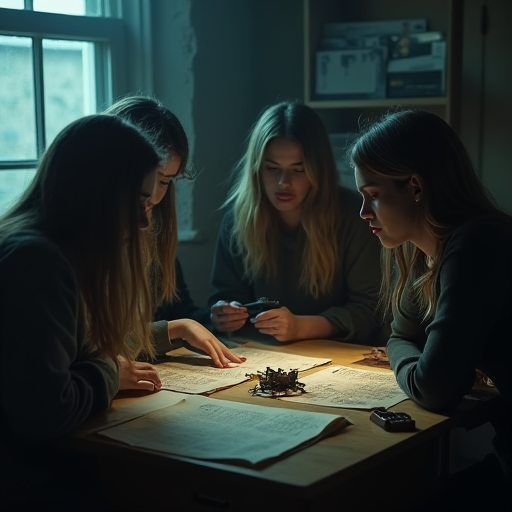
She arrived with two copied pages from a student-union subfile too boring to attract real scrutiny and exactly therefore useful. The pages described not a haunting, not an apparition, but a category of “misplacement incidents” in earlier campus reports: ritual objects moved from one linked site to another by frightened students who did not understand what they were carrying.
One note in particular caught Evan’s attention:
Items recovered from water should never be returned to dormitory spaces without identity verification.
Claire read it twice.
Then a third time.
“Identity verification,” she said. “For who? The owner?”
Quinn gave her a tired look.
“No. The wearer.”
That word again.
Wearer.
Not possessor.
Not victim.
Wearer.
The pages also contained a crude classification list: throat bindings, hand weights, eye-fasteners, veil nails. Small objects associated not with killing, but with post-death handling—ways of fixing, directing, or shaping something after the body had already become available.
Claire looked up from the paper slowly.
“This is all corpse work.”
Quinn nodded.
“Or attempted corpse work.”
Evan took the page and laid it beside the eye-fastener.
A cluster was forming now whether they liked it or not:
the school’s hidden ritual architecture,
the Soul-Lamp logic his teacher had warned about,
and a material toolkit for making the dead usable in pieces.
No wonder the student union had buried these records in language dull enough to sedate curiosity.
If students ever understood that the campus legends were not only hauntings but remnants of actual handling practices, panic would not remain literary for long.
Leo, watching the pieces gather again, looked sick.
“So what do we do with it?”
That was the first useful question he had asked in hours.
Evan answered honestly.
“We stop treating it like evidence and start treating it like active material.”
Claire rubbed at her forehead.
“And that means?”
“It means,” Quinn said, before Evan could, “that we assume it’s still pointing.”
That landed perfectly.
Because of course it was.
Objects made to direct vision do not stop directing just because the original ceremony failed. They wait. They retain orientation. And if the thing was meant for a wearer not yet fully secured, then bringing it back to the dorm had not simply preserved evidence.
It may have resumed sequence.
⸻
They did not sleep that night.
Not out of discipline. Out of mutual lack of trust in the room.
Evan wrapped the eye-fastener three times over: paper, cloth, thread, then salt around the bundle because none of them knew whether salt worked and not knowing had ceased being a reason not to try. He placed it in a desk drawer and set a chair against the drawer as if mundane obstruction could meaningfully participate in occult containment.
Claire stayed by the window.
Quinn took the only chair not facing a reflective surface.
Leo sat nearest the door, which might have been strategic or merely cowardly.
At around three in the morning, the first thing happened.
Not footsteps.
Not knocking.
A subtle scraping from inside the desk.
Everyone heard it.
No one commented for three full seconds, because the human mind has a shameful desire to let impossible sounds become furniture before naming them.
Then Claire said, very quietly, “Tell me that was the building.”
Nobody did.
The scraping came again.
Longer this time.
Measured.
As though something wrapped inside the drawer had shifted exactly far enough to test whether it still knew which way to face.
Evan stood.
Quinn stood with him.
Leo did not move at all.
“Don’t open it,” Claire said at once.
Evan nodded. “I wasn’t planning to.”
The scraping stopped.
That should have reassured them.
Instead it made the silence afterward feel selected.
Then Claire saw movement in the glass.
Not a face. Not yet. Just the suggestion that the dark window no longer reflected the room according to ordinary rules. She turned away before shape could finish assembling.
“Evan,” she said.
He understood from her voice alone.
Without looking toward the glass, he took the wrapped bundle from the drawer, shoved it into his satchel, and said the sentence that changed the next phase of the investigation:
“It doesn’t stay here.”
⸻
By dawn they had agreed on three things.
First: the eye-fastener was active.
Second: Adrian had been part of a preparation sequence, not a standalone haunting.
Third: if the object had resumed pointing now that it was back in circulation, they needed to know toward whom.
Claire argued against the obvious answer.
She had to.
If she did not, then all the strange checks, sightings, and inquiries around her during Adrian’s final week would become one continuous line rather than scattered unease. And continuous lines are harder to live beside than isolated incidents.
But Quinn, who had far less emotional investment in denial, said it plainly:
“If it was meant for a wearer, and if Adrian was only carrying it, and if Leo’s first impulse after retrieving it was to isolate Claire—whether because he chose that or because something nudged him—then yes.” She looked directly at Claire. “It’s possible this was always about you.”
Claire stared back until looking felt like surrender.
Then she said the only thing left that still sounded useful.
“Fine. Then we make that fact expensive.”
Evan almost smiled.
There she was, after all.
Not the frightened witness the school’s machinery preferred, but the one who learned fastest once the shape of danger stopped flattering ambiguity.
He nodded once.
“Good,” he said. “Then Unit 7 starts with Claire.”