Ghost Corridor Unit 5: Cold Rice
That was the infuriating part.
Not that the clues were invisible.
That nobody had understood what kind of clues they were.
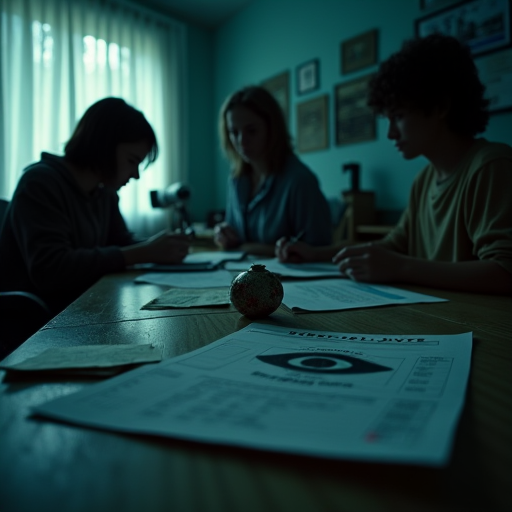
Claire Morgan sat at the desk with Adrian’s autopsy report on one side and the corroded eye-marked object on the other while Evan Cross paced the room in a slow, controlled line that told her he was assembling chronology rather than theory. Leo Grant sat farther back than before, quieter now, as if surrendering the object had cost him more than he wanted to admit.
“Start a week before the accident,” Evan said.
Claire looked up. “What?”
“We’ve been treating the truck as the event. It wasn’t. So go back.”
That made sense immediately and maddeningly.
A week before the accident, Adrian had still been attending class.
Still sleeping in the dorm.
Still speaking when spoken to.
Still walking around campus under his own name and face.
And yet the body in the morgue suggested that something in him had already crossed over long before impact.
Claire thought back carefully.
At first, memory gave her only mood:
Adrian quieter than usual.
Distracted.
A little too inward.
But mood was useless. Fear lives on imprecision. What they needed now was behavior.
Evan turned to Leo first.
“You lived with him. What changed?”
Leo rubbed the back of his neck.
“He stopped eating with us.”
Claire looked at him sharply.
“That’s not nothing.”
“I know that now.”
“No,” Evan said, “you knew it then. You just didn’t know how much it mattered.”
Leo looked away.
“He used to come down for late food whenever anybody offered. Burgers, noodles, junk from the night stall, anything. Then suddenly he wouldn’t touch any of it.” He hesitated. “One night I asked if he was sick. He told me he was eating fine.”
“Was he?” Claire asked.
Leo swallowed.
“He was eating soaked rice.”
The room went still.
Claire remembered it then—not from Leo, but from a complaint she had overheard in passing. Someone from Adrian’s floor joking bitterly that Adrian had “started living like a famine ghost,” eating bowls of cold water-soaked rice in the dark rather than proper food. At the time it had sounded eccentric, maybe depressed, maybe just cheap. Now it sounded ritualistic.
Evan stopped pacing.
“How often?”
Leo thought.
“Every day that last week, I think.”
Claire looked at the autopsy report again.
A body already older in death than in law.
A boy withdrawing from warm food.
A wake that worked too quickly.
A dead voice instructing the living.
It was starting to take shape.
“Who saw him eating?” she asked.
“All of us,” Leo said. “Or enough of us.”
Evan nodded.
“Good. That means it wasn’t private breakdown. It was visible.”
Claire frowned. “Why is that good?”
“Because if he was changing openly, someone else may have seen more than we did.”
⸻
They spent the next day collecting Adrian’s last week through other people’s irritation.
That, Claire learned, is one of the most reliable ways to reconstruct the dead: not through affection, but through the tiny inconveniences they caused while still alive.
A classmate from systems lab remembered Adrian staring too long at reflective surfaces—monitor screens after shutdown, lab windows at night, even the darkened glass of a vending machine as if waiting for something to resolve behind his own face.
A girl from comparative literature said Adrian had started smiling at odd moments, not happily, but with that private detached look people wear when they are listening to two conversations and only one of them is happening in the room.
Someone else remembered he had stopped taking hot tea.
That detail bothered Claire more than it should have.
Not because tea mattered, but because warmth did.
If Adrian had begun refusing warm food and drink, what exactly was he feeding instead?
Evan asked the question differently.
“Did anybody notice sleepwalking? Blackouts? Missing time?”
Mostly they got shrugs.
Then they found Ben Shaw from the next room over, who at first insisted he had seen nothing, then—under the pressure of Evan’s very patient silence—admitted one thing.
“Twice,” Ben said, “I woke around three or four and heard Adrian talking.”
“To who?” Claire asked.
“That’s what I’m saying. Nobody.”
Evan leaned in slightly.
“What did it sound like?”
Ben made a face, trying to remember exactly.
“Like… not an argument. More like answering. Very politely.”
That landed harder than if Adrian had been heard screaming.
Because politeness implies hierarchy.
“Could you hear words?” Evan asked.
“Not clearly. Once I heard him say ‘yes, I understand.’ Another time, ‘I’ll do it before dawn.’”
Claire felt her stomach turn.
Leo looked sick again.
“Before dawn,” he repeated quietly. “That’s what he told me too.”
Now the room changed in earnest.
Because what had seemed like isolated strangeness was becoming repetition.
Adrian had not simply started behaving oddly.
He had entered a relationship.
Not romantic. Not social. Not anything the living have a right to normalize.
A relationship of instructions and compliance.
And he had been in it before the truck.
⸻
That evening, back in the dorm, Claire spread all the pieces out verbally while Evan listened.
“He withdraws from everyone. Stops eating hot food. Starts eating cold soaked rice. Talks at night. Smiles at nothing. Fixates on reflective surfaces. Keeps agreeing to things before dawn.”
Evan nodded once. “And then dies in a way that suggests he may already have been partially gone.”
Claire hated how natural that sentence sounded now.
“What does the rice mean?” she asked.
Leo answered before Evan could.
“My grandmother used to say cold soaked rice is what you leave for wandering spirits.”
Claire turned.
“You never mentioned that.”
Leo looked embarrassed.
“I also never thought any of this would become real.”
Evan’s expression tightened.
There it was.
The first culturally legible piece that wasn’t just mood or anomaly. If Adrian had begun eating spirit-food while still alive, then either he had been performing for something, feeding something, or participating in a transitional state no one around him had recognized because recognition would have sounded insane.
Claire spoke slowly.
“So maybe he wasn’t dead yet. But he was already crossing.”
“Yes,” Evan said. “Or being prepared.”
The choice of phrase chilled all three of them.
Being prepared implied process.
Deliberate process.
Something farther along than haunting and closer to induction.
Then Claire thought of another detail.
“At the crosswalk,” she said, “when he smiled at me…”
Neither of the boys interrupted.
“It didn’t feel like he was saying goodbye. It felt like he was acknowledging something.”
Evan looked at her carefully.
“Something in you?”
“I don’t know.”
Leo shifted uncomfortably.
That did not escape Claire.
“What?”
He shook his head too fast.
“Nothing.”
“No,” she said. “What?”
Leo stared at the floor.
“Sometimes that week,” he said reluctantly, “Adrian would ask where you were.”
Claire frowned.
“That’s not unusual.”
“It wasn’t normal either.” Leo kept going because now he had to. “Not how he asked. Not like he liked you. More like he was checking whether you were in the place you were supposed to be.”
The silence after that was ugly.
Because this connected far too neatly with Unit 4:
Leo sent to retrieve the object.
Leo trying to isolate Claire afterward.
Adrian’s instructions extending past his death.
Claire folded her arms tightly.
“So I was part of it before he died.”
Neither boy corrected her.
⸻
That night Evan did something Claire had come to recognize as one of his worst habits and best methods: he went to talk to someone older.
Not his teacher this time.
An old shopkeeper near the west gate.
The man ran a funerary goods stall so cramped and dim it looked less like a business and more like something that had grown out of the alley by feeding on neglect. Evan had already met him once. He was the one who had slipped him the black-reactive spirit paper and then acted as if the gift had meant nothing.
Tonight the old man listened to the account of Adrian’s last week without surprise.
That alone made Evan uneasy.
When he finished describing the cold rice, the before-dawn instructions, the reflective fixation, and the corpse that seemed older than its calendar, the shopkeeper only grunted and said:
“He was being taught to belong elsewhere.”
Evan waited.
The old man continued stacking paper ingots while speaking.
“People think the dead arrive all at once. That’s only true for the merciful cases. Some are led. Some are negotiated over. Some are thinned out from the inside while the body keeps attending class, drinking water, answering to its name, and pretending not to notice that appetite has already changed.”
Evan kept his voice level.
“And the cold rice?”
“A courtesy. Or submission. Depends who taught him.”
That answer was almost too opaque to use.
“Can it be reversed?”
The old man looked at him then, finally.
“Can a man return fully after he has started accepting food on behalf of the dead?”
Evan said nothing.
The shopkeeper softened very slightly.
“I asked a different question from yours,” he said. “That should tell you enough.”
It did.
More than enough.
On his way back to campus, Evan understood something he did not want to bring into the room with Claire and Leo, because once said aloud it would become one more fixed point in the map:
Adrian may not have been a victim in the simple sense.
At some stage, he had begun consenting.
⸻
He told them anyway.
Not with cruelty, but without softening.
“Whatever was happening to Adrian,” he said once the dorm door was shut again, “it wasn’t just attack. At some point he started cooperating.”
Claire stared at him.
“That sounds like blame.”
“No. It sounds like mechanism.”
She hated that answer because part of her knew it was the most mercifully precise one available.
Leo spoke next, voice very low.
“If he was cooperating, then why the truck?”
Evan looked toward Adrian’s empty bed.
“Maybe because crossing over wasn’t enough.” He paused. “Maybe he still had to die in public.”
Claire felt the words settle into her like cold water.
Public death.
Witnessed death.
A body everyone could confirm.
Of course.
If Adrian had been moving through some kind of transition, the accident would do more than kill him. It would certify him. Lock the event into community memory. Make him usable to whatever system needed not just a dead student, but a dead student everyone agreed had died in one specific way.
That made the smile at the crosswalk far worse in retrospect.
Not farewell.
Alignment.
And somewhere in that sequence, Claire’s presence had mattered enough to be checked in advance.
⸻
By the end of Unit 5, they knew three things for certain.
First: Adrian’s death had begun before the truck.
Second: he had spent his final week being instructed, shaped, and gradually converted toward some other mode of belonging.
Third: Claire had already been inside the pattern before he ever stepped into the road.
None of that solved Adrian.
But it corrected him.
He was no longer merely the boy who died.
He was the boy who had begun learning how.
And in a school like theirs, that distinction was not philosophical.
It was operational.