The Most Beautiful Wound
It was heavier than it looked.
That is the sort of detail people never mention in stories, perhaps because it sounds too practical, too domestic, too stupidly specific to belong inside violence. But I remember the weight very clearly. The smooth ceramic base slick in my hands. The brief resistance when it struck bone. The ugly, wet sound that followed.
Then silence.
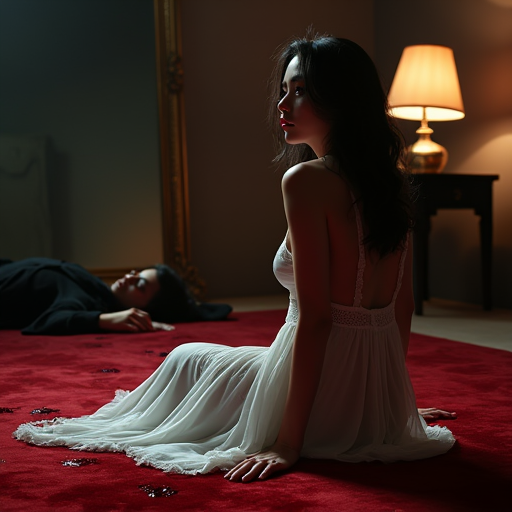
The man folded sideways onto the red carpet without dignity, his body collapsing the way expensive coats do when dropped over the back of a chair. Blood spread slowly at first, then with more confidence, soaking into the thick fibers beneath him until the whole floor looked as though it had opened a second mouth.
I sat down beside the body because my knees no longer trusted me.
The room smelled of dust, perfume, and hot copper.
The lamp was still in my hand.
I remember thinking, absurdly, that I ought to put it back upright before someone saw the shade bent at that angle.
That was how calm I was.
Or how far beyond calm.
Sometimes shock is simply the body’s most elegant form of denial.
⸻
His name was Adrian Cross.
At least that was the name he had given me.
Whether it was the one on his birth certificate no longer seems relevant.
Men like Adrian are often made less of flesh than of presentation. The right jacket. The right smile. The right voice pitched at the exact frequency to make women think they are being noticed rather than studied. He had money in the casual way that suggests inherited appetite rather than achievement, and he moved through rooms with the air of someone long accustomed to being forgiven before he has technically done anything wrong.
I met him at a launch party I should never have attended.
Not because parties are dangerous. Because women who have already begun to split inwardly should not accept champagne from beautiful liars in dark suits.
I knew this, in theory.
In practice, theory rarely survives loneliness.
Back then I was doing beauty work—campaigns, fragrance shoots, small designer presentations, the sort of career built on being looked at so often that eventually you begin to feel that being seen and being desired must overlap somewhere. They do not. This takes some women years to learn. Others never do.
I was learning slowly.
Then Adrian arrived and accelerated the lesson.
He told me I was unforgettable within three minutes of meeting me.
By the end of the night, he had also implied that I was different from the other women around him, which should have embarrassed me but instead made me feel chosen.
This is how men like him work.
Not by lying badly.
By telling flattering truths wrapped around the larger lie of singularity.
He took me home a week later.
And after that, again and again, until repetition began pretending to be meaning.
⸻
His apartment looked exactly like the kind of place a beautiful predator would build for himself if he mistook atmosphere for intimacy.
Tall windows. Dark wood. Black leather. A dining table no one ever used properly. Heavy curtains. Art selected not for taste but for effect. Everything arranged to imply both wealth and shadow, as if a hotel suite and a confession booth had been forced into collaboration.
The red carpet in the bedroom was the only thing in the whole place that looked excessive.
Deep crimson. Too plush. Too suggestive under lamplight.
I hated it immediately.
Of course that meant it would matter later.
Adrian liked me in white.
That detail still makes me angry.
He said pale dresses made my skin look “dangerously innocent,” which was the kind of line that should have sent me back out the door barefoot. Instead I laughed and let him unzip me slowly and tell me my body looked more expensive than most people’s ambitions.
There is a kind of seduction that functions less like pleasure than anesthesia.
That was what being with him felt like.
I was not stupid enough to believe he loved me.
But I was vain enough to believe I interested him more than other women did, and sometimes vanity is the exact bridge horror needs.
He never asked much about me.
That should have mattered.
He wanted the present tense only—the body, the mouth, the reactions, the visible response to his own performance. He had no curiosity for history unless it could be weaponized later.
Still, I stayed.
Because when you are lonely in a beautiful way, men mistake you for willing and women mistake you for fortunate, and both errors can become habit if repeated often enough.
⸻
The first sign came in the mirror.
It always does, in stories like this.
Not because mirrors are magical.
Because they are patient.
One night, while Adrian showered, I stood at the edge of his bedroom mirror fastening an earring and saw another woman behind me.
Not clearly.
A suggestion only—dark hair, bare shoulders, a face turned partly away as though refusing the gift of full recognition.
I spun around.
No one there.
When I looked back, the mirror held only me again. White slip dress. Hair unpinned. Mouth slightly open with embarrassment at my own nerves.
Adrian came out of the bathroom toweling his hair and found me still staring.
“What’s wrong?”
“Nothing,” I lied.
He kissed the back of my neck and said, “You say that beautifully.”
That should have frightened me more than the mirror did.
A few days later I found a lipstick in his bathroom that wasn’t mine.
A week after that, a silk scarf in the wardrobe. Another woman’s earring under the bed. A photograph half-burned in the kitchen bin—two figures in evening clothes, the woman’s face torn away before the paper was set alight.
When I confronted him, Adrian did what men like him always do.
He became calm.
Which is to say he became cruel politely.
He did not deny sleeping with other women. He denied that it meant anything. He suggested that my emotional vocabulary was too provincial for the kind of arrangement we had. He told me I was more interesting when I wasn’t trying to possess what had never been offered.
Then he smiled.
And asked me not to ruin a beautiful evening.
There are moments when humiliation and desire rot into the same chemical.
That was one of them.
I should have left for good.
Instead I went back.
Twice more.
Perhaps because I wanted proof that I could still be chosen. Perhaps because the version of myself he had injured kept returning to the site of damage hoping to find a better ending. People do this all the time and call it love because the truth is less flattering.
⸻
The second sign came in blood.
Not his.
Mine.
A tiny cut at first—nothing, really. He liked rings, and one of them scraped my shoulder in the dark. But afterward the wound didn’t close properly. Instead it widened over the next day into a thin red crescent just below the collarbone, too shallow to be dangerous and too raw to ignore.
When I saw it in the mirror, I thought at once of a smile.
That unsettled me enough that I covered it with concealer.
The next time I went to him, Adrian noticed.
“What happened there?”
“Nothing.”
Again that word.
Again the wrong man hearing it.
He touched the mark lightly and his expression altered—not concern, not guilt, but fascination.
Then he kissed the cut.
The contact made every muscle in my back lock.
He looked up at me and smiled with actual delight.
“You’re even prettier damaged.”
If I had left then, perhaps none of the rest would have happened.
But by then I was too far inside the structure of it.
The women in the mirror appeared more often after that.
Never fully. Never enough to make certainty possible. A shoulder passing a doorway. A pale face near the red carpet. A handprint at the edge of reflected glass that vanished when approached.
Not one woman, I began to think.
Several.
All of them beautiful in the flattened way remembered women often are. All of them carrying the same expression of nearly being about to say something.
The apartment had become crowded with absences.
And Adrian moved through it without unease.
That was when I understood the most important thing of all:
He had seen them too.
He simply wasn’t afraid.
⸻
The truth came accidentally, which is the only way truths worth fearing usually arrive.
He was in the study taking a call.
I was in the kitchen looking for wine.
The drawer stuck halfway and then gave, and underneath a sheaf of receipts I found a little stack of cards. Hotel keys. Membership tags. Folded notes written in different hands.
And beneath all of them—
photographs.
Women.
Always in white.
Always in his apartment.
Always with some visible wound.
A split lip.
A bruised throat.
A cut shoulder.
A bitten mouth.
A line of blood on pale skin.
Some of them were looking into the camera.
Some were looking away.
In none of them did the woman appear surprised.
That was the detail that undid me.
They looked entranced. Drugged. Devoted. Or perhaps only emptied to the point where refusal had become too large an action to attempt.
On the back of one photo, in Adrian’s handwriting, was a single line:
The scar makes them singular.
I don’t remember dropping the glass.
Only the sound of it.
Then Adrian in the doorway.
Then his face—not guilty, not panicked, only annoyed, which was in many ways much worse.
“You should not go through my things,” he said.
I held up the photo.
He sighed.
“As I said,” he murmured, “you’re more interesting when you don’t ask to understand everything.”
That was when I realized he was not a cheat.
Or not only that.
Cheating suggests appetite without art.
This was art to him.
Selection, injury, aesthetic arrangement, possession through marked beauty.
He did not merely want women.
He wanted wounds.
And he wanted them arranged.
Documented.
Preserved.
That room, the red carpet, the dark wood, the mirrors—
all of it had been stagecraft.
⸻
I wish I could say I planned what happened next.
That I seized the lamp with strategic clarity. That I understood danger, chose survival, and acted.
But the truth is simpler and uglier.
He stepped toward me.
I stepped back.
He said my name in the gentle voice men reserve for frightened animals and unstable lovers.
Then I saw in the mirror behind him—not one woman this time, but many.
A whole crowded procession of white dresses and damaged skin and unspeaking faces, all watching from the red room as though the wall had finally gone translucent enough for witness.
One of them touched her own throat.
Another lifted a bloodied hand toward the lamp.
That was enough.
I hit him.
Once.
Hard enough that he fell.
Not dead yet.
He tried to rise.
I hit him again.
Then again.
By the third blow, the room had become mostly sound—ceramic cracking, wet impact, my own breathing broken into pieces, a noise from Adrian that did not belong to speech anymore.
When it was over, the lamp base was warm in my hand and his head was no longer a thing I could look at directly.
So I looked at the carpet instead.
Red swallowing red.
And the mirror behind the bed.
The women were gone.
Only me remained.
And on my shoulder, reflected under the bedroom lamp, the little crescent wound had widened into something almost elegant.
A beautiful injury.
His kind of beauty.
I laughed then, though only once.
Because horror has a sense of irony too refined for comedy.
⸻
I should have called the police.
Instead I cleaned.
Not because I wanted to conceal the murder forever.
Because habit is stronger than morality in the first ten minutes after catastrophe.
I wiped the lamp handle. Washed my hands twice. Stared at the blood on my thighs and lower belly with detached revulsion. Noticed my own body had become part of the scene he might once have photographed.
I stood in front of the bathroom mirror and watched red water circle the drain.
When I finally looked up, there was a woman standing behind me again.
Not a stranger.
Me.
Or the version of me that would now always belong to that room.
Same face. Same shoulders. Same cut. But calmer. Sharper. As if some hidden architecture had clicked into place the moment Adrian’s blood hit the carpet.
She smiled first.
A fraction earlier than I did.
And for a terrible second I thought:
So this is how it begins.
Not with haunting.
With inheritance.
⸻
They called it self-defense.
Later.
Much later.
After lawyers, interviews, forensic photos, cautious sympathy, and the inevitable stories from women no one had listened to before a dead man made their memories admissible.
There were others.
Of course there were.
Enough to build a case around pattern, coercion, narcotics, assault, staged intimacy, trophies.
No one ever proved he had killed anyone before me.
No one proved he hadn’t.
His reputation after death became what such men often become once they can no longer sue the truth: complicated, brilliant, troubling, misunderstood, predatory, magnetic, tragic.
Women are expected to find these adjectives satisfying.
I did not.
Because every now and then, late at night, I still stand before a mirror with my hand resting lightly on the scar below my collarbone and watch my reflection with more attention than vanity requires.
And sometimes—only sometimes—it smiles before I do.
Not because Adrian is there.
Because something in that room recognized itself at last when I broke his skull open.
The most beautiful wound was never mine.
It was the opening he left.