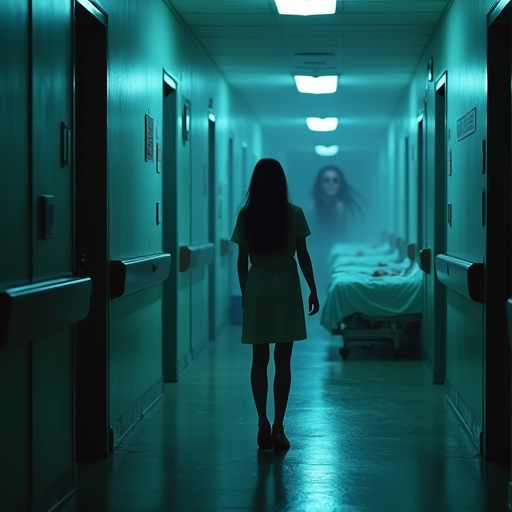
Soul Snare – Part 2
That was not courage.
It was exhaustion worn thin enough to look like surrender.
Yulu lay in the hospital under white sheets and fluorescent light, breathing but unreachable. Luna had not woken. Detective Zhang had reached the point where even skepticism looked tired. And somewhere between a banned game disc, an online ghost named Sky, and girls collapsing with their eyes wide open, my life had shifted into a place where ordinary explanations arrived too late to be useful.
Xiao Zhao was the last kind of help I would once have trusted.
He was young—too young, I thought at first, to carry himself with that amount of confidence. A wiry boy-man with the posture of someone raised by old rituals but trained by necessity to survive the modern world. He didn’t look like a mystic. He looked like a smart dropout who’d learned to pass between temples, internet cafés, and train stations without belonging fully to any of them.
That should have reassured me.
Instead it made him harder to dismiss.
Detective Zhang had found him through channels I did not ask about. In a week full of impossible things, introducing me to a village-trained occult practitioner who also knew Photoshop somehow no longer ranked high on the list.
At the hospital, Xiao Zhao examined Yulu only briefly before asking for two things:
“A computer,” he said, “and the disc.”
I laughed then.
Not because anything was funny.
Because there are moments when the mind, faced with the choice between panic and absurdity, chooses absurdity just to stay upright.
“You know how insane that sounds?”
“Yes,” he said. “That’s why it’s probably right.”
⸻
We left the nurses in charge of Yulu and went back to my apartment.
The place felt less haunted than before, which in its own way was worse. A room actively haunted at least acknowledges your fear. A quiet room just makes you feel foolish for still having it.
Xiao Zhao went straight to the desk, powered on my computer, connected his phone, and began working with the easy competence of someone who had long ago decided that supernatural work without digital literacy was professional negligence.
Watching him use image software with total fluency after everything else I had already seen should not have surprised me.
It did.
“You know how to do all this?”
He gave me a quick sidelong look. “Master Bu says if you don’t know computers and at least one foreign language, the dead will modernize faster than you.”
I stared at him.
He shrugged. “He’s not wrong.”
He pulled up a series of photos he had taken at the hospital—close-ups of Luna, Yulu, and the other unconscious girls. Then he enhanced them: contrast, light, shadow, the parts beneath the obvious. At first I saw nothing. Then, slowly, the pattern rose.
On each girl’s face—so faint it had escaped everyone under normal light—there was a second structure trying to resolve itself beneath the first.
A face under the face.
Or perhaps not under.
Through.
I felt sick.
Xiao Zhao sent the images out by email to someone he called Master Bu, then leaned back in the chair as if the world had become marginally less impossible.
That was when I made the mistake of wandering into Yulu’s room.
Her computer was still there.
The tray was empty.
But the disc case for Soul Snare 2 sat on the desk like an insult.
I knew I should leave it alone.
I knew curiosity had already cost enough.
Still, there are certain doors that once opened refuse the dignity of being left shut.
I put the disc back into the drive.
⸻
The loading screen was beautiful.
That was the first and worst problem with it.
Not grotesque. Not obviously cursed. Just beautiful in a highly artificial, deeply intentional way—washed in bruised blues and grays, with a young woman half turned away from the viewer, hair falling across one side of her face. Only one eye was visible.
The other side remained buried in shadow.
A title sequence began. Music like distant breathing. Menu text that seemed to waver between languages without fully becoming unreadable. None of it looked especially illegal. None of it looked like it should have left girls unconscious in hospital beds.
That was what made it sinister.
Monsters are easier to reject when they announce themselves.
This thing wanted to be invited.
I clicked into the game.
The first stage opened into a hospital corridor.
Of course it did.
Weak fluorescent lights. Polished floor. Doors with narrow wired-glass windows. The playable character moved too slowly, as if wading through a dream. Somewhere ahead, just out of sight, a young woman’s voice laughed softly and then stopped.
My hands began to sweat on the mouse.
“Turn it off,” Xiao Zhao said behind me.
Not loudly.
Not urgently.
Just with complete certainty.
I turned to look at him.
His face had gone pale.
“What is it?”
He pointed at the monitor.
Not the game.
The reflection on the black edges of the screen.
There, beside my own faint outline, stood another woman.
Same hair.
Same mouth.
Same eyes.
Mine.
Only emptier.
She was not in the room behind us.
She existed only in the reflection.
And she was smiling.
I slammed the monitor shut with both hands so hard the desk shook.
For one second, the speakers remained on.
From inside them came a voice—bright, girlish, perfectly cheerful.
“You’re getting closer.”
Then the room went dead silent.
⸻
Xiao Zhao did not scold me.
Which somehow frightened me more than if he had.
He crouched beside the tower, pulled the power cable, removed the disc, wrapped it in yellow paper covered in quick black strokes, and tied it shut with red thread as if packaging contaminated meat.
“Can that stop it?” I asked.
“No.”
“Then what does it do?”
“It makes it take longer to notice us.”
That was not encouraging.
At almost the exact moment he said it, Detective Zhang called.
Another girl had collapsed.
This one in an internet café on the south side of the city.
Same age bracket. Same facial structure. Same eyes.
And one more thing: security footage showed she had been alone at her terminal except for the reflection on the dark monitor beside her.
The reflection, Zhang said, appeared to be smiling when the girl was not.
He arrived at my apartment less than an hour later.
His coat was rain-damp, his face drawn tight in that particular way men’s faces do when they are still trying to pretend a situation belongs to their profession.
Xiao Zhao showed him the altered hospital images.
Zhang looked for a long time without speaking.
Then, finally, “What am I looking at?”
Xiao Zhao answered before I could.
“A replacement process.”
Zhang’s eyes did not leave the screen.
“That is not a police term.”
“No,” said Xiao Zhao. “It’s a survival term.”
⸻
Once spoken aloud, the theory settled over the room with the sick comfort of pattern.
The entity—ghost, curse, imprint, whatever name you preferred when daylight still mattered—was not simply killing girls.
It was searching.
For a specific configuration.
A face close enough. Eyes close enough. A body young enough to be worn without too much resistance.
It had tried Luna.
Then Yulu.
It had studied me through the hospital glass and decided, not yet.
That phrase sat inside my spine like cold wire.
Not yet.
Meaning eventually.
Meaning inevitability mistaken for scheduling.
Zhang wanted a plan. Xiao Zhao wanted time. I wanted all the mirrors in the apartment buried under concrete.
Instead we got none of what we wanted.
Master Bu finally replied to the email.
Not in prose.
Just one line beneath the returned hospital image:
It has no face of its own anymore. Burn the door, not the hand.
Zhang read it twice and said, “I hate people who answer in riddles.”
Xiao Zhao nodded. “That means the game isn’t the source. Just the door.”
“And the source?”
Xiao Zhao looked at me.
“Someone who lost her face but kept wanting to be seen.”
I thought at once of Sky in the morgue.
Of the missing eyes.
Of the girls in their beds.
Of the shadowed menu screen face with one visible eye.
The answer reached me only when I stopped resisting it.
“She’s building herself,” I said.
Neither man contradicted me.
⸻
We went back to the hospital at midnight.
That was Xiao Zhao’s demand.
“If she’s choosing through likeness, she’ll come where the almost-right bodies are gathered.”
That sentence alone should have made every official in the building evacuate the ward.
Instead, because institutions are incapable of respecting horror until it affects billing, we got one locked corridor, two overworked nurses told to remain elsewhere, Detective Zhang with his service weapon, Xiao Zhao with a cloth satchel full of paper charms and old metal tools, and me—apparently present because if the thing had chosen me, then I counted as bait.
It is humiliating how often survival begins to resemble volunteering.
The ward lights were dimmed.
The girls lay still.
Luna.
Yulu.
Others I had never spoken to and already felt responsible for.
Time passed strangely in the hush of hospital machinery. Even the monitors seemed to beep more softly, as if afraid of attracting attention.
Then the glass in the ward door darkened.
Not black.
Deep.
Like water seen at night.
My reflection appeared first.
Then, one by one, the others.
All the girls in the room reflected standing, though their bodies still lay flat in bed.
The standing reflections turned toward the glass together.
And behind them, at the center, something else rose slowly into view.
A woman’s face assembled from resemblance.
Not identical to me. Not identical to Luna or Yulu either. But made of all of us in the way a composite sketch is made of witness error—accurate enough to accuse, wrong enough to haunt.
Where one eye should have been was a dark wet hollow.
The other was beautiful.
That may have been the worst part.
Because beauty makes evil feel insultingly selective.
The face smiled.
Then every monitor in the ward shrieked at once.
⸻
What happened next survives in me as fragments.
Xiao Zhao throwing yellow slips across the glass like cards.
They stuck and blackened instantly, as if touched by acid from the wrong side.
Detective Zhang shouting for me to get back.
The reflected girls in the glass lifting their hands to the exact same height at the exact same angle.
The one-faced woman speaking without moving her lips.
I heard the words inside my skull.
You kept me waiting.
Then the ward door opened.
Not outward.
Inward.
Though no one had touched it.
The thing stepped through.
Not all the way. Not like flesh enters space.
More like a reflection deciding the room deserved it.
Cold hit us first.
Then smell—old metal, damp hair, computer heat, hospital bleach, and the sweet underside of something long sealed.
Zhang fired.
The shot passed through her shoulder and shattered the monitor behind.
She smiled wider.
Xiao Zhao moved then with sudden brutal speed, cutting his palm on a small hooked blade and smearing blood across a folded paper sigil before slapping it toward the open dark eye socket.
It hit.
For one instant, the whole figure convulsed—not with pain exactly, but with interruption.
The girls in the beds all screamed at once without waking.
The sound was unbearable.
I did the only useful thing I have perhaps ever done in terror.
I grabbed the wrapped Soul Snare 2 disc from Xiao Zhao’s bag, tore the paper open, and hurled the disc directly into the dark side of her face.
It sank into the socket like something finding the place it had been made for.
The apparition went still.
Then every reflective surface in the ward cracked at the same time.
Glass.
Monitors.
The polished metal of the IV stands.
Even the blank black TV mounted in the corner.
The scream that followed did not come from her alone.
It came from every image of her that had been waiting in every borrowed face.
When the lights surged back, the ward was full of broken glass and unconscious girls, but the woman was gone.
Not vanished.
Collapsed inward.
Taken back into whatever void remains when something assembled from stolen likeness loses its last working door.
⸻
Luna died before dawn.
Yulu lived.
That arithmetic has never stopped offending me.
The city called it a mass psychogenic event tied to illegal software and rumor contagion. The police buried what they could not frame. Detective Zhang transferred six months later. Xiao Zhao disappeared back into whatever half-modern network of shrines, message boards, train routes, and dead things produced him.
He left me only one sentence on a scrap of paper:
Anything that wants your face first wants your attention. Don’t be generous.
I keep that note in my desk drawer.
Not because it helps.
Because I still catch myself looking too long into dark screens.
And sometimes, when the power flickers and the monitor reflects me back a fraction late, I remember the one-eyed woman in the ward and the shape she was trying to finish.
I still don’t know whether we destroyed her.
Only this:
She stopped saying not yet.
And that is not the same thing as gone.