Square Eyes
That was part of the trouble.
In small towns, certain people arrive so slowly they seem less like strangers than weather—there one day, somehow, in the corner of the road or by the mill wall or crouched beneath the shrine tree, as though they had always belonged to the landscape and the town had merely been late in noticing.
He was filthy, barefoot in all seasons, wrapped in layered rags stiff with old mud and rain. Children ran from him. Dogs barked and then tucked their tails and backed away. He rarely spoke, and when he did, the words came out in fractured little mutters that never added up to conversation.
But everyone remembered his eyes.
At first people only said they were strange. Then they began saying they looked wrong. Then, once fear found the right vocabulary, they said it plainly:
The man’s pupils were square.
Not clouded. Not misshapen from injury.
Square.
Sharp-cornered and dark as old coins.
He would stand in the lane and stare at people with those impossible eyes until they crossed the street to avoid him. Women spat after he passed. Old men muttered that he had been cursed. Children dared one another to get close enough to look and then woke crying at night after doing it.
Eventually, as towns do, Black Reed adapted.
The madman became part of the map.
People stopped asking who he had once been.
They only prayed he would keep to the edges.
Then one summer evening he turned violent.
No one later agreed what triggered it. Some said a grocer struck him first for begging at the wrong door. Some said the madman bit a child. Some said he fell into a screaming fit in the marketplace and clawed his own face bloody while shouting about money inside his head.
What mattered was the result:
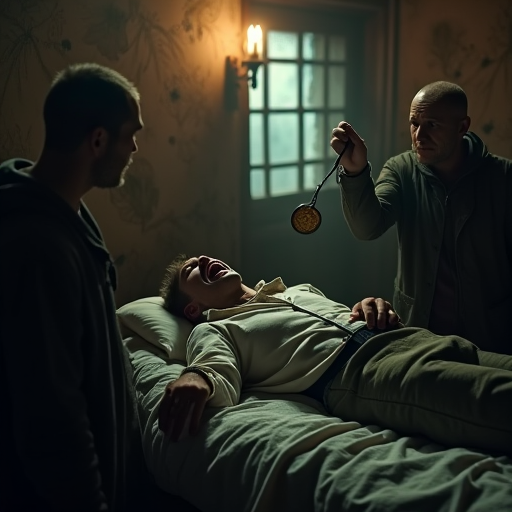
They tied him down to a bed in Doctor Lin’s surgery and called the whole town to witness what happened next.
⸻
Doctor Lin had the reputation all rural doctors need most—competence large enough to make arrogance look like efficiency.
He disliked superstition. Disliked priests, charm-sellers, trance women, and any explanation that arrived without instruments. So when the townspeople dragged in the madman and demanded he inspect the eyes, the doctor did what men like him always do when handed mystery in public:
He performed certainty.
The madman was lashed flat to the narrow iron-framed bed with belts and ropes. Four men held him anyway. He screamed, twisted, foamed at the mouth, and tried to grind his teeth down to stumps. Through it all those square pupils stared upward with such fixed unnatural concentration that even Doctor Lin hesitated before leaning in.
Then he announced what he would do.
He would remove the eyes.
Not as treatment, he said, but as proof.
If the eyes were diseased, malformed, parasitized, or packed with some mineral growth, they would find it. If not, the town could stop talking nonsense.
No one argued with him.
That was the problem with intelligence in places built on fear: once it puts on a white coat, it becomes another superstition with better posture.
The doctor took a scalpel first.
He cut into one eye.
The blade barely entered.
A shrill metal scraping sound came from the socket—high, grating, unmistakable. Doctor Lin froze.
The room went silent.
“He hit something hard,” one of the men whispered.
The doctor’s face changed then. Not to fear. To fascination.
Someone handed him a narrow hook.
Holding it sideways, he set the point to the center of the madman’s pupil and pushed.
There was resistance.
Then a puncturing give.
He threaded the hook through, braced his wrist, and pulled.
The madman’s head slammed back against the bed frame with a crack so hard that women near the doorway cried out.
What emerged on the hook was not an eye.
It was a coin.
A round old copper coin, black with blood until the last smear ran off and yellow metal flashed beneath.
For one suspended second nobody moved.
Then everyone did.
The coin rattled on the hook. Blood poured from the empty socket. The madman screamed so hard his voice tore and came back as a raw animal sound.
Someone grabbed the hook from the doctor.
Another thrust it in again.
Then another.
Each time the metal scraped, hooked, and tore something loose, a coin dropped wetly to the floorboards with a bright ringing note.
One after another.
Again and again.
Soon no one bothered counting.
By the time the madness in the room had burned itself out, men were crouching on the floor in blood and lamplight, stuffing coins into sleeves and pockets like children collecting chestnuts after a storm.
The madman died before dawn.
No one agreed whether it was from blood loss, shock, or the violence of having greed excavated from his skull in public.
The town never solved that mystery.
Because before they could decide what it meant, a new horror began.
⸻
After the night of the coins, Doctor Lin changed.
At first only subtly.
He became less patient with ordinary illness. Less interested in conversation. More likely to stare too long at a patient’s face before touching them. He stopped making house calls after dusk. Locked his surgery earlier. Began wearing gloves even when no wound required them.
Then the deaths started.
A fever patient died within hours of treatment. Then an old woman with stomach pain. Then a farmer with a crushed thumb who should have been discharged in a day but instead was carried out dead the next morning. Each death, taken alone, could be excused. Together, they formed a pattern no one wished to name while it was still growing.
So the town waited, as frightened places do, until suspicion had gathered enough bodies to become courage.
By then there were whispers that Doctor Lin’s pupils changed when he examined the very ill.
Square, some said.
Or nearly square.
Others claimed he stared at the sick the way moneylenders look at ledgers. That his eyes no longer followed people naturally but fixed on them, measured them, assessed them, as if calculating what could be taken out rather than what might be healed.
Then two patients vanished in a single week.
No bodies.
No explanation.
Only Doctor Lin’s abandoned instrument hook found behind the surgery, and on it—threaded through dried black blood—four mangled human eyeballs.
That was enough.
In Black Reed, proof had never needed to be elegant.
⸻
They came for him on an autumn night.
Not officials.
Not soldiers.
Four men with permission no one wrote down and a purpose everyone understood.
They dragged him from his surgery half dressed, bound his wrists, and ignored his shouting. He swore innocence. Then swore revenge. Then swore that the town had no idea what had entered it the night they tore the madman open.
No one listened.
They hauled him to the bone field beyond the cemetery, where the ground had long since turned unreliable from old burials and shallow graves. The moon was thin, the grass damp, the air sharp enough to sting the throat.
He laughed when they pushed him into the pit.
That was the only moment some of them wavered.
Because the laugh was not the laugh of a guilty man.
It was the laugh of someone who knows the story has already moved beyond anyone’s control.
“Look at yourselves,” he said from the bottom of the grave, face slick with dirt, eyes glittering strangely in the dark. “You think I brought it here?”
One of the men took a shovel to stop his mouth.
They buried him alive.
The earth moved for a long time after the last of his shouting stopped.
No one slept well that night.
⸻
Years later, Black Reed still told the story in different versions depending on what lesson the speaker preferred.
Some said the madman had been cursed by greed, and the coins were the shape avarice took once it had eaten through the soul and settled in the body.
Some said Doctor Lin became infected the moment he pierced that eye—the curse passing not through blood but through appetite.
Some said the whole town was punished because the moment the first coin hit the floor, no one thought to pray.
They only bent down to pick it up.
I prefer the last version.
Not because it is more supernatural.
Because it is more human.
A curse is frightening.
Contagion is frightening.
But nothing is more dependable than this:
Show people something impossible and precious enough, and the first instinct will not be terror.
It will be ownership.
And perhaps that was always the real disease.