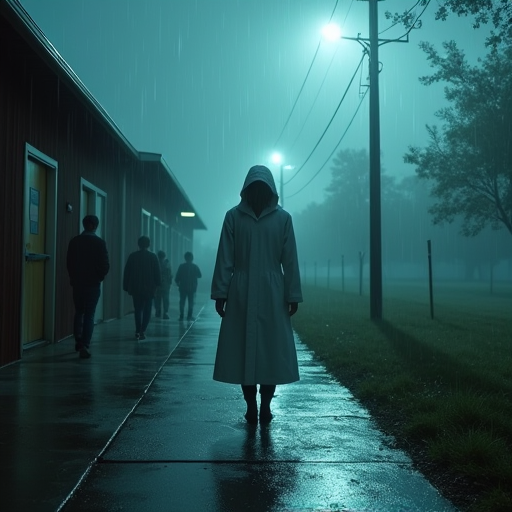
The Woman in the White Raincoat
I was running.
Not through a forest, not through a city, not through any place I could name with confidence—only through rain. Endless rain. Gray sky, black ground, water needling my face while something in a white raincoat followed just close enough that I never had to see her clearly to know she was there.
I never turned around.
That was the rule.
In the dream I knew, with the kind of certainty only nightmares provide, that if I turned and looked at her face, whatever remained of my ordinary life would stop belonging to me.
I would always wake before that happened.
So for years I told myself it was just a dream left over from childhood.
Then, on the twenty-fifth anniversary of the day itself, I finally admitted the truth.
It wasn’t a dream.
It was memory.
⸻
I was eight years old when we waited outside the girls’ bathroom for the woman in the white raincoat.
The school was different then. Smaller. Poorer. The kind of provincial campus where the playground and the football field blurred into each other and the buildings looked tired even in sunlight. To the south of the field stood a low squat restroom block with separate entrances for boys and girls and a leaking roof that always smelled of concrete, rust, and standing water.
That afternoon I was playing soccer with four other boys after dismissal.
Xiao, Fei, Big Tony, and Ernie.
The kind of names boys give each other before they become men and stop believing nicknames can survive adulthood.
We had been playing for longer than we should have. One by one the other students went home. The sky darkened. A fine drizzle began. None of us cared. We were still running, shouting, slipping in the wet grass, the ball skidding strangely over mud and puddles.
Then it happened.
I took a pass from Xiao, dribbled around Big Tony, looked up, and saw—through the veils of rain—a figure in a white raincoat rounding the corner by the wall near the girls’ restroom.
Head lowered. Face hidden. Slender enough that even at that age I thought: woman.
It barely registered.
A second later Fei blasted the ball too hard, and it sailed over all of us in a beautiful useless arc and vanished straight through the entrance of the girls’ bathroom.
At almost the exact same moment, the woman in white turned and went in after it.
We all groaned.
The ball had gone into the girls’ restroom. Which, to a pack of boys with more superstition than manners, was a legal and spiritual problem of the highest order.
Fei, being the one who had kicked it in there, was immediately nominated to retrieve it.
He refused.
“Are you insane?”
Big Tony, who was stupid in the useful way that sometimes resembles confidence, slapped his thigh and said, “What are we worried about? That woman just went in. We’ll wait until she comes out and ask her to toss it back.”
It was, in that moment, genius.
So that’s what we did.
We stood about fifteen feet from the entrance in the rain, five boys staring at the dark mouth of the girls’ restroom, waiting for the woman in the white raincoat to emerge.
At first we joked.
Fei complained.
Big Tony mocked him.
Xiao sneezed twice and swore at the weather.
Someone suggested she was taking forever because she was “doing something girls take forever doing,” which made us all laugh in exactly the nervous stupid way little boys laugh when they are trying not to admit they are cold.
Then the waiting stretched.
Five minutes.
Ten.
Maybe more.
No one came out.
The rain thickened. The field darkened. The other buildings seemed farther away than they should have been. We gradually stopped talking because each new joke sounded wrong in the air, as if the weather had turned the whole school into a place where laughter didn’t carry properly.
We waited anyway.
Because children would rather remain in a bad idea than admit fear in front of one another.
At some point lightning split the sky.
For a second the whole field flashed silver-white and we all saw each other’s faces clearly—wet, tense, no longer pretending.
Then darkness dropped back over us.
The restroom entrance remained empty.
No footsteps.
No swinging door.
No woman.
No ball.
Only rain.
And the oppressive feeling that the field had become much too large for five boys and one missing soccer ball.
Then Big Tony pointed toward the main gate and made a sound I had never heard from him before.
Not a word.
Not a yell.
A small, cracked animal noise.
Something was coming across the field.
At first it looked like a black lump with a giant misshapen head, moving low and fast through the rain.
“Ghost!” one of us screamed.
And that was enough.
We bolted.
All five of us ran in different useless directions until a woman’s voice behind us began yelling hoarsely:
“Stop! Stop, you idiots!”
Xiao was the first to realize it.
“That’s Old Mrs. Lee!”
He turned, and we all did too.
The black shape was only the groundskeeper’s wife in a broad black rain cape, panting under an umbrella, furious beyond reason.
She marched right up to us and demanded to know what on earth we were doing, standing in the rain staring at the girls’ bathroom like little criminals.
We babbled the story.
The white raincoat.
The ball.
The waiting.
The woman who never came out.
Mrs. Lee stared at us for several seconds.
Then, with the practical savagery adults reserve for frightened children, she marched straight to the restroom, leaned inside, and shouted for us to look.
The place was empty.
No woman.
No wet footprints except our own near the entrance.
No ball either.
Mrs. Lee made us search both sides of the field until we found it half-submerged in mud several yards from the building—far enough that none of us could explain how it had gotten there.
Then she marched us all to the gate, scolded us for ten full minutes, and told each of us that if she ever caught us waiting outside the girls’ bathroom again, we’d wish the ghost had taken us first.
We never spoke about it afterward.
Not really.
That’s what childhood fear often becomes when it survives—an agreement not to look directly at the same thing again.
⸻
I told myself for years that we had simply imagined the woman.
Rain distorts shapes. Lightning lies. Kids suggest things to one another and turn uncertainty into certainty in seconds. That explanation worked well enough until college, then work, then marriage, then the dream began returning with ritual regularity every rainy season.
The same white raincoat.
The same certainty of pursuit.
The same refusal to turn around.
The older I got, the less I believed in coincidence.
So I went home.
Not to solve anything. That sounds too heroic.
I went back because the dream had begun bleeding into waking life. Because on certain wet evenings I could smell the field again. Because once, standing under an office awning in a storm twenty-five years later, I caught sight of a white coat rounding a corner and my heart stopped so completely I thought, this is it; she has finally come the rest of the way.
My hometown school was mostly unchanged, which was more disturbing than if it had vanished entirely.
The field was smaller. The buildings more run-down. The restroom block had been repainted badly and repaired with obvious reluctance. But the layout remained.
South edge of the field.
Girls’ bathroom.
Rain-dark concrete.
I stood there in weather too similar to that first evening and felt childhood come back into my bones like illness.
Old Mrs. Lee was dead by then.
Her husband too.
But their daughter still lived nearby and remembered enough to speak when I asked.
At first she laughed when I mentioned the white raincoat woman.
Then she saw my face and stopped.
“There was a girl,” she said.
Not at our school, but years before our time. A student from the teacher’s college up the road. She had been walking home in heavy rain, cut across the field to use the restroom, and was never seen leaving it. They found her body later in the drainage channel beyond the far wall, carried there by floodwater after she slipped, struck her head, and was washed along where no one thought to look until morning.
She had been wearing a white raincoat.
I asked whether people at the school ever talked about seeing her.
Mrs. Lee’s daughter looked away toward the field.
“My mother did,” she said finally. “Once.”
That was enough to chill me more than if she had said yes a hundred times.
“What did she say?”
“She said if you see a woman go into a place and she doesn’t come back out, don’t wait for her.”
⸻
I should have gone home then.
Instead I crossed the field.
The rain had begun to thicken by then, not hard yet, just enough to put a silver grain over everything. I stood outside the girls’ bathroom again for the first time since I was eight.
The entrance was darker than I remembered.
Or perhaps I was old enough now to recognize darkness as itself, not merely absence of light.
I took one step closer.
Then another.
Inside, the air smelled of wet cement and old drains.
And there, halfway down the corridor where the stalls began, I saw her.
White raincoat.
Head lowered.
Face hidden by wet hair and the tilt of her shoulders.
Standing exactly as if she had only just gone in and paused, for one endless second, before deciding whether to turn back.
I did not move.
Neither did she.
For a moment I thought perhaps all the fear and memory and weather had finally converged into a hallucination worthy of the years it had taken to build.
Then, very slowly, she began to turn.
The dream returned in full force.
That ancient certainty struck me again: if I saw her face, something would finish.
Not die.
Finish.
My body made the choice before my mind did.
I ran.
Across the field, through the rain, stumbling and half-sliding in mud like the little boy I had once been, except now there was no pack of friends around me to make fear communal. Only the sound of water and the unbearable knowledge that I could feel her behind me with the exact same patience she had carried for twenty-five years.
I reached the main gate and didn’t stop until I hit the road.
When I finally turned around, no one was there.
Only the school behind me, the field gone gray in rain, and the restroom block half-obscured by weather like something memory itself was trying to erase.
I laughed then. Not because anything was funny, but because panic needs somewhere to go once it survives.
Then I went home.
That night I slept dreamlessly for the first time in years.
I have never decided what that means.
Did she only want to be remembered?
Did I complete some circuit by going back?
Or did she simply get tired of chasing a boy who had finally learned what fear was for?
I only know this:
When it rains hard enough, I still avoid school fields.
And if I ever see a woman in a white raincoat enter a building and fail to come out, I do not wait.
Not even for the sake of a ball.