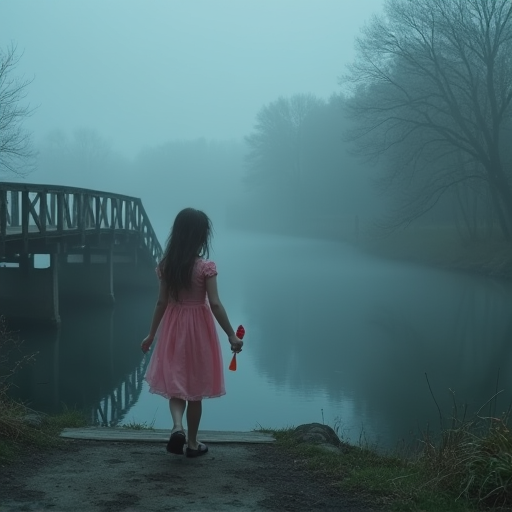
The Boy Who Went for Ice
Not because the place is grand.
Because it is repeated.
A corner shop. A bridge. A playground. A path cut through weeds. Somewhere a child has been taken often enough that the route becomes part of the body before it becomes part of memory.
For little William Hart, that place was the ice shop by the river.
He had only just learned to walk properly the year his mother began taking him there every Saturday. The town sugar mill still ran back then, and on hot afternoons the streets smelled faintly of steam, syrup, and wet stone. Near the old mill stood a tiny ice shop known for one thing above all others: strawberry shaved ice piled high in paper bowls and drenched in thick homemade syrup.
William adored it.
He adored the cold, the sweetness, the pink stain it left on his lips, and the ceremony of going there more than the dessert itself. Because after the ice came the walk to the little riverside park. And after the park came the wooden footbridge over the stream, built of uneven planks that made crossing feel like a game.
He would step from board to board as if the water below were lava, then demand to do it again.
Children do not understand that repetition is a form of worship.
Adults rarely notice it is happening.
As William grew, his mother grew busier.
She could no longer take him every afternoon, then no longer every few days, until finally the outing became a once-a-week promise.
William hated that.
“Can’t we go today?” he would ask on Mondays. On Tuesdays. On any day that seemed remotely vulnerable to pleading.
His mother would smile tiredly and say, “Saturday. We’ll go on Saturday.”
Once, trying to comfort him, she made the mistake that would matter later.
“When you’re bigger,” she said lightly, “you’ll be able to go all by yourself.”
William looked up at her then with unusual seriousness.
The sentence entered him whole.
⸻
The next two Saturdays came and went.
On the first, he was distracted, strangely watchful, looking down side streets and toward the road as if checking landmarks only he cared about.
“What are you looking for?” his mother asked.
“Nothing.”
His voice sounded guilty, but she was thinking about groceries, bills, and the fact that she had to be back at the factory by Monday.
So she let it pass.
On the second Saturday, William was quieter still.
He ate his strawberry ice with focus rather than delight. He stared at the bridge. At the gravel path. At the bend where the road disappeared behind reeds and willow branches. He seemed to be measuring the place rather than enjoying it.
A child building a map.
Again, his mother failed to understand what she was seeing.
A week later, on Friday morning, William was gone.
So was ten dollars from the kitchen drawer.
His grandmother sent word in a panic to the factory, and his mother came running home wild-eyed and breathless. They searched the house first, then the alley, then the neighboring streets. They checked every yard where children played, every relative’s home, every place he had ever hidden when cross or shy.
Nothing.
His father went one way, his mother another.
By noon the whole family was searching.
By evening, the town had begun to help.
And still, no William.
That was when his mother remembered the ice shop.
⸻
It was already getting dark when she reached the place by the old mill.
The owner shook his head before she even finished asking.
No, he hadn’t seen the boy.
No, no one had come in alone matching that description.
No, he was sorry.
The park was empty.
The bridge trembled slightly under the evening wind.
She crossed it with her heart hammering so hard it made the world pulse at the edges.
On the far side, the path narrowed into scrub and low river grass. A child could have wandered there. Fallen. Hidden. Been taken.
She called his name until her voice cracked.
No answer.
By full dark, men with lanterns were combing the riverbank.
Someone suggested he might have drowned.
Someone else suggested he might have followed the road out of town.
The worst suggestions were always the quietest.
When they finally brought his mother home near midnight, she no longer cried. She walked like a person moving through a house already altered beyond use.
On the kitchen table stood the spare paper bowl she had bought the previous week and forgotten to throw out.
Pink sugar dried at the bottom.
She stared at it until dawn.
⸻
William returned the next morning.
That was the first miracle.
Or the first wrongness.
He walked into the yard just after sunrise with mud on his shoes, a scrap of red paper clutched in one fist, and a calm expression that immediately made his mother begin sobbing with relief before she had even reached him.
She dropped to her knees and crushed him against her.
“Where were you?”
“At the ice shop.”
No one moved.
His grandmother crossed herself.
His father, who did not believe in superstition until it involved his own blood, went gray around the mouth.
“What do you mean at the ice shop?” his mother whispered.
William looked at her with mild confusion, as if adults had become inexplicably slow overnight.
“You said when I was bigger I could go by myself.”
He held up the red paper scrap.
It was part of an ice bowl.
His mother took it with shaking fingers.
The paper was old.
Not simply torn.
Old.
Soft with damp, edges pulped and grayed, as if it had spent years somewhere wet before being brought up into morning light.
“Who took you there?” his father asked.
William shrugged.
“I went with the lady.”
“What lady?”
“The one in the pink dress.”
His mother felt the blood leave her hands.
No one in town wore pink to the ice shop anymore. Not that shade. Not that old-fashioned rose color she suddenly remembered from photographs and market portraits and one awful story her own mother had told only once.
There had been a woman years earlier.
A young woman who had worked at the ice shop before the current owner inherited it. She had slipped from the bridge in flood season one summer and vanished into the river with her apron still on and syrup staining the front of her dress.
Children were not told that story anymore.
Not because they had forgotten it.
Because everyone preferred that they did.
William, of course, could not have known.
“Was she nice?” his mother asked softly.
He nodded.
“She bought me strawberry.”
His mother made a sound she would later swear was not a cry.
“She said I wasn’t supposed to go farther than the bridge because the dark water wanted little boys who walked alone.”
No one in the room spoke.
William frowned faintly, looking from face to face.
“Why are you all acting weird?”
His grandmother took the old paper scrap from his mother and turned it over.
On the inside, faint but legible in faded blue ink, was the shop’s old logo—one that had not been used in at least fifteen years.
⸻
For the next week William slept in his parents’ bed.
No one argued with that.
At first he seemed perfectly normal. A little tired, perhaps. More subdued. But otherwise unchanged.
Then, on the third night after his return, his mother woke to find him sitting upright at the foot of the bed with his back to them, facing the bedroom window.
“What are you doing?”
He answered without turning.
“She’s outside.”
His mother froze.
William pointed toward the dark glass.
“She says the bridge is prettier at night.”
His father switched on the lamp so fast he nearly tore the chain from the wall.
The window showed only the yard, the road, and their own terrified reflection.
William blinked at the light and seemed to wake fully.
The next morning he remembered none of it.
After that came the other things.
He began humming little melodies no one in the family recognized, always while drawing the same picture: a bridge, a bowl of red ice, and a woman with one hand extended.
He started refusing ordinary dessert and asking specifically for strawberry syrup, even in winter.
Worst of all, once, when his grandmother scolded him for wandering too close to the creek, he looked at her with sudden adult irritation and said:
“You don’t understand. She saved me because you were too slow.”
He had never spoken to anyone like that in his life.
The whole family fell silent.
When his mother knelt to ask who he meant, William only looked confused again.
“Who?”
⸻
They took him to church first.
Then to a doctor.
Then, when those routes failed to quiet the dread in the house, his grandmother insisted on something older.
There was a widow who lived beyond the edge of town, a woman people visited when livestock sickened without reason or when children came home from places they should not have reached.
She listened in silence as William’s mother told the story.
Then she asked for the paper scrap.
Then she asked whether the boy had crossed the bridge completely or only halfway.
When she heard the answer, she nodded once.
“That’s why he came back.”
No one in the room liked the certainty in her voice.
“The dead woman found him before the water did,” she said. “Children are easy to call, especially when they already know the road in their bones. But she wasn’t trying to take him. Not yet.”
“Yet?” his mother whispered.
The widow ignored the question.
“She died wanting to be remembered kindly,” she said. “Now she keeps what strays near her old place. Not always forever. Sometimes she only borrows.”
William’s mother began to cry.
“What do we do?”
The widow gave precise instructions.
No more mention of the ice shop.
No sweets for three days.
No child left alone after sunset.
And on the fourth morning, before dawn, take him to the bridge with a fresh bowl of strawberry ice and leave it there unopened.
“Then bring him home without looking back,” she said. “Whatever calls from the water, whatever voice asks him to stay, you do not turn around. If you turn around, she’ll know you still belong partly to her.”
His father scoffed right up until the moment William looked toward the shut window and smiled at someone outside.
After that, he stopped scoffing.
⸻
They did exactly as they were told.
The air before dawn was white with river mist when William’s parents carried the bowl to the bridge. William walked between them in silence, still half asleep, one mittened hand in each of theirs.
At the midpoint, his mother knelt and placed the unopened strawberry ice on the wooden planks.
For one heartbeat, nothing happened.
Then the river moved.
Not visibly.
Not enough for anyone else to call it movement.
But all three of them felt it—some subtle shift in attention, as though the water had looked up.
William tugged once at his mother’s hand.
“She says thank you.”
His father almost turned.
His mother gripped him so hard his knuckles cracked.
They walked home.
Behind them, as the widow had predicted, a woman’s voice called once through the mist:
“You forgot the spoon.”
William laughed.
His parents did not.
And none of them looked back.
⸻
After that, William slowly became ordinary again.
The drawings stopped.
The humming faded.
The strange phrases disappeared from his mouth.
Years later, he would remember the ice shop only vaguely, as one of those childhood places that seem larger and brighter in memory than they could possibly have been in real life.
His mother remembered enough for both of them.
She never took him back to the river after that.
The bridge was eventually rebuilt. The old ice shop closed. The sugar mill shut down. The whole district changed.
But every summer, on the first hot Saturday of the season, a fresh bowl of strawberry ice still appeared at the edge of the water beside the bridge.
No one in the family ever admitted leaving it there.
No one had to.
Some rescues deserve gratitude.
Especially the ones carried out by the dead.