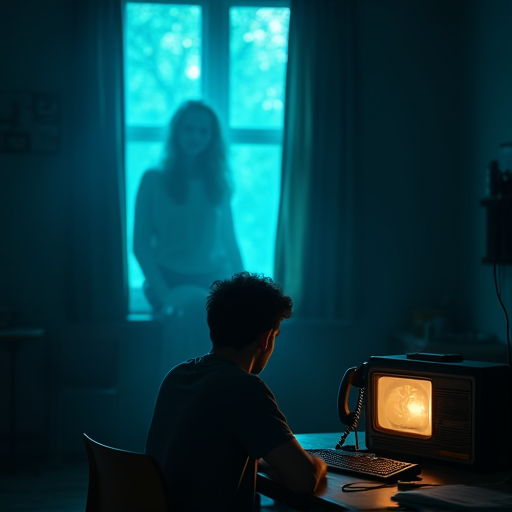
Midnight Broadcast
That was the first thing Daniel Price understood about it.
Not vanish in any dramatic sense—no tragic swan dives into academic madness, no noble collapse under the weight of genius. Nothing so theatrical. Just the slower, meaner kind of disappearance: your name removed from the work you did, your ideas diluted into your advisor’s publications, your time quietly converted into labor for people with better offices and less talent.
Daniel was a physics graduate student, though in practice that meant three things:
He did unpaid work in a lab with failing equipment.
He ghostwrote articles for his advisor.
And he spent an embarrassing amount of time posting half-finished theories on the campus network, hoping someone—anyone—would read them.
Most people didn’t.
The campus boards were oceans of gossip, anonymous flirtation, melodrama, and badly punctuated thirst. Daniel’s essays on consciousness, electromagnetism, and post-mortem neural persistence sank without ceremony beneath threads about cheating boyfriends and dorm room hookups.
Except for one recurring voice.
Xiaoru.
She wasn’t a username on the forum, not exactly. She was a caller on a late-night radio program called Midnight Broadcast, a local AM show hosted by a woman with a smoky, velvet voice who called herself Nightfeather. The format was simple: eerie music, whispered introductions, and a hotline for listeners to call in with strange experiences or original ghost stories.
Daniel listened at first because insomnia makes cowards of skeptics and romantics of lonely men.
He kept listening because of Xiaoru.
She called often enough to become part of the show’s identity. Her voice was young, sweet, almost sunlit—completely wrong for horror, which made it far more unsettling. She told her stories slowly, with a quiet confidence that pulled the listener along before they realized how far they had gone. She never sounded like someone reading. She sounded like someone remembering.
Nightfeather adored her.
The audience clearly did too.
And before Daniel was willing to admit it, he did.
He had never seen her face.
He didn’t know her major, her age, or whether “Xiaoru” was even her real name.
But her voice entered his life in the hours when loneliness is most persuasive. It followed him into sleep. It lingered in the lab. It appeared uninvited in the blank spaces between equations. Once, to his enduring humiliation, it appeared in a dream vivid enough to leave physical evidence by morning.
That was when he stopped pretending it was harmless.
He was in love with a voice.
⸻
Every night, Xiaoru called in with another story.
A collector of antiques whose treasures collected him back.
A cohabiting couple whose domestic life acquired a third presence.
A rainy street where something in white kept pace just beyond sight.
Girls in dorm washrooms learning too late that not everyone who comes back from the shower is still themselves.
She spoke as though she had endless stories.
Daniel could not imagine where she got them.
What he could imagine—what he began imagining far too often—was what it might feel like to make her listen to his voice the way he listened to hers.
So he wrote.
All day.
At first badly, then obsessively, then with the feverish discipline of a man who mistakes obsession for destiny. He drafted between experiments. Revised during seminars. Collected grotesque details in the margins of course notes. By the end of the week he had finished what he considered his first real horror story.
It wasn’t particularly good.
But it was his.
And more importantly, it was a reason to call the show.
On the first Saturday he tried, the line was busy.
On the second, a drunk undergrad from another dorm got through before him and spent five minutes describing what was obviously a raccoon with mange.
On the third, Daniel got close enough to hear Nightfeather say the hotline number in her smoky half-whisper and then froze before dialing, overwhelmed by the realization that Xiaoru might actually hear him.
He hung up before he even started.
After that he grew angrier with himself.
Then one night, while Xiaoru was telling a story about a doctor who collected antiques and perhaps pieces of people, Daniel found himself less interested in the tale than in the cadence of her pauses. He could hear the intelligence in them. The tiny smile before a reveal. The way she let silence do part of the work for her.
That was when wanting to hear her became wanting to meet her.
And once a lonely man decides he wants to meet the invisible woman who has arranged herself inside his nights, the story is already moving toward bad weather.
⸻
Finally, one weekend, everything aligned.
Daniel’s roommate had gone out chasing a new romantic disaster, leaving him alone in the dorm with the communal phone, a cheap radio, and the private certainty that tonight would change something.
The show began at midnight.
The familiar theme music played. Nightfeather’s voice unfurled through the static like smoke through black velvet. Daniel barely heard her introduction. He was sitting on the edge of the bed beside the shared dormitory phone, fingers already curled around the receiver, silently rehearsing the hotline number.
Then Xiaoru called in first.
Of course she did.
Daniel listened anyway.
That was the problem with longing: even when you have decided to act, you can still be diverted by the thing itself.
She told a new story that night, something set in a neon market district and scented candles and a young man drifting through his own loneliness. Daniel could picture every beat of it. By the time she finished, he was breathing more quietly than he realized, waiting for one more sentence that never came.
Nightfeather praised her.
Xiaoru laughed.
The line went dead.
Daniel stared at the phone as if it had insulted him personally.
He almost dialed then.
Didn’t.
Instead he waited until the show ended, ashamed of himself and vibrating with frustration.
Then the dorm phone rang.
The sound was so sudden and so loud in the little room that he physically jerked.
It rang once.
Twice.
Again.
Someone in the next room pounded angrily on the wall.
Daniel reached for the receiver, pulled his hand back, cursed himself, reached again—
and the ringing stopped.
The silence after it was unbearable.
He stood there with his pulse in his throat, furious at his own cowardice.
Then the phone rang again.
This time he snatched it up at once.
“Hello?”
A small pause.
Then a bright girl’s voice said:
“Is this Daniel? It’s Xiaoru.”
Everything inside him went white.
For a few seconds he forgot all language.
He heard her laughing softly.
“Still there?”
He managed something like yes.
What they said after that never lived in his memory as sentences, only as atmosphere: delight, disbelief, the subtle intoxicating horror of finding that a voice you have lived with privately now knows your name. She said she had listened to him trying to get through the hotline more than once. Said she liked the story idea he had mailed to the station. Said she thought he sounded “interesting.”
Interesting.
That one word was enough to take him apart.
They talked for a long time.
Long enough for the dormitory hallway to go silent. Long enough for the city outside the window to flatten into that strange hour when almost no one decent is awake. Long enough for Daniel to forget caution entirely.
At some point Xiaoru said, in an almost playful tone, “Do you want to meet me?”
He said yes too quickly.
She laughed.
“Then come.”
He never told anyone where she told him to go.
That, later, would become part of the problem.
⸻
Daniel Price disappeared sometime after midnight.
Not dramatically. Not publicly. Not in a way that made immediate sense.
By morning his bed had not been slept in. By afternoon the department office had called his dorm. By evening campus security had already used the word missing in the hushed official way institutions do when trying to keep fear at a manageable volume.
The investigation stretched on for weeks.
Police went through his notebooks, his workstation, his shared dormitory drawers. His family confirmed he had not gone home. His advisor contributed nothing useful except annoyance. Classmates described him as quiet, intense, and not socially memorable.
The radio station was checked.
Nightfeather existed.
The show existed.
The phone records existed.
But the number Daniel had written on a sheet of stationery beside his bed—the number he had circled twice and labeled Xiaoru—led nowhere.
It was a dead line.
A ghost number. Never assigned. Never active. Impossible to trace.
No one at the station admitted to knowing any regular caller by that name.
Which was not quite the same thing as saying there had never been one.
His belongings were eventually boxed and left in the care of his former roommate until family could collect them.
Among them were drafts of half-finished ghost stories, a cheap radio with worn tuning knobs, and pages full of Daniel’s handwriting repeating the same few observations:
voice before body
transmission without source
what answers back may not be alive
if memory can travel, why not desire?
The police labeled the case unresolved.
Campus called it tragic.
The dormitory called it weird.
And by the end of the semester, almost everyone had moved on.
Almost.
⸻
There was one final incident.
A month after Daniel vanished, his roommate was alone in the dorm on another Saturday night when Midnight Broadcast came on as usual from a neighboring room.
He wasn’t really listening.
Not until he heard Nightfeather say, in that languid after-midnight voice:
“We have a familiar caller tonight.”
Then came a girl’s laugh.
Sweet. Bright. Soft with private amusement.
“Hello,” said Xiaoru. “Tonight I’ve brought a very special story. It’s about a graduate student who fell in love with a voice.”
The roommate stood up so fast he knocked over his chair.
He later swore the rest of the story was told in alternating voices—Xiaoru first, then a young man’s voice he was certain belonged to Daniel, calm and close and somehow farther away than radio should allow.
By the time he got to the station, the building was locked.
By the time police obtained a recording, that segment of the program had become nothing but static.
Nightfeather denied anything unusual had happened.
No one could prove otherwise.
But after that, Daniel’s roommate never again stayed in the dorm on Saturday nights, and the campus rumor changed shape.
Students no longer said Daniel had run off.
They said he’d picked up on the wrong frequency.
That there are voices which only want to be heard until they finally find the one listener lonely enough to follow them all the way through.