Eight Pairs of Eyes
That was the official version.
The unofficial version was simpler: they were young, broke, impatient, and had mistaken cheap rent for luck.
The apartment was a narrow one-bedroom on the third floor of an aging building just off campus, the kind of place landlords describe as “cozy” because calling it cramped would sound like liability. Still, it had everything two graduate students thought they needed—one bedroom, a tiny kitchen, a desk nook by the window, a bathroom that functioned well enough if you didn’t ask too much of it, and furniture already included.
Most importantly, it was affordable.
That alone should have made them suspicious.
But when you’re twenty-three and in love, suspicion feels like a bad habit older people mistake for wisdom.
So they signed the lease, hauled their boxes upstairs, and spent the first two weeks congratulating each other on their maturity.
Living together, they told friends, was practical. Efficient. A serious adult decision.
What they meant, of course, was that they liked waking up in the same bed and were pretending this counted as philosophy.
⸻
Claire wore contacts.
That mattered more than either of them realized.
She was fussy about them too—would only use a particular Japanese storage case, oversized and ridiculous, shaped more like a pair of tiny sake cups than anything meant for ordinary optical hygiene. Noah teased her about it constantly. She ignored him constantly.
Their evenings had a predictable rhythm.
He worked at the computer. She drifted between cooking, reading, and mocking his taste in music. Sometimes they argued about nothing. Sometimes they made up elaborately. Sometimes they invented stories just to see who could unsettle the other more.
That was how the trouble began.
They had been home all day, bored enough to become theatrical. By evening they were sprawled around the apartment inventing ghost stories for each other based on themes chosen at random.
“Same rules as before,” Claire said. “No repetition. No murderers with knives. Supernatural only.”
“Fine.”
She thought for a moment.
“Co-habitation,” she said. “And eyes.”
Noah laughed. “That’s weirdly specific.”
“That’s why it’s good.”
So they played.
They took turns building stories out of the prompt: strange things seen in mirrors, lovers in dark rooms, bodies that were almost right except for the eyes, eyes left in drawers, eyes mistaken for pearls, eyes looking through keyholes, eyes in soup, eyes where fruit should have been, eyes in glasses of water staring up through ice cubes.
By the end, Claire was hungry.
She got up to make dinner.
Noah stayed at the desk, collecting their best lines into a document because that was the kind of man he was—one who treated even nonsense as material worth saving.
He was halfway through typing a sentence about sight surviving the death of the body when Claire shouted from the kitchen:
“What the hell is wrong with you?”
He smiled without turning. “If this is part of your story, it’s a little late for dramatic timing.”
There was no answer.
Then Claire called again, and this time her voice had changed.
Not playful.
Not annoyed.
Thin. Trembling.
“Was this supposed to be a joke?”
Noah stood.
The apartment was small enough that he could see directly into the kitchenette from the desk alcove.
Claire was standing rigid at the counter, one hand pressed flat against the laminate.
“What are you talking about?”
She looked at him like she no longer trusted the ordinary meaning of his face.
“You tell me.”
He crossed the room.
On the cutting board sat six pairs of human eyes.
Not props.
Not plastic.
Not anything that could be mistaken for decoration by anyone still in possession of their sanity.
They were wet. Glossy. Fresh-looking. Each pair arranged almost carefully, as though laid out for counting. Irises dark in the kitchen light. Thin red threads of tissue clinging to the severed backs. One pair half-rolled toward him, showing too much white.
For a moment Noah simply stared.
He could not understand what he was seeing because his mind refused to propose any explanation it believed in.
Claire began counting under her breath.
“One… two… three… four… five… six…”
Then she stopped and looked at him.
“This wasn’t me.”
Noah might have said something. He never remembered what.
Because at that exact moment, the computer monitor behind him went black.
The kitchen light flickered.
And from the dark glass of the screen, something pushed forward.
A head.
A woman’s head, hair hanging in damp ropes, neck turning slowly as if the bones had been rearranged by hand. Her face was pale and wet with the colorless sheen of something preserved too long in darkness. Where her eyes should have been were two empty blood-black hollows.
Her mouth stretched into a smile.
Then, in a voice like someone speaking through a mouthful of river water, she said:
“Seven pairs…”
Noah felt every muscle in his body lock.
Claire made a sound too small to be called a scream.
The head rotated farther, impossibly far, until those empty sockets seemed aimed directly at him.
Then the voice came again, more distinctly this time, with a kind of patient delight:
“Eight pairs.”
⸻
They did not sleep in the apartment that night.
To be precise, they did not do anything dignified enough to be called leaving. They fled.
Claire grabbed her coat without putting on shoes. Noah yanked the power cord from the computer so violently he tore the whole strip loose from the wall. Neither of them remembered locking the door behind them. They ran down three flights of stairs and out into the parking lot, where they stood in freezing air under a dead streetlamp, shaking hard enough that talking became secondary to breathing.
Eventually they ended up in a twenty-four-hour diner across town.
The waitress took one look at their faces and asked no personal questions, which was perhaps the kindest thing anyone did for them that week.
At dawn, Noah said what both of them had been avoiding:
“We have to go back.”
Claire stared at her coffee. “Do we?”
“All our stuff is there.”
She didn’t answer.
They waited until daylight had fully hardened the city into something rational before returning.
The apartment looked ordinary.
That was almost insulting.
The computer was dead. The kitchen counter was clean. The cutting board held nothing but onion skins and a knife. No blood. No eyes. No footprints. No signs of intrusion.
And yet something had changed.
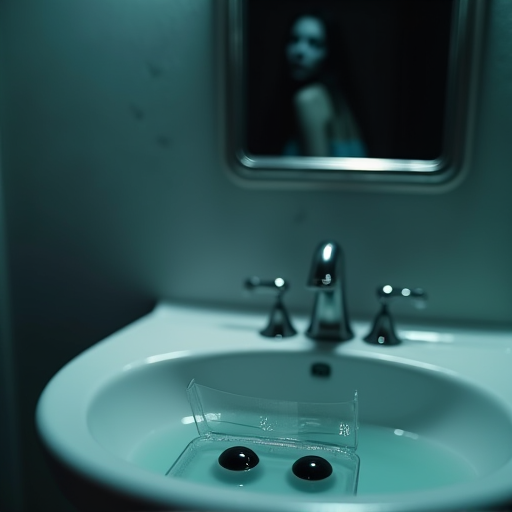
The contact lens case on the bathroom shelf was open.
Inside, floating in the pale blue cleaning solution, was a single pair of human eyes.
Not Claire’s brown lenses.
Eyes.
Actual eyes.
Looking up through the liquid like something resting comfortably where it had always belonged.
Claire saw them first.
She vomited into the sink.
That was the moment denial finally died.
Because a nightmare can be explained away. A visual glitch, a panic episode, a shared hallucination produced by exhaustion and bad storytelling. But not persistence. Not repetition. Not evidence arranged with intention.
Noah slammed the case shut so hard the solution splashed over his hand.
It smelled faintly metallic.
Neither of them stayed long enough to decide what to do next.
⸻
They moved out within forty-eight hours.
Officially, it was because of mold.
That was the explanation they offered the landlord, their friends, and eventually themselves.
No one wanted the real version. The real version requires too much from listeners. It demands they accept either the supernatural or the complete collapse of trust in the senses, and most people would rather call you dramatic than do that work.
But Noah could not let it go entirely.
Some stubborn, academic, self-destructive part of him needed context.
So he started digging.
The building had been remodeled twice in thirty years. Before that, the third floor apartments had been rented mostly to students. One local archive listing led to a newspaper clipping. Then another. Then a much older one, yellowed and half-digitized, with enough names missing to be almost impossible to follow.
Almost.
A woman had died there.
Not in their apartment exactly, but in the unit that occupied its footprint before renovation shifted walls and swallowed old layouts into new cheap geometry.
She had been partially blind.
Obsessed, according to one account, with preserving sight.
There were rumors about missing specimens from an anatomy department. Rumors about glass jars. Rumors that when police entered the apartment after neighbors complained of a smell, they found her sitting before a blank computer screen—long before computers should have mattered to the story at all—surrounded by labeled dishes and pairs of eyes suspended in solution.
The official record called her mentally disturbed.
The article ended with a line Noah could never forget:
Several sets of eyes were recovered, though authorities could not confirm that they all belonged to the deceased.
After that, he stopped researching.
Some facts are not clarifying. They only prove that horror had paperwork before it had witnesses.
⸻
Claire never wore contact lenses again.
That was the smallest consequence.
The larger one was this: she stopped letting Noah joke about the things people use to see each other. Eyes, attention, intimacy, being watched, being understood. Anything in that territory made her go flat and silent in a way that frightened him more than tears would have.
He changed too.
Not visibly, perhaps. Not in ways friends could name.
But every now and then, late at night, working at a screen, he would catch himself staring at the reflection in the black monitor after it powered down.
Waiting.
Counting.
Making sure his own eyes still moved when he did.
Years later, long after they had broken up for reasons that had nothing to do with the apartment and everything to do with how fear changes the dimensions of people, Noah woke one night needing solution for a dry contact lens.
He had gone back to wearing them after Claire left. Slowly. Quietly. Out of convenience.
In the dark bathroom, half asleep, he reached automatically for the little case on the sink.
He opened it.
A pair of dark human eyes floated upward through the blue liquid, turning gently toward him as if disturbed from rest.
And from somewhere beyond the doorway—whether in the hall, inside the wall, or just behind his own thoughts—he heard a woman’s voice say, pleasantly:
“Nine pairs.”