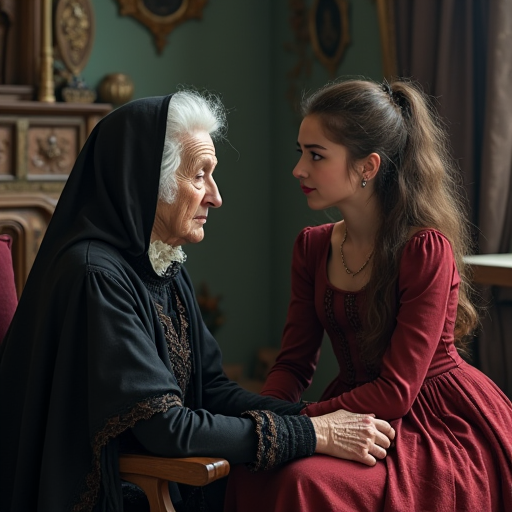
The Unborn
For the past week, her stomach had been in knots. Even the smell of coffee or warm bread made her gag. We both assumed it was stress, maybe a stomach bug, maybe grief in one of its quieter disguises. So we each took the morning off and went together.
Looking back, I still wonder when exactly Vivian and I became close.
We worked for the same company, though not in the same department. I was a manager. She was junior staff. Under normal circumstances, we probably would have remained polite colleagues and nothing more.
But normal circumstances had ended six months earlier.
Her husband, Patrick, had died in a car accident.
They’d been renting a small apartment together, and after he died, Vivian couldn’t afford to stay there alone. Someone at work mentioned that I had a spare room and asked whether I’d consider renting it to her.
I said yes before they’d even finished asking. I told them not to worry about rent.
A week later, Vivian moved in.
That was how it began.
⸻
The waiting room smelled faintly of bleach and wet coats. Rain streaked the windows. Vivian sat beside me with both hands wrapped around her bag, saying nothing. Her face looked drained, gray around the mouth.
“It’s probably nothing,” I said for the third or fourth time. “You’ve barely been eating. That alone can mess with your stomach.”
She nodded, but I could tell she wasn’t listening.
When the doctor finally called us in, we both stood too quickly.
Vivian forced a smile. “So… my stomach’s okay?”
The doctor glanced at the chart. “Your stomach looks fine.”
I let out a breath. Vivian did too. For a second, I thought we were done.
Then the doctor added, in the gentle tone medical professionals use when they know they’re about to alter the shape of your life:
“However, your test results indicate that you’re pregnant.”
Vivian blinked. “What?”
“You’re pregnant,” he repeated. “You’ll need rest, proper nutrition, and follow-up care.”
“No,” I said immediately. “That’s not possible.”
The doctor looked at me over his glasses.
I heard my own voice rising. “There has to be some mistake. Her husband is dead. She lives with me. I know where she goes, when she gets home, what her life looks like. She wouldn’t—”
He cut in calmly. “The lab is very unlikely to be mistaken.”
Vivian shook her head too fast. “No. No, that can’t be right. Last month, around the sixth or seventh, I was on my period. Fiona knows. She was there.”
I nodded at once. “That part is true. She gets terrible cramps every month. I had to buy her painkillers. Last month was especially bad.”
The doctor’s expression didn’t change.
“I can only tell you what the results show.”
⸻
On the way home, I bought lunch for both of us, but Vivian barely touched hers.
She sat curled on the sofa, pale and hollow-eyed, while I tried to talk sense into the room.
“Lab tests can go wrong,” I said. “Machines break. Samples get mixed up. It happens.”
She picked at the rice with her chopsticks.
“I believe you,” I said.
That got her to take a few bites.
Five minutes later she was in the bathroom vomiting.
⸻
By evening, she was still sick.
I told myself it had to be her stomach. Food poisoning, ulcers, stress—anything but pregnancy. Still, unease had already crept in, and once it does, it roots itself deep.
I asked her to come sit in my room.
She perched on the edge of the chair, hands folded in her lap like a child called in by the principal.
“Vivian,” I said carefully, “I need to ask you something, and I need you to tell me the truth. Did anything happen? Anything at all?”
Her eyes widened. “No.”
“Think before you answer.”
“I am thinking.”
“Then help me understand this.”
She swallowed hard. “I can’t explain something that didn’t happen.”
I studied her face for signs of deception and found only exhaustion.
Maybe I was being unfair. Maybe grief had made me suspicious.
But then she missed her period again.
And I remembered a client from Tokyo who had visited the office the previous month. He’d taken an obvious interest in her, asked her to dinner, laughed too easily at things she said.
I hated myself for thinking it.
I pushed it away.
I chose to trust her.
For two weeks, we never spoke of it again.
⸻
Then one night, long after midnight, there was a knock on my bedroom door.
It opened a crack before I could answer.
“Fiona?” Vivian’s voice trembled. “Are you awake?”
I sat up. “Come in.”
She stepped inside in her pajamas, barefoot, arms wrapped around herself so tightly she looked cold.
“I need to tell you something,” she said. “The pregnancy… it’s real.”
I stared at her. “Whose is it?”
Her mouth trembled.
“Vivian, listen to me. I’m not judging you. You’re an adult. What you do with your life is your business. But if you trust me at all, tell me the truth.”
She looked at me with a strange, searching fear.
“If I tell you,” she whispered, “will you believe me?”
I almost laughed. “Try me.”
She took a breath that hitched halfway in.
“It’s Patrick’s.”
The room seemed to lose all air.
“No,” I said flatly. “Don’t do this.”
“It’s his.”
“Patrick died six months ago.”
“I know that.”
“Then don’t say things like this.”
Tears welled up in her eyes. “I’m not lying.”
I stood and paced once, twice, trying not to lose my temper. “Then tell me something I can actually understand.”
She nodded shakily.
“The night of the sixth,” she said, “the night you gave me painkillers… I fell asleep holding Patrick’s picture.”
“I remember.”
“I dreamed about him.”
“That’s not unusual.”
“No,” she said. “Not like this.”
She looked down at her hands.
“He came to me in the dream. He looked exactly the way he used to. He touched me. He held me. We…” Her voice dropped to almost nothing. “We slept together.”
I closed my eyes briefly.
“Vivian—”
She rushed on before I could stop her.
“When I woke up, I was naked. My clothes were on the floor. There were marks on my skin—finger marks, scratches, bite marks on my neck. I know how this sounds. I know.”
“You could have done that in your sleep.”
She shook her head violently. “I don’t keep my nails long. You know that. And I couldn’t have bitten the back of my own neck.”
I said nothing.
“After that, he came back,” she whispered. “Every night.”
The words hung there.
“Every night,” she repeated. “Always in dreams. Always the same. He told me he couldn’t bear to leave me alone. He said he would come whenever I needed him. And every morning, I’d wake up… like that.”
I felt the first cold edge of genuine fear.
Still, I fought it.
“Dreams can do strange things to the body,” I said. “Sleepwalking. Trauma. Hallucinations—”
“You think I don’t know how insane this sounds?”
She was crying openly now.
“A few days ago, I dreamed he took me to a clinic. In the dream, he was smiling. He said he had finally given me something wonderful—something to make up for the child we never had.”
I stared at her.
She wiped at her face.
“And before we came to the hospital with you… I’d already gone to see someone.”
“Who?”
“An old healer. A woman my aunt once knew. She took one look at me and said I was carrying a child.”
I said nothing.
“Yesterday, I went back to the hospital alone. I had an ultrasound.”
That got my attention.
“And?”
Her eyes lifted to mine, full of a horror too deep for panic.
“I heard a heartbeat.”
My scalp prickled.
“But the doctor couldn’t see anything on the screen,” she said. “Nothing. He kept moving the wand, changing angles, asking me to hold still. He said he heard it too. But there was nothing there.”
I sat down very slowly.
At last, I asked the only thing that seemed to matter.
“What are you going to do?”
She let out a broken sound that wasn’t quite a laugh and wasn’t quite a sob.
“I don’t know. If I keep it… what exactly am I giving birth to? And if I don’t—how do you remove something that’s growing inside me when even the machine can’t see it?”
I had no answer.
That night, after I got her back into bed, I lay awake until dawn.
I did not believe in ghosts.
But I believed Vivian believed what she was saying.
And that was bad enough.
⸻
A week later, under the excuse of a work trip to a warehouse outside the city, I went to see my great-aunt Mabel.
She lived in a village so old and isolated it felt detached from time itself. People there still went to her when prayers failed, when medicine failed, when something came into a house and refused to leave.
No one called her a witch to her face.
They called her a medium.
Or, when they were frightened, simply Mabel.
She was seventy-three, thin as bundled sticks, with clear pale eyes that made lying feel impossible.
After tea and small talk, I told her everything.
She didn’t interrupt.
When I finished, she sat in silence for so long that I thought perhaps she hadn’t heard me.
Then she sighed and said, “No.”
I leaned forward. “No?”
“I won’t be part of it.”
I stared at her. “You understand what this is?”
“Yes.”
“Then help her.”
Mabel folded her hands. “If this were happening to you, perhaps. But this woman is not my blood.”
I dropped to my knees before I even realized I was doing it.
“Aunt Mabel, please.”
She looked tired rather than surprised.
“Get up, Fiona.”
“I’m not leaving without an answer.”
At that, something in her face shifted.
“You really want the truth?”
“Yes.”
She studied me for a moment.
“The dead man crossed a line he had no right to cross,” she said. “Love doesn’t excuse it. Grief doesn’t excuse it. The living belong to the living. The dead belong elsewhere.”
A shiver crept across my arms.
“What is inside her?” I asked.
Mabel’s gaze drifted to the rain-silvered window.
“A spirit child,” she said. “A soul taking shape without flesh. That’s why machines hear it and cannot see it.”
I could barely breathe. “Can it be removed?”
“Yes.”
Relief flooded me so suddenly it made me dizzy.
Then she added, “But the cost will not be small.”
I waited.
“If I sever the thing inside her, the man’s spirit will be destroyed with it.”
I swallowed.
“And the one who performs the rite will lose years of life.”
“How many?”
“Four,” she said.
Tears sprang to my eyes. “Then forget it. I never should have come.”
Mabel laughed softly, not unkindly.
“I’m old, Fiona. I’ve had a long enough run. Bring me to her.”
⸻
I never told Vivian what the price would be.
I introduced Mabel as an old family acquaintance, someone who understood unusual spiritual disturbances. That was all.
Vivian thanked me so sincerely it made me feel ashamed.
The ritual was set for the following night.
That evening she went to bed early, but around midnight Mabel and I both heard her talking in her sleep.
“Patrick… we can’t keep it…”
Her voice rose, cracked, pleaded.
“No. Please. Don’t ask me again… I love you, but this can’t stay with us…”
Then, after a long silence:
“No—”
The next morning, I found her sitting upright on the bed, white-faced, staring at the wall.
I handed her a mug of warm milk. She pushed it away.
“Fiona,” she said quietly, “what didn’t you tell me?”
My pulse jumped.
“I don’t know what you mean.”
“Yes, you do.”
I tried to smile. “Vivian—”
“Please don’t lie.”
Her eyes filled.
“He told me everything last night.”
I sat down.
“Patrick?”
She nodded.
“He said he was sorry. He said he only came because he couldn’t bear leaving me alone. He said he never meant for this to happen.” She pressed both hands to her mouth, trying to steady herself. “He wanted to keep it at first. But if I carry it to term, I’ll die. And whatever is born won’t belong here. It won’t live in this world. It would have to go with him.”
I felt all the strength leave my shoulders.
“He doesn’t want that,” she whispered. “He said he won’t take me with him.”
I pulled her into my arms.
“You’re still here,” I said. “That’s what matters.”
She clung to me like someone drowning.
⸻
That night, the ritual began.
Mabel drew symbols on the floor in white ash and salt. She lit candles at the four corners of the room and seated Vivian in the center. The old woman murmured prayers in a language I didn’t know, her voice low and steady as a pulse.
Then she burned a slip of paper inscribed with something dark and curling, let the ashes fall into a cup of water, and handed it to Vivian.
“Drink.”
Vivian obeyed.
I was not allowed into the room. I watched through the narrow crack of the door, my fingernails pressed into the frame.
The candles fluttered all at once.
Then every flame went out.
The darkness was so sudden and complete it felt solid.
A second later, Vivian screamed.
I nearly shoved the door open then and there, but Mabel had warned me not to enter no matter what I heard.
So I stood frozen outside, palms slick with sweat, while something inside the room made a sound no human throat could have formed.
It was wet.
It was furious.
And it was followed by another scream, shorter this time, strangled at the end.
At some point after that, I must have blacked out on the living room sofa.
When I woke, dawn had already broken.
Mabel was sitting upright in a wooden chair, looking smaller than I’d ever seen her.
Vivian lay on the floor mattress in my spare room. Blood stained the front of her nightgown. There was dried blood at the corner of her mouth.
I dropped beside her. “Vivian?”
Mabel’s voice came from behind me, thin and frayed. “She’ll wake. Give it time.”
I turned, and for the first time in my life, Mabel looked old.
Not elderly.
Ancient.
I helped Vivian into bed and stayed with her the rest of the morning.
Neither of us said much.
Neither of us had the strength.
⸻
A week later, Mabel returned to her village.
I used nearly all my savings to have repairs done on her little house and sent what money I could afterward, though she never asked for it.
Then I took Vivian back to the hospital.
This time the doctor reviewed her scans, her bloodwork, and her charts without any trace of confusion.
“No pregnancy,” he said.
Nothing unusual. Nothing to report.
Vivian sat perfectly still.
I thanked him, because one of us had to.
We drove home in silence.
A year later, Mabel died quietly in her sleep.
No illness. No struggle. No warning.
Just sleep.
Sometimes I still tell myself there must have been some other explanation. Some medical anomaly. Some shared delusion built from grief and stress and loneliness.
Sometimes I almost believe it.
But every now and then, on certain nights, Vivian wakes screaming from dreams she can’t remember.
And when she does, I still find myself listening for a second heartbeat in the dark.