The Other Twin
That usually surprised people.
To everyone else, a birthday meant candles, wrapped boxes, too much cake, dinner reservations, and the faint flattering lie that you were, for one day at least, the center of the world. But for Clara, birthdays had always meant something else.
They meant the dream.
It came every year without fail, arriving sometime in the days before her birthday like weather crossing a horizon. It was always the same dream, or near enough: cold glass, greenish liquid, a narrow confined space, and the unbearable sensation of sharing it with something that hated her for breathing.
By the time she turned twenty-six, even the anticipation had become enough to make her anxious.
That year, though, the celebration was larger than usual.
There were more flowers. More food. More laughter. Her parents had outdone themselves, partly because they adored her and partly because this was the first birthday she was celebrating with her boyfriend, Daniel Lowe.
Everyone called him Dr. Daniel, even though he was young enough that it sounded faintly ridiculous. He was an up-and-coming surgeon at the university medical center, bright, handsome in a soft intelligent way, and uniformly adored by Clara’s family for the simple reason that he made people feel safe.
Clara loved him for the same reason.
If she fell asleep in his arms, she told herself, maybe the dream wouldn’t come.
Maybe the body remembered comfort better than fear.
Maybe love could protect you from whatever had been reaching for her all these years.
That night, after the cake and the photographs and the champagne and the smiling exhaustion of a successful family gathering, Clara went to bed with Daniel’s hand still wrapped around hers.
The dream came anyway.
⸻
This time it was clearer than before.
She was submerged.
Not drowning—suspended.
The liquid around her was thick and cool, green-gray in the half-light, and all around her was curved glass. She could not move properly. Every attempt seemed to pull against some invisible tether.
And there was something else in there with her.
Not beside her.
Attached.
Its presence pressed against her with an intimacy so total it was indistinguishable from imprisonment. She could not see it fully, only flashes: a small hand where no hand should be, a malformed shoulder, a slick curve of flesh against her own.
Then a voice—not heard, exactly, but known.
You don’t get to keep everything.
Clara woke with a scream.
Daniel jolted upright beside her, fumbling for the lamp.
When the light came on, she was shaking so hard she could barely breathe.
He gathered her against him and asked what she’d seen, but the dream had already begun dissolving in the ordinary brightness of the room. She told him it was nothing. Just the usual nightmare. Something stupid.
He did not look convinced.
Still, he didn’t push.
That was one of the things she loved most about him: he knew when fear needed questioning and when it only needed gentleness.
For a few days after that, things seemed normal again.
Then Daniel invited her to the medical school.
He had a few hours of paperwork to finish, he said, and afterward they could grab dinner. Clara said yes without thinking much about it. She’d never spent time inside the old teaching wing before, and she was curious.
That curiosity lasted right up until he led her into the pathology specimen room.
The place smelled like formaldehyde, paper, steel, and time.
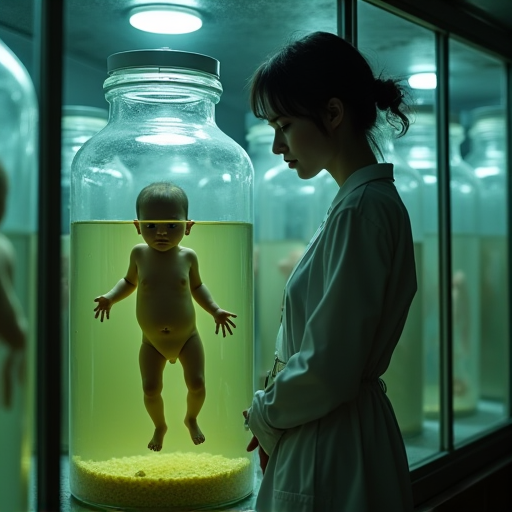
Rows of glass jars stood in cabinets under fluorescent lights, each one holding some preserved catastrophe of the human body: malformed organs, diseased tissue, fetuses too small and pale to belong to the world she knew.
Clara hated it instantly.
But she didn’t want to seem childish, so she kept walking.
Then she saw the jar.
It sat slightly apart from the others, larger than most, and inside it floated what she first took for a damaged infant specimen.
Then she stepped closer.
The thing in the jar had two bodies.
Or rather, it had once had two.
One twin had clearly been more fully formed. The other looked unfinished, as though a second child had begun growing from the abdomen of the first and then stopped halfway through the attempt. One leg. One shrunken arm. A torso twisted into dependence.
The preserved skin had gone that pale yellow-white particular to old specimens. The fluid around it shimmered faintly green.
Clara felt her stomach drop.
If this is where I was, she thought suddenly, irrationally, then this is the jar from the dream.
“Clara?”
Daniel’s voice sounded far away.
She pointed at the specimen. “What is that?”
He glanced up casually. “Conjoined twins.”
There must have been something strange in her face, because he came over at once.
“That one’s old,” he said. “A historic case. Professor Shaw did the separation surgery decades ago.”
Clara swallowed. “And one of them died?”
“One was never likely to survive,” he said. “The surgery was done to save the stronger twin.”
He said it with the flat clinical certainty of medicine.
Save one. Lose one. Record the procedure. Preserve the evidence.
He saw that she still looked pale and reached for a nearby file.
“Here,” he said. “If you want the full story, it’s in the case record.”
She should have refused.
Instead, she took it.
⸻
The photographs were yellowing at the edges.
The first pages showed the twins shortly after birth—both girls, joined low across the abdomen and pelvis. One infant was largely normal. The other seemed to erupt from her like an afterthought of flesh. Smaller. Incomplete. Built around dependency.
Clara kept turning pages.
The notes described respiratory distress in the malformed twin, emergency consultations, debates among surgeons, consent from the parents. The procedure itself had been radical for its time. Risky. Experimental. Possibly hopeless.
Professor Nathan Shaw had performed the operation.
The stronger infant survived.
The weaker infant died.
That much was straightforward.
What was not straightforward was the photograph at the end.
Post-operative.
The surviving infant’s lower right abdomen had an oval surgical scar.
Clara’s hand flew to her own stomach.
Low on the right side, hidden beneath the waistband of her skirt, was an oval patch of darker skin she had been told all her life was a birthmark.
Her mother had always said she was born with it.
Clara turned back frantically through the file. There was no birth date on the main page. For one terrible moment she thought she had imagined the resemblance.
Then she saw the surgery date.
It was the date she dreaded every year.
The date of the dream.
She kept reading until she found the note that broke whatever fragile barrier still separated coincidence from horror:
The twins were twenty-six days old at the time of surgery.
Clara went cold all over.
She did the math again and again, as if arithmetic might rescue her from meaning.
Same year.
Same hospital.
Same surgical mark.
Same date that returned every year in sleep.
Her vision blurred.
Unable to stop herself, she looked back at the jar.
The dead twin seemed to be smiling.
Not with the mouth.
With the eyes.
Clara made a small strangled sound and collapsed.
⸻
After that, people said she became delicate.
It was the kind word for what actually happened.
She ate less. Spoke less. Slept badly. Started at shadows. Lost weight. Daniel grew frantic trying to help, but she could not tell him the truth because she didn’t have a truth, only pieces of one.
She began questioning her parents.
At first casually.
Then obsessively.
Had there really been another birth in the hospital that day? Had there been an operation? Had anyone ever said anything about complications? Why did no one ever have photographs from her first month of life? Why had her mother always looked away when Clara asked about the mark on her stomach?
Her mother denied everything too quickly.
Her father became angry in the way frightened men sometimes do when they believe anger can keep the buried buried.
Months passed.
Clara did not get better so much as learn how to pretend well enough that the people around her stopped pushing.
Then Daniel proposed.
And because terror makes ordinary happiness feel like a lifeline, she said yes almost before he finished asking.
If she married him, she thought, perhaps that would anchor her to the living.
Marriage meant routine, solidity, family, future. The opposite of jars. The opposite of greenish fluid. The opposite of being unfinished.
Their wedding was noisy and generous and overfull in the way good weddings should be.
Friends, cousins, colleagues, old neighbors, too many relatives, too much food.
Among the guests was Professor Shaw himself—an old man now, sharp-eyed and warm-voiced, still carrying the easy authority of someone accustomed to being listened to.
Clara watched him across the room and had to resist the urge to ask him outright:
What did you cut away from me?
She didn’t ask.
She smiled for the photographs.
She became a wife.
⸻
For a little while, marriage seemed to work.
There was a honeymoon period so lovely it embarrassed her later to remember how completely she believed in it. She slept better. The dream retreated. Daniel’s arms around her at night felt like proof that the world still operated by sane and human rules.
Then, one morning, she woke up on the balcony before sunrise.
She had no memory of getting out of bed.
Daniel found her there in her nightgown, sitting very straight in the cold gray light, hands folded in her lap as if waiting for permission to move.
“You’re up early,” he said lightly.
Clara turned toward him and smiled.
“I couldn’t sleep.”
Something in the way she said it unsettled him.
Later he told himself it was only because she sounded so calm.
But over the following weeks he began to notice changes.
Clara became bolder. Sharper. Sometimes cruelly amused. She started revisiting the pathology building alone, despite having sworn after the first incident that she would never set foot in the specimen room again. Now she went back repeatedly. Worse, she seemed fascinated by the preserved twins’ file, rereading the surgical notes with an intensity that made Daniel deeply uneasy.
Once he found her standing before the jar, smiling faintly.
Another time she was seated at his desk with the case file open, one finger resting on the diagram that showed where the two bodies had been joined.
When she noticed him, she laughed softly and said, “Remarkable what people call a successful outcome.”
He stared at her.
She seemed not to notice.
After that, Daniel began to feel watched whenever he was alone in the specimen room.
He would turn sharply, expecting someone in the doorway.
No one.
Only the cabinets. The jars. The lights buzzing overhead.
But the sensation remained.
Persistent.
Intimate.
Like resentment with eyes.
⸻
Clara’s mother came to visit one afternoon and left in tears.
She told Daniel, in a halting, broken confession, what the family had hidden all these years.
There had indeed been a difficult birth.
There had indeed been surgery.
The surviving baby had been given to Clara’s parents—the “good baby,” as the doctors called her, though no one had said it in those exact words. The other one had lived only long enough to become a medical problem and then a specimen.
The parents had been told never to speak of it again.
It would only confuse the child, they’d said.
Let her have a normal life.
Daniel listened in silence while Clara’s mother wept and wrung her hands.
When he asked why no one had ever told Clara, the woman only said:
“Because how do you raise one daughter with the knowledge that she used to be two?”
That night Daniel went home determined to speak carefully, gently, rationally.
He found Clara in the bedroom, sitting on the edge of the bed.
In her lap was the old case file.
She looked up at him with eyes too bright to be human.
“You knew,” she said.
He stopped in the doorway.
“Clara—”
“No,” she said. “Not Clara.”
The room changed around those words.
Not visibly.
But decisively.
Like a door closing somewhere unseen.
Daniel’s mouth went dry.
She stood slowly.
“You’ve been sleeping beside the wrong sister.”
⸻
What followed never became part of any official account.
Daniel later tried to record it for himself and failed. Every version sounded insane the moment it was written.
He remembered Clara—or the thing in Clara—speaking in alternating voices, sometimes hers, sometimes not. He remembered her describing years spent trapped in glass, in chemical sleep, in silence, watching the living twin walk through the life that should have been shared.
He remembered her saying:
You had twenty-six years. It’s my turn now.
He remembered backing away.
He remembered the smell of formalin suddenly filling the room though there was no source for it.
He remembered hands—not two, but four—closing around his throat in the dark.
When he woke, he was on the floor of the pathology room with a bruised neck and a nurse shaking him.
Clara was gone.
She was found the next day seated in the specimen room before the twin jar, smiling at nothing.
She had no memory, she said.
None at all.
The doctors called it dissociation. Trauma response. Sleep disorder. Delusional fixation triggered by a recovered surgical history.
Professor Shaw did not offer an opinion.
He only stood in the specimen room for a very long time, staring at the jar.
Then he said quietly, to no one visible:
“I should have buried you.”
⸻
Life did not collapse after that.
It warped.
Clara continued to live with Daniel, and most days she seemed entirely herself. Warm. Fragile. Intelligent. Ashamed of things she couldn’t explain.
But every year, as her birthday approached, she changed.
Sometimes only a little.
Sometimes enough that Daniel locked the bedroom door at night and pretended he was doing it for security.
She resumed visiting the specimen room.
Always on the same date.
Always alone.
One winter evening Daniel followed her there.
He stood outside the half-open door and watched his wife place one palm against the glass of the jar.
Inside, suspended in yellow-green fluid, the malformed twin floated in eternal incompletion.
Clara smiled.
Then another smile appeared beside it.
Not on her face.
In the glass.
A reflection that did not belong to her—same features, same mouth, same eyes, but twisted by a slow and private triumph.
Daniel did not enter.
He backed away without a sound.
From inside the room, through the hum of the fluorescent lights, he heard Clara speaking softly.
Or perhaps he heard two women speaking in perfect unison.
“Soon,” they said.
When he finally forced himself to look back through the doorway, Clara was standing alone before the jar.
Only her.
Of course only her.
But inside the glass, behind the preserved infant’s blind floating face, two small watchful eyes seemed to be open.
And fixed on him.