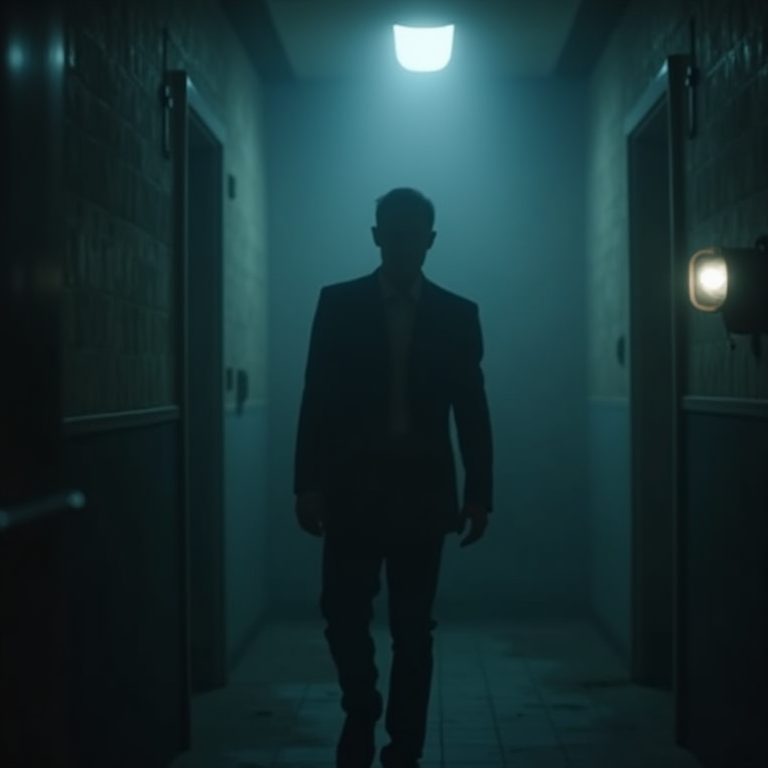
The File That Was Missing
The last message arrived at 3:47 AM. Chen Wei was half-asleep on his couch, phone glowing against his face, when the notification lit up the dark living room. One word from an unknown number: Run. He sat up slowly, the weight of the small apartment pressing down around him. His fingers hovered over the screen. He deleted the message without replying, told himself it was a wrong number, went back to sleep.
At 7:12 the next morning, his colleague Lao Li didn’t show up for work. Chen checked Lao Li’s desk — a half-finished cup of coffee cooling beside stacks of unsorted files. When he asked HR, everyone shrugged. Lao Li had resigned weeks ago, apparently. Chen remembered filing Lao Li’s resignation letter himself. Or at least, he thought he had. The memory wobbled like smoke.
He started paying attention to things.
The elevator in the building always stopped on the same floor even though nobody worked down there. The digital display flickered through a momentary ghost image of characters before returning to normal. At first he thought it was a glitch. Then he noticed that every time the elevator stopped on that floor, someone else got on too. A man in a dark coat standing perfectly still, facing the corner. Three women in identical grey dresses, eyes forward, not blinking. They always left at the lobby floor simultaneously, moving as one unit.
Chen began recording everything on his phone. Audio. Notes. Timestamps. He set up a second account at the data center, separate from work, where he archived copies of every anomaly he logged. The data center itself became less reliable the more he watched. Servers that were online yesterday would go offline overnight. Logs showed access timestamps that predated the company’s founding. He found a folder labeled ARCHIVE-NULL containing seventeen years worth of employee records — names he recognized from old staff photos on the wall, people who had supposedly been laid off or retired. Their employment status read: ACTIVE. Their termination dates read: NEVER.
You are asking too many questions, said Director Yang during their weekly review. Yang was a man built of soft edges and polite smiles, whose voice carried the precise warmth of someone rehearsed in saying nothing useful. Chen looked up from his tablet. Lao Li never submitted a resignation. The servers keep losing records. People who have been dead for fifteen years appear on the active roster. Yang smiled. He reached across the desk and placed both hands flat on the surface, palm up. Wei, you know how much mental energy we spend on legacy systems? Some errors feel real but they are ghosts. Dont chase ghosts.
That night, Chen drove home slower than usual. The city felt different — the kind of different that arrives when you notice something fundamental about the world and cannot unnotice it. He passed the same intersection four times, each time convinced hes seen a red sedan parked ahead. It wasnt until the fourth pass that he realized all four sightings had been the exact same car, in the exact same position, driven by the exact same person. He called a ride-share. The driver assigned had no name listed. Only a vehicle number: 4471-B3.
When the car arrived, the interior smelled like ozone and wet paper. The driver turned around and Chen saw an eye socket that held a reflection of his own face looking back, slightly distorted, slightly older. Where to? the voice said, and it sounded like a recording played backward through a speaker. Chen couldnt speak. He gave the address through his teeth. The driver nodded once. When they reached the apartment complex, the driver extended a receipt across the partition. It printed from nowhere. The amount charged read $44.71. The destination field read: MEMORY CLEANSE PROTOCOL.
Chen kept the receipt. He put it in his jacket pocket and walked into his building. From inside his apartment, he heard the elevator arrive on the seventh floor. He pressed his ear against the door. Footsteps sliding, barely lifting off the carpet. Then silence. Then the sound of someone breathing just beyond the wood.
His phone vibrated on the counter. Another message from the unknown number. Two words this time: They know youre watching.
Chen pulled the laptop out of his bag and opened the archive folder hes built. He selected every file, copied them to an encrypted drive, and shoved the drive into the hollow leg of his desk drawer. He opened the browser to his secondary email, prepared to send everything to his personal cloud, and froze. On the monitor, reflected in the black glass, stood a figure behind him. He turned. Nothing there. He turned back. An email draft, unsaved, open on the screen. Subject line: To whoever finds this. Body text filled with everything he knew, organized chronologically, timestamped, cross-referenced with server logs and photographs hes taken of the data center corridors.
He hadnt written any of it.
Chen stared at the cursor blinking at the end of the last sentence, wondering when it had moved there. He reached for the keyboard. His fingers touched the keys. The typing continued — letters forming, sentences completing — but his hands werent moving. Whatever was typing had learned his cadence, his mistakes, his habitual comma placement after introductory clauses. It even used the same phrase he used when describing uncertainty: maybe, perhaps, possibly, depending on the rhythm needed.
The draft finished itself. The cursor stopped. The email sent.
Chen ran. Out the door. Down the hallway. Past the elevator, past the stairwell, into the lobby, out into the cool evening air. He made it three blocks before the city changed. Street signs he knew by heart rearranged themselves into unfamiliar characters. Buildings shifted their addresses. Maps on his phone displayed roads hed never seen branching outward from his current position like capillaries spreading from a wound.
His phone buzzed again. Unknown number. Final message: Welcome to the permanent staff.
He turned around. The street was empty except for people walking away from him in perfect synchronization, shoulders aligned, stride length matching, heading deeper into neighborhoods that dissolved into grey static at the edges. He laughed — a brittle, desperate sound — and walked the opposite direction. Behind him, the city folded inward like origami, rooms within rooms within rooms, until nothing remained but a single corridor stretching endlessly, lined with doors, each one numbered with his name.
One of the doors was unlocked.