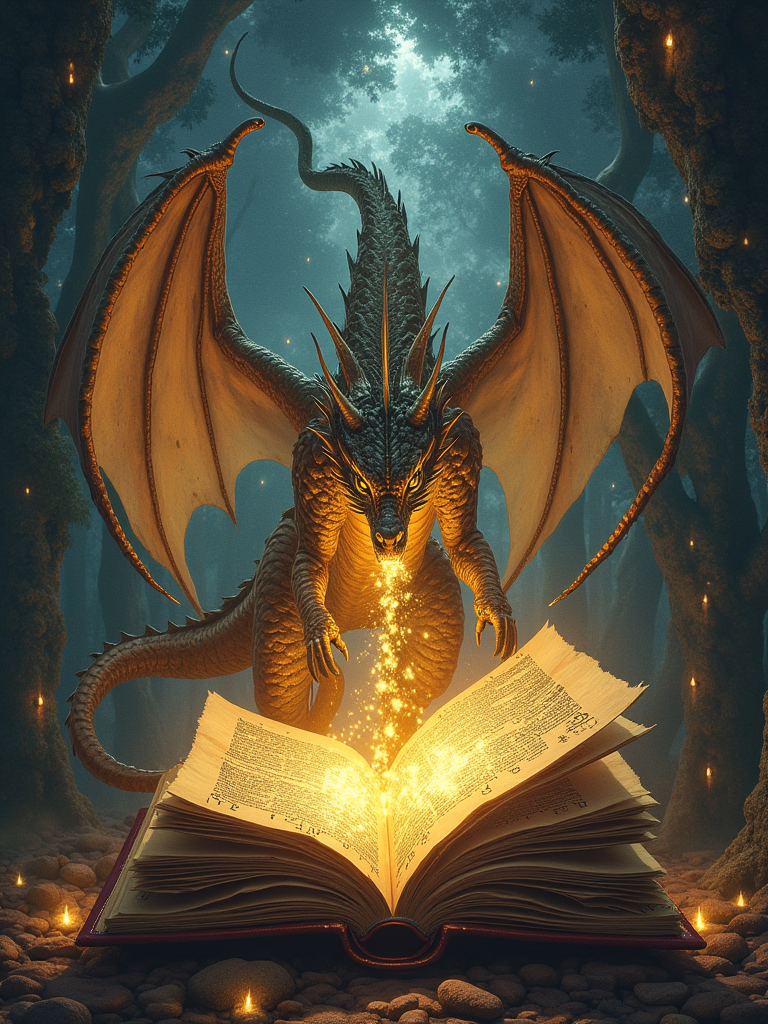
The Dragon Scribe
Corin was hired to write a dragon’s memoir. It sounded absurd until he saw the creature in person—three tons of obsidian scales curled in a cavern that smelled of sulfur and old books.
“Begin with the burning of Vaelmark,” the dragon said. Its voice carried through the stone walls like distant thunder filtered through a whisper.
“That was two hundred years ago,” Corin said, unrolling his parchment.
“Memory does not decay with time. It decays with neglect. Write what I tell you before I forget what it felt like.”
The First Session
The dragon spoke for seven hours. Corin wrote until his fingers cramped and the ink ran dry. When he finally stopped, the dragon was silent for a long moment.
“You write too slowly,” it said.
“You speak too quickly.”
“I speak at the speed of a creature who has watched empires crumble. Perhaps you should adjust.”
They came to an arrangement. Three sessions per week. Two hours each. Corin would transcribe everything word for word, and the dragon would try to remember its stories in manageable pieces.
By the third session Corin understood why the dragon needed a scribe. It was not vanity. It was fear. The creature was dying—not from wounds or disease, but from something far more insidious. It was losing its memories.
“Dragons remember everything,” the creature explained during the fourth session. “That is our gift and our curse. We carry the weight of every battle, every loss, every sunrise we have witnessed. But when the memory begins to fade, it takes pieces of us with it.”
Corin looked at the parchment. Three weeks of work filled twelve sheets. He had barely scratched the surface of two centuries of living, and already the dragon was forgetting things it had told him the week before. Time was running out for both of them.
What the Dragon Forgot
During the seventh session, the dragon paused mid-sentence and looked at him with eyes the color of molten gold.
“What was I saying?”
“The Treaty of Thornfield. You were telling me about the king who tried to enslave your kind.”
“Yes. The Treaty of—” The dragon stopped. Its massive head tilted slightly. “Who wrote that treaty?”
“You did not say.”
“I did. I said it yesterday.”
“No. You did not.”
The dragon closed its eyes. When it opened them again, something had changed. Something fundamental, like a crack appearing in a dam.
“I forgot something important,” it said quietly. “I can feel the shape of the absence but not the shape of what filled it. It is like reaching for a stair that is no longer there.”
Corin put down his quill. “Tell me everything else you remember about that day. We will reconstruct it together.”
They worked through the night. When dawn came, Corin had reconstructed the missing memory from fragments—half-sentences, emotional echoes, the way the dragon’s voice changed when it mentioned a particular word. It was not perfect. But it was enough.
The Last Page
The final session came six months later. The dragon’s voice had grown thin, like fire burning through the last of its fuel. Corin had filled two hundred and forty-seven pages.
“Read me the last entry,” the dragon said.
Corin read the passage he had written that morning. The dragon listened with its eyes closed.
“Good,” it said. “That is how I want to be remembered.”
“You will not be forgotten.”
“Everything is forgotten eventually. But books last longer than dragons. I have counted.”
The dragon breathed once, deeply, and then went to sleep. Corin sat beside it for three days, watching the slow rise and fall of its chest. On the fourth day the breathing stopped, and Corin packed his parchment and walked out of the cavern into the morning light.