The Cartographer of Lost Places
Elara mapped places that did not exist. This was not a metaphor. It was her profession, her family’s trade for seven generations, and the reason she lived in a house at the edge of the city where the roads stopped being paved and the signs stopped making sense.
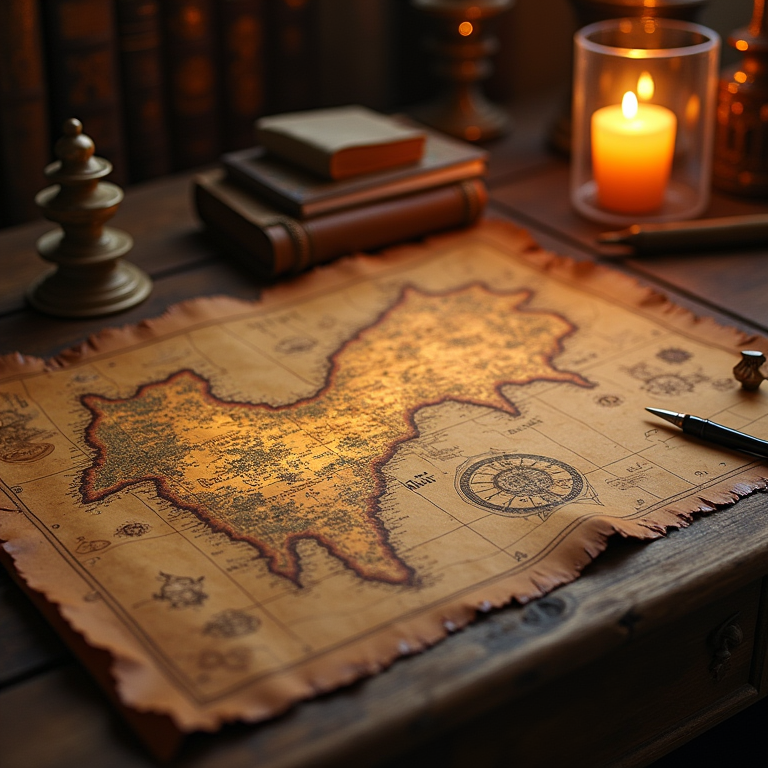
The Cartographers of the Unseen did not draw maps of cities or mountains or rivers. They drew maps of the spaces between—the alleys that appeared only during rainstorms, the staircases that existed on Tuesdays but not Wednesdays, the doorways that opened into rooms that belonged to someone else’s dream. These places were real. They were just not always there. And someone had to map them, because if no one mapped them, they would vanish entirely, and the people who lived inside them would vanish too.
Elara had inherited the maps from her grandmother, who had inherited them from her grandfather, and so on, back to the first Cartographer who had discovered that the world was larger than most people believed. The maps were stored in leather-bound volumes, their pages made of a paper that did not age, their ink drawn from a formula that no living Cartographer fully understood. The ink shimmered in certain lights, as if the lines on the page were alive and shifting when no one was looking.
She maintained the maps the way a gardener tends a garden. She walked the unseen paths, verified the locations, noted the changes. Some alleys had narrowed. A staircase that used to lead to a bookshop now led to an empty room that smelled of salt. A doorway in the old quarter that had opened into a tavern for two hundred years now opened into silence—nothing on the other side, not even darkness. Just absence.
These changes worried her. The maps were fading. Not the paper. Not the ink. The places themselves were disappearing. And she did not know why.
The Discovery
It started with the bridge. The Glass Bridge, as her grandmother had called it, was a structure that spanned nothing—a hundred feet of transparent arch hovering above an empty lot in the city’s oldest district. It appeared only at dusk, lasted for exactly forty-seven minutes, and led to a garden that existed in a time that was not the present. Elara had crossed it twice a month for ten years, documenting the garden’s slow transformation through the seasons, watching the flowers bloom and die in colors that had no names.
On the evening of October twelfth, the bridge did not appear. She stood at the edge of the empty lot, her map in hand, and waited. Dusk came and went. The sky turned the color of bruised plums. The streetlights flickered on. The lot remained empty. No bridge. No garden. No shimmering arch of glass. Just cracked concrete and weeds.
She checked the map. The bridge was still there, drawn in her grandmother’s hand, the ink still shimmering. But the place it led to was gone. Not dormant. Not hidden. Gone. As if it had never existed at all.
She checked the other maps. One by one, she verified the locations her family had documented for centuries. And one by one, she found them empty. The Tuesday staircase—gone. The rainstorm alley—gone. The dream doorway—gone. Of the forty-seven unseen places her family had mapped over seven generations, only twelve remained. The rest had vanished, leaving behind nothing but maps to places that no longer existed.
The Cause
She found the answer in the oldest map in the collection—a document so fragile she handled it with gloves, its edges crumbling like autumn leaves. It was drawn by the first Cartographer, her ancestor who had discovered the unseen world, and it contained a note in the margin that she had never noticed before. The handwriting was small, cramped, written in a hand that trembled:
The unseen places are sustained by belief. Not the belief of the many, but the belief of the few—the children who look under beds, the lovers who swear the city conspires to keep them apart, the old who remember when the streets were different. When belief fades, the places fade. When the last believer stops believing, the last place vanishes. And the Cartographer becomes the final map, drawn in a hand that no one will ever read.
Elara sat in her study, the oldest map spread before her, and she understood. The unseen places were not disappearing because of magic failing or the world changing. They were disappearing because people had stopped believing in them. The children no longer looked under beds. The lovers no longer blamed the city. The old no longer remembered. And without belief, the places starved. They withered. They ceased to be.
She was the last Cartographer. And when the last unseen place vanished, she would vanish with it—not dead, not alive, but unmapped. A person with no location in a world that required everything to have one.
The Last Map
She spent the final months doing the only thing she could: she mapped what remained. Twelve places. She walked each one, verified its coordinates, documented its condition. The work was meticulous and heartbreaking, because with every map she completed, she knew she was drawing the last record of something that would soon be gone forever.
On the last day, she stood in the final unseen place—a room beneath the city’s oldest library, accessible only through a bookshelf that shifted at exactly midnight, containing a single volume that told the story of the world as it was before anyone drew the first map. She opened the book. She read the first page. And she began to write her own entry, not as a Cartographer but as a believer—as someone who had spent her life mapping the unseen, and who refused to let it disappear without leaving a trace.
She wrote until the room began to fade. She wrote until the walls grew transparent and the floor beneath her feet felt like mist. She wrote until there was nothing left to write on, because the book, the room, the library, the city—all of it was dissolving into the space between memory and forgetting.
And in the last moment, before the final unseen place vanished, she did one last thing. She drew a map. Not of a place that existed. Not of a place that had existed. But of a place that might exist—if someone, someday, believed in it enough to look.
She left the map on the floor of the empty lot where the Glass Bridge used to appear. It was drawn on ordinary paper, in ordinary ink, and anyone who found it would see nothing but a sketch of a garden that did not exist. But if someone looked at it with the right kind of eyes—the kind of eyes that still believed in alleys that appeared during rainstorms and staircases that existed on Tuesdays—they would see something else. They would see an invitation. And if they accepted it, the unseen world would begin again.