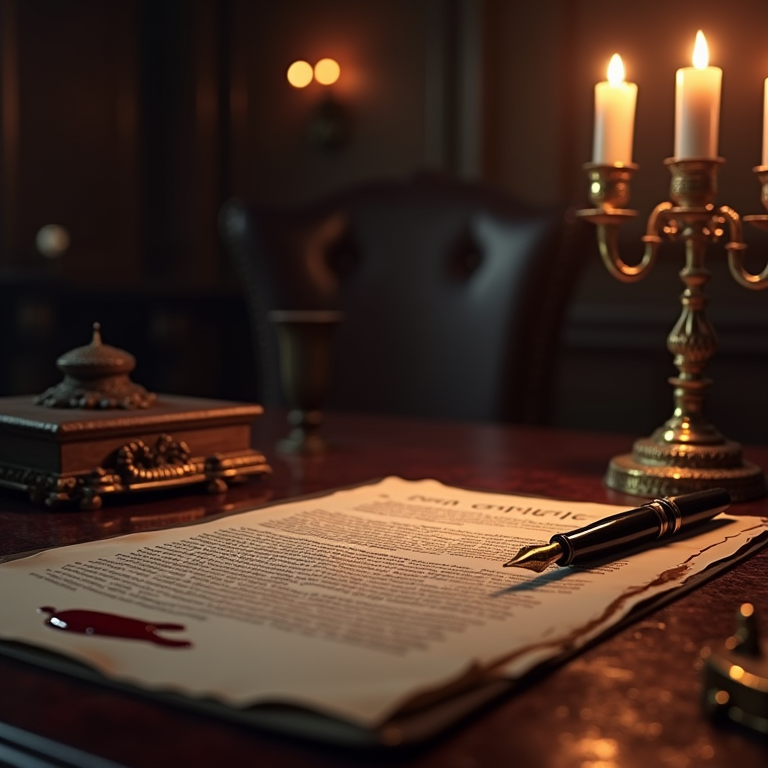
The Blackwood Contract
The letter arrived on a Tuesday, printed on paper thick as velvet and smelling faintly of wet earth. Victor Crane had never heard of Edmont Blackwood, let alone expected anything from him, yet the return address on the cream-colored envelope belonged to a law firm on Madison Avenue, and the name at the bottom of the typed letter was his own, inked in a formal script that looked almost hand-carved.
*You have been named sole beneficiary to the estate of Edmont Blackwood. Fifty million dollars and all holdings within the Blackwood estate have been transferred to you, pending the signing of a contract whose terms will be explained by Mr. Harold Pierce of Pierce, Hartley & Associates. You have seventy-two hours from the date of this letter to appear at the Blackwood residence in Ashford, Vermont.*
Victor read it three times. He worked as a freelance copywriter, shared a one-bedroom apartment in Hoboken with a cat named Soup, and had not spoken to his own family in over a decade. Fifty million dollars was not a number that fit inside his life. It sat there, enormous and wrong, like a boulder in a bathtub.
He went to Ashford.
The house stood at the end of a gravel road behind a stand of white pines so dense they blocked the sky. Three stories of Georgian brick, windows dark as sealed coffins, the roof angles sharp enough to cut the wind. A caretaker, a thin woman with wrists like matchsticks, let him in and led him to a study where Harold Pierce waited behind a mahogany desk.
Pierce was sixty, maybe seventy, with white hair combed back from a face that held no particular expression. He wore a charcoal suit and a tiepin shaped like a small skull.
“Mr. Crane. Thank you for coming.” His voice was the color of his suit. Gray. Flat. “Please, sit.”
Victor sat. The study smelled of leather and something else, something metallic and old, like the air in a basement that hadn’t seen sun in decades.
“You knew the man?” Victor asked.
“No. No one knew Edmont Blackwood, not truly. He was a recluse. Very wealthy. Oil, real estate, shipping. He died eight months ago.”
“And he left everything to me.”
“Yes.”
“Why?”
Pierce’s mouth thinned into a line. “The letter didn’t explain everything, I understand. The terms of inheritance require a contract. I am here to present it.”
He opened a drawer and slid a document across the desk. The paper was heavy, cream-colored, the same paper as the letter. The top line read, in the same elegant script:
*The Beneficiary Contract of Edmont Blackwood*
Victor read the first clause. It was simple enough. He would inherit. He would reside in the Blackwood estate for a period of not less than six months each calendar year. He would not sell, transfer, or mortgage any property belonging to the estate.
The second clause required him to maintain the grounds, the house, and all contents within, and to employ at least three staff members. The third, fourth, and fifth clauses concerned maintenance schedules, financial reporting to the estate’s trustees, and a prohibition against discussing the inheritance with members of the press.
Then he reached the sixth clause, and his hand stopped moving down the page.
*Clause 6: The Beneficiary shall be present in the house on the night of every autumnal equinox, from sundown until dawn. During this time, the Beneficiary shall remain in the main library. The Beneficiary shall not leave the library under any circumstances. All doors and windows of the library shall be sealed by a licensed locksmith before the evening begins. The Beneficiary shall endure whatever sounds occur.*
Victor looked up.
Pierce was watching him with the patience of a man who had seen this reaction before.
“What sounds?” Victor asked.
“That is not specified in the contract.”
“Because it’s not finished yet.”
“There are four more pages.”
Victor read on. Clause nine required him to keep a personal journal, to be reviewed annually by the trustees, containing his thoughts and experiences in the house. Clause eleven prohibited him from removing any item from the house’s walls, including paintings, mirrors, or clocks. Clause fourteen obligated him to sleep in the master bedroom on the second floor, the one at the end of the hall, for no fewer than two consecutive nights each week.
Clause sixteen was the one that made Victor set the pages down.
*Clause 16: Should the Beneficiary decline to sign, decline to comply with any term, or attempt to transfer the estate to another party, all inheritance rights are revoked and the Beneficiary forfeits any claim to the estate’s assets. The estate’s legal counsel shall then contact the next potential heir. If no heir accepts the contract within ninety days of the original Beneficiary’s refusal, the estate passes to the trustees, and the Beneficiary’s name is removed from any record of inheritance.*
“It sounds like a threat,” Victor said.
“It is not a threat, Mr. Crane. It is a condition. And a very old one.”
“What happens if I refuse?”
Pierce was quiet for a moment. Then he opened a second drawer and removed a photograph. He placed it on the desk. It showed a man in his forties, clean-shaven, standing in front of this same house.
“His name was Paul Ashford,” Pierce said. “He was the first heir. A distant cousin, like you. He was presented with this contract seven years ago. He refused. Three weeks later, his car was found at the bottom of a ravine in the White Mountains. The official cause of death was listed as exposure and blunt force trauma. His wife said he had never gone hiking in his life.”
Victor stared at the photograph. The man’s eyes looked ordinary. Tired, maybe. But ordinary.
“And the second?” Victor asked.
Pierce hesitated. He placed a second photograph beside the first. This man was older, grayer, with deep lines around his mouth.
“Thomas Blackwood. Edmont’s nephew. He signed the contract but failed to comply with Clause six after the first year. He left the library on the equinox night. The locksmith was never called. The house was found empty. No body. No car. His credit cards haven’t been used since.”
Victor felt the temperature in the room drop, though the radiator in the corner ticked with heat.
“How many people?” he asked.
“Three accepted the contract before you. All three either refused or failed to comply. The outcomes were… consistent.”
“That’s insane. I could go to the police.”
“You could. But the contract is legally binding, Mr. Crane. It has been reviewed by fourteen separate law firms over the past thirty years. It holds up. The estate’s wealth has sustained it. The terms are unusual, yes, but not unlawful. And Edmont Blackwood was not a man who did things without purpose.”
Victor stood. He walked to the window. Outside, the pines stood in rows like mourners. The sky had gone the color of a bruise.
“I need time,” he said.
“You have until Thursday at midnight.”
He drove back to Hoboken that night. He didn’t sleep. He sat on his kitchen floor with the contract spread out on the tile and read every clause until the words blurred. He thought about Soup. He thought about his studio apartment. He thought about fifty million dollars and a house that had consumed three people and a clause that told him to sit in a locked room and endure whatever sounds occurred.
On Wednesday, he called Pierce.
“What are the sounds?” he asked again.
“I don’t know, Mr. Crane.”
“But you’ve read the contract.”
“I’ve read the contract.”
“Then you know what happens on the equinox.”
“I know what the clause requires.”
“You don’t know what happens.”
There was a long silence on the line.
“No,” Pierce said quietly. “No one does.”
Victor hung up. He sat with Soup in his lap and watched the sun come up through the dirty window of his apartment. At eleven forty-five on Wednesday night, he drove back to Ashford.
Pierce was waiting in the study with a pen. The ink was black, the nib fine, and the contract lay open to the signature line at the bottom of page seven.
Victor picked up the pen. He looked at the house around him, at the dark walls, the heavy drapes, the grandfather clock in the corner whose pendulum swung without making a sound.
He thought about Paul Ashford and his car at the bottom of a ravine. He thought about Thomas Blackwood, erased so completely that even his cards had gone silent.
He signed.
The pen moved smoothly over the heavy paper. Victor Crane. The letters looked ordinary, even small, sitting at the bottom of a document that held clauses he didn’t understand and obligations he couldn’t yet imagine.
Pierce folded the contract, placed it in a leather folio, and locked it in the desk.
“Welcome home, Mr. Crane.”
Victor drove back to Hoboken at two in the morning, Soup asleep in a carrier on the passenger seat. He told himself it was just a house. He told himself fifty million dollars bought silence, and silence was a price worth paying.
But on the drive through the mountains, he kept both hands on the wheel, and the rearview mirror showed him nothing but the dark road behind, stretching back toward Ashford like a question he had agreed, in writing, to answer.
The equinox was four months away.