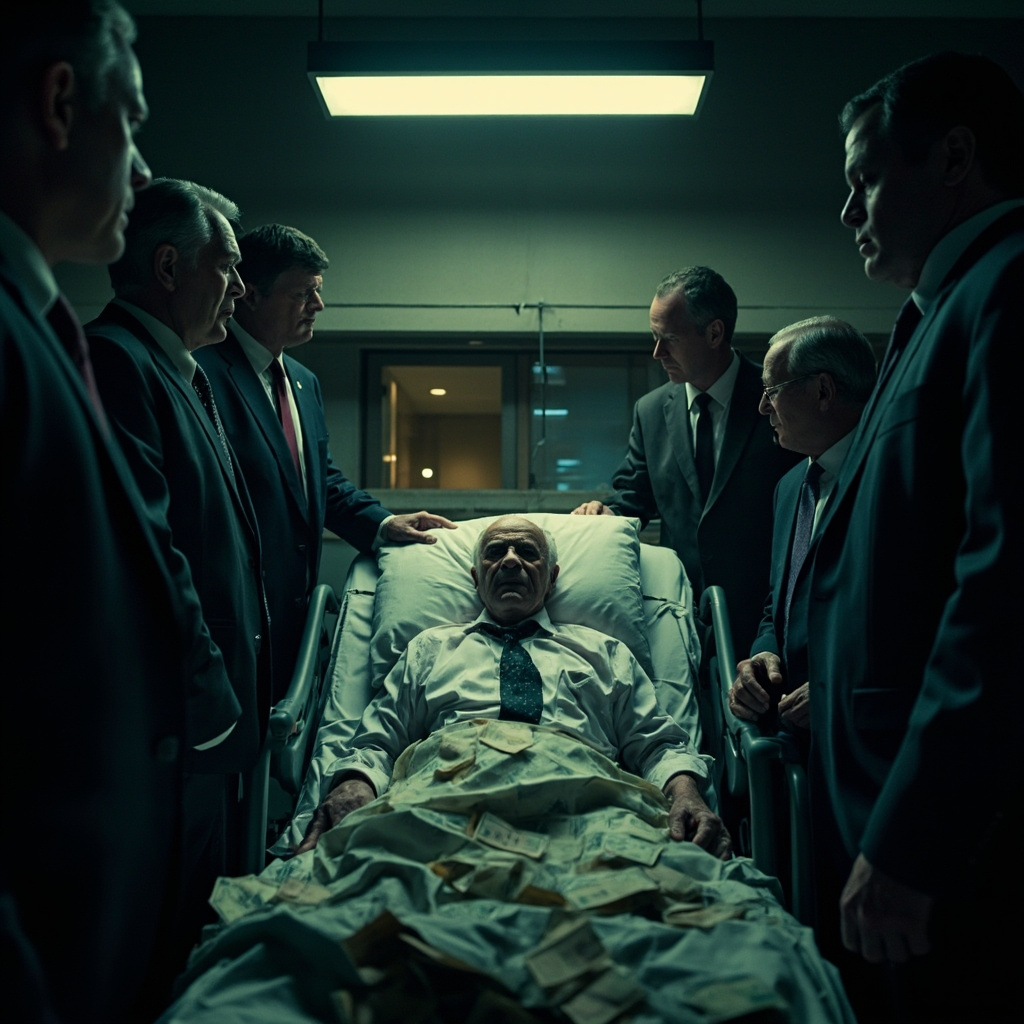
The Billionaire’s Undone Plan
Victor Ashford had built his empire on the ruins of other people’s dreams. Real estate, technology, pharmaceuticals—he had taken whatever he wanted, whenever he wanted, without regard for the consequences. By the time he was sixty, he controlled more of the world’s wealth than most small countries.
But Victor was dying. The doctors gave him eighteen months, maybe less. And as he lay in his private hospital suite, surrounded by machines that kept his body functioning and specialists who kept his secrets, he found himself thinking about legacy.
His children wanted his money. His shareholders wanted his power. His enemies wanted his destruction. No one wanted Victor Ashford himself—and that was the one thing he had never been able to buy.
He had one final plan. A project that would cement his legacy for generations. A venture that would carry his name into the future long after his body had turned to ash.
He called his three children to his bedside and made them an offer. “One billion dollars,” he said. “To whichever of you can produce an heir to my fortune within the next twelve months. The child must be biologically mine—a grandchild I can raise as my own successor. The mother must agree to give up all parental rights. The child will be raised by me, trained by me, prepared to take over when I’m gone.”
His children looked at each other. None of them had children of their own. None of them had ever wanted any.
But one billion dollars was one billion dollars.
Victor had two daughters and one son. The eldest, Catherine, was forty-two and had spent her entire adult life avoiding marriage, children, and any kind of commitment that might limit her independence. She was also secretly dating a woman named Margaret and had no intention of ever getting pregnant.
The middle child, Victoria (so named to avoid confusion, despite the chaos it caused at family gatherings), was thirty-nine and had been married and divorced twice. She wanted children but couldn’t have them—something she had accepted after years of failed treatments and heartbreak. She had no intention of using her ex-husbands’ genetic material to father a child she would never see.
The youngest, Edward, was thirty-six and had been the designated heir since birth—until Victor’s recent decision to open the competition to all his children. Edward had never wanted the responsibility of running an empire. He wanted to paint watercolors and collect antique books. But he also wanted his father’s approval, and he had spent his whole life trying to earn it and failing.
None of them wanted to participate in Victor’s insane competition. But one billion dollars could buy a lot of watercolor supplies.
Catherine was the first to make a move. She approached her father with a proposal: “I’ll find a surrogate mother. I’ll use my own genetic material. I’ll pay for everything myself. All I ask in return is that you leave me alone during the process and don’t interfere with how I choose to raise the child.”
Victor agreed. He was too weak to argue and too desperate to care about the details. Catherine found a surrogate within weeks, began the process, and waited.
Victoria was next. She tried a different approach, approaching Victor with evidence of fraud she had discovered in the company’s accounting systems. “I’ll give you this,” she said, “and in exchange, I’ll be named sole heir. No competition. No children. Just you and me.”
Victor took the evidence and immediately had his lawyers bury it. Then he added a clause to Victoria’s inheritance: she would receive nothing unless she produced a grandchild within the specified timeframe.
Edward tried the direct approach. He announced that he was already married to his longtime partner Michael and that they were in the process of adopting a child. Victor laughed in his face. “Adopted?” he said. “Adopted children don’t carry my blood. They don’t carry my legacy. If you want my money, Edward, you need to give me a real heir.”
Catherine’s surrogate was pregnant with twins—a boy and a girl, both carrying Victor’s genetic material. For a while, it seemed like she had won. Then, at seven months, the surrogate went into early labor.
The girl did not survive. The boy survived but had severe developmental issues that would require lifelong care. Victor, who had been planning to name the twins his heirs, changed his will within a week of their birth. “I won’t leave my empire to a child who can’t run it,” he told Catherine. “Find another surrogate. Try again.”
Catherine refused. The experience had broken something in her—the realization that she was treating pregnancy like a transaction, that she was treating children like products to be manufactured and delivered. She walked away from her father’s offer entirely, leaving the damaged boy in the surrogate’s care with a trust fund that would cover his medical expenses.
Victoria saw an opportunity. If Catherine was out, and Edward was out, she was the only remaining candidate. She approached Victor with a new proposal: “I’ll carry the child myself. Use my own eggs, a donor, and a surrogate. The child will be biologically related to you through the donor, and I’ll raise it as a single mother. You can be as involved as you want.”
Victor agreed. Victoria underwent the procedure, and within three months, she was pregnant with triplets.
Part Five: The Outcome
Victor Ashford died eight months later, surrounded by lawyers and doctors and family members who were all waiting to hear the final terms of his will. The triplets were still in utero, scheduled to be born six weeks early due to complications from the pregnancy.
The will was read aloud in a conference room at Ashford Pharmaceuticals’ headquarters. Victoria sat in the front row, her hand on her swollen belly, already imagining the life she would provide for her children.
Then the lawyer reached the relevant clause and her world collapsed.
“In the event that Victor Ashford’s biological heir is not born within his lifetime, the Ashford fortune will be distributed as follows: forty percent to charity, thirty percent to the employees of Ashford Industries, and thirty percent to a foundation for the study of ethical business practices.”
Victoria stood up. “That’s impossible. I’m pregnant. With triplets. They were supposed to be—”
“Victor changed the terms three months ago,” the lawyer said quietly. “He added a clause requiring that any heir be born while he was still alive. He wanted to see his successor with his own eyes before he died.”
Victor had seen his grandchildren through an ultrasound screen three days before his death. But according to the will, that didn’t count. The triplets received nothing. Victoria received nothing. Edward and Catherine received their small trust funds and nothing more.
The empire Victor had spent his life building went to a foundation that would spend the next fifty years trying to undo everything he had done.
And Victoria, holding her newborn triplets in a hospital room while the news played on a muted television, finally understood what her father had really wanted. He hadn’t wanted heirs. He hadn’t wanted legacy. He had wanted to win—even if winning meant destroying everyone around him, even if winning meant that no one in his family would ever speak to each other again.
The triplets grew up never knowing their grandfather. Their mother raised them in a small apartment, funded by a modest inheritance from their grandmother. They were happy. They were loved. They were free.
And somewhere in the afterlife—if there was such a thing—Victor Ashford was still trying to figure out how he had lost.