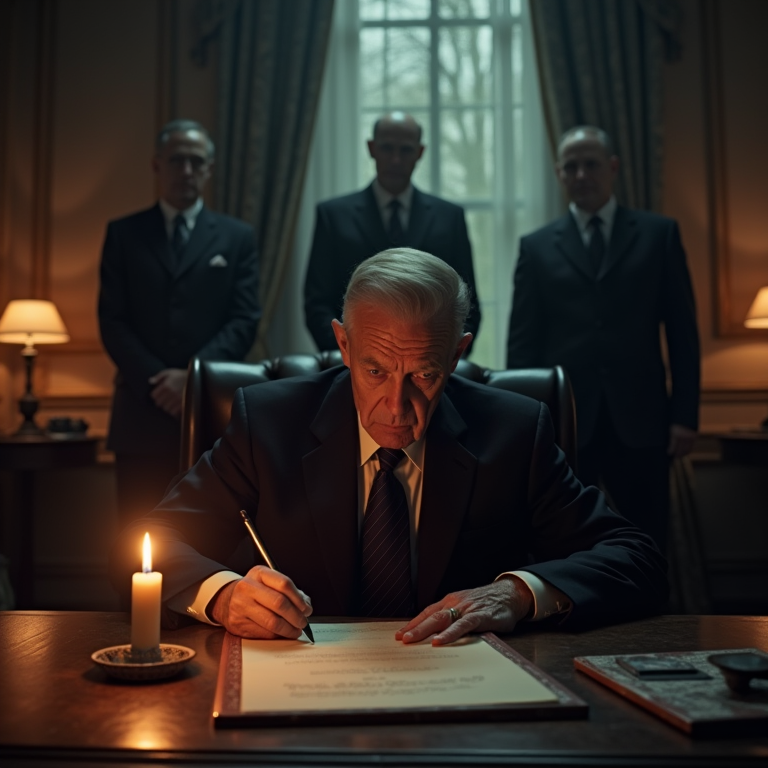
The Billionaire’s Death Pact
Victor Ashworth had three months to live. The doctors had been very clear about this, using words like “aggressive” and “metastatic” and “beyond intervention.” Victor had listened, nodded, and then gone back to his office, where he spent the next twelve hours rewriting his will.
He was seventy-one years old, worth approximately eleven billion dollars, and had spent the last forty years building an empire that controlled everything from shipping to pharmaceuticals to media. He had enemies—in fact, he had made enemies the way other people made friends, deliberately, strategically, and without remorse. When you controlled that much of the world, someone always wanted you dead.
Now someone would get their wish. But not before Victor had a chance to settle a few scores.
Victor had kept a journal for the last thirty years. Not a diary—nothing so sentimental. This was a ledger, a record of every person who had wronged him, every deal that had gone against him, every insult and injury and betrayal. There were forty-seven names in total. Some were dead already. Others were powerful enough to require careful handling.
But three names stood out. The three men who had destroyed his only son.
Marcus, his business partner of twenty years, who had embezzled three hundred million dollars and framed young Thomas for the crime. Thomas had died in prison, still protesting his innocence, still believing his father would save him. Victor had been in a meeting when the call came. He hadn’t canceled the meeting. He’d finished the meeting, then flown to his son’s funeral three days late.
Richard, the prosecutor who had buried the evidence and let Marcus walk free. Richard was now a senator, untouchable, riding the wave of his wrongful conviction rate into a political career built on the bones of the innocent.
And Elizabeth, the judge who had thrown out the final appeal. Elizabeth had been Marcus’s lover at the time. She was now the Chief Justice of the State Supreme Court.
Victor spent his remaining months setting events in motion. He liquidated assets, moved money through offshore accounts, and created a series of trusts and foundations that would outlive him by decades. He hired the best investigators, the best lawyers, and the best assassins money could buy—which was saying something, given how much money he had.
But that wasn’t enough. Victor wanted more than their deaths. He wanted them to suffer. He wanted them to lose everything the way his son had lost everything—reputation, freedom, dignity, life itself. He wanted them to know, in their final moments, that this was happening because of what they had done to Thomas Ashworth.
So he created the Death Pact. Three sealed envelopes, each containing evidence of the crimes his three targets had committed. Each envelope was programmed to open automatically upon his death, releasing its contents to the FBI, the press, and the public simultaneously. No escape. No deal. No way out.
The first to die was Marcus. He choked on a grape at a charity gala six weeks after Victor’s death—perfectly timed, perfectly executed, the grape precisely calibrated to block his airway without anyone suspecting foul play. His empire collapsed within days as Victor’s evidence was released, and he died a pauper, hated by everyone he had ever known.
Richard lasted eight weeks. He was found in his office, surrounded by evidence of his crimes, a glass of whiskey in his hand and a bullet in his brain. The suicide note he left was in his own handwriting, confessing to everything, though Victor’s people had written it for him. The evidence was too damning for anyone to question the verdict.
Elizabeth was last. She saw what had happened to the others. She knew she was next. She tried to flee, tried to hide, tried to use her connections to find Victor’s people and offer them more money than Victor had paid. But Victor had anticipated this. The investigators he hired were not motivated by money. They were motivated by something much more reliable: justice delayed, justice denied, justice that had waited forty years for this moment.
Elizabeth was found in her chambers on the day of her retirement party, surrounded by her family, by her colleagues, by the people who had celebrated her career. She died with a smile on her face and a needle in her arm—the same combination of drugs that had been used to execute the death penalty in her state for decades. The autopsy ruled it natural causes, brought on by the stress of recent events.
Victor had won. His son had been avenged. The men and women who had destroyed Thomas Ashworth had paid with their lives, their reputations, everything they had built on his son’s corpse.
But Victor had not been alive to see it. He had died three months after his diagnosis, in his bed, alone, surrounded by nothing but his money and his hate. His lawyers found him with a smile on his face and a copy of his son’s prison letter in his hand—the last letter Thomas had written, the one Victor had never answered because he had been too busy with a meeting.
The letter said: “I know you will save me, Father. You always do.”
Victor had not saved him. But he had, in his own twisted way, made sure that someone else would pay. Whether that was justice or simply another kind of crime, Victor had not stayed around long enough to decide.