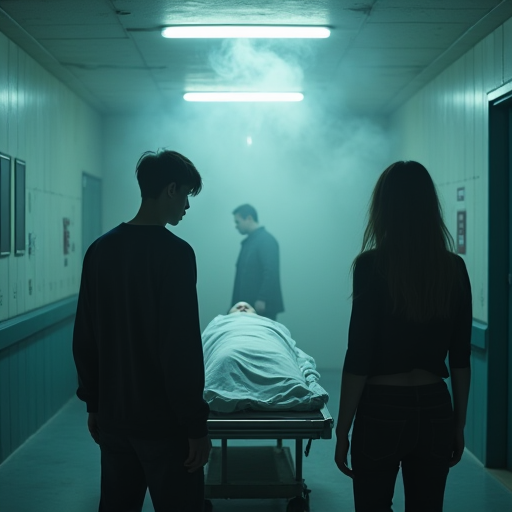
Ghost Corridor Unit 2: The Dead Before Death
It was the autopsy summary.
She got it through means that would have sounded less respectable if described plainly, but grief has always had a flexible relationship with procedure. As class representative, she still had access to just enough administrative goodwill to ask questions people thought she was emotionally entitled to ask. What she got back was not consolation.
It was contradiction.
The report stated, in the careful bloodless language of institutional self-protection, that Adrian’s body had decomposed far beyond what should have been possible in the time since the accident. Refrigeration had functioned properly. Storage conditions were normal. Yet the corpse had shown deterioration more consistent with a body dead for at least a week.
A week.
Claire read that line three times before the words arranged themselves into meaning.
Then she folded the report and went looking for Evan.
He found her instead, standing outside the dormitory stairs with the paper in both hands as if it might bite.
“What happened?” he asked.
She handed it over.
He read in silence.
His expression did not change much at first. That was one of the things Claire had already begun to dislike and depend on in equal measure—Evan did not dramatize fear. He absorbed it, turned it over, and only then let it alter him.
By the second page, his jaw had tightened.
By the last line, he looked up at her and said quietly, “This doesn’t prove Adrian was murdered.”
Claire stared at him.
“You’re saying that’s the reassuring interpretation?”
“No,” Evan said. “I’m saying it proves the accident wasn’t the beginning.”
That was worse.
Much worse.
Because murder was still linear. Human. Contained. This suggested something else entirely—that Adrian’s body had been obeying a different clock from the one the rest of them had been living by.
Claire lowered her voice.
“So what do we do?”
Evan folded the report once more, too neatly.
“We go see the body.”
⸻
The morgue sat at the edge of the city’s mortuary complex, which was exactly as cheerful as it sounds.
White corridors. White walls. White light so clean and bright it made every living person inside seem already a little ghostlike. The place smelled of disinfectant, overworked refrigeration, and something older sitting beneath both—something like damp paper and hidden rot.
Claire hated it immediately.
Evan disliked it for more practical reasons. Institutions that handled death professionally tended to arrange access around hierarchy, and hierarchy bored him unless it obstructed him directly.
Today it did.
They spent too long talking first to a clerk, then to a manager, then to a police liaison whose expression suggested he had not expected two undergraduates to show up asking questions about decomposition. In the end it was not compassion that got them inside, but irritation. People often surrender information faster when they are tired than when they are kind.
The morgue attendant who finally led them down the hall looked annoyed from the neck down and profoundly uneasy from the eyes up.
“That one,” he said, stopping outside a side chamber. “No one likes being near that one.”
Claire’s stomach dropped.
“What do you mean?”
The man hesitated.
Then, seeing no advantage in pretending professionalism any longer, he said, “Bodies don’t rot like that. Not here.”
He opened the door and stepped aside.
The room beyond was colder than anything on the surface ought to be.
At the center stood a single gurney beneath a white sheet. Around it, faint yellow-white crusts stained the floor where fluids had leaked, dried, and been only partially cleaned away. The smell hit Claire before the sight did—a heavy chemical attempt to suppress corruption that had not quite succeeded.
For one moment she thought she might faint.
Evan reached the body first.
He did not fully uncover it, only enough.
A hand. The side of the face. The shoulder line.
That was enough.
Claire turned away immediately.
Not because she couldn’t bear corpses. She had already borne more than she thought she could. But because what lay under the sheet no longer looked like Adrian in any morally acceptable sense. He looked reduced. Deflated. A young body gone prematurely dry in places and swollen in others, as though something had hurried decomposition unevenly through him.
“Jesus,” Claire whispered.
The attendant, still near the doorway, muttered, “Exactly.”
Evan kept looking.
That frightened her more than the body itself.
He wasn’t fascinated. He was comparing.
She knew that expression by then.
Comparing the report to the flesh.
Comparing the traffic accident to the body in front of him.
Comparing the memory of Adrian smiling at the crosswalk to this thing half-spoiled on a slab.
Finally he covered the corpse again.
Then he did something Claire would later remember far more vividly than the body itself.
He took three incense sticks from his coat.
The attendant stared at him. “You can’t light things in here.”
“I know,” Evan said. “That’s why you’re going to stand at the door and not notice for thirty seconds.”
The man opened his mouth, considered the room, considered the body, and then looked away.
That was effectively permission.
Evan lit the incense with a lighter he always carried and held the sticks upright before the covered body.
He did not chant.
He only said, under his breath, “If you were wronged, show it.”
The smoke rose.
Claire leaned forward despite herself.
If Adrian had died unjustly—if the dead held grievance in the old way Evan’s teacher claimed, if the body carried the rage of a soul unwilling to pass—then the smoke should bend.
It should turn.
It should pull.
Instead it went straight up.
Perfectly straight.
Not trembling. Not veering. Not a single coil slanting toward accusation.
Claire felt cold all through.
“What does that mean?” she asked.
Evan pinched the incense out and pocketed the ash before answering.
“It means,” he said, “Adrian isn’t staying because he was murdered.”
That should not have been the answer she least wanted.
But it was.
⸻
Outside, in the mortuary courtyard, Claire finally asked the question that had been growing in her since the report.
“If he wasn’t wronged, then why did he rot like that?”
Evan looked toward the far wall where sparse winter grass moved in the wind.
“I don’t know yet,” he said. “But the smoke tells us something important.”
“That we’re looking in the wrong direction?”
“That Adrian’s death wasn’t only an event. It was part of a process.”
Claire hated that phrase.
Part of a process.
It sounded like systems, patterns, machinery—all the cold impersonal things people use to make horror less emotional and somehow even worse.
She pulled the folded report from her bag again.
“There’s something else.”
He waited.
“The police liaison said he wanted to speak to us.”
Evan grimaced. “Of course he does.”
The police officer—Detective Superintendent Hale Carter, thick-waisted, expensively tired, with the cultivated friendliness of a man who considered every conversation a negotiation—received them in a side office that smelled of tobacco, stale air conditioning, and opportunism.
He was sweating lightly.
Not from weather.
From ambition.
That became obvious almost immediately.
He had no interest in comforting students. He wanted leverage. A case this strange, if solved, would travel upward through the chain of command very nicely.
“I won’t waste your time,” Carter said, smiling too much. “Your friend’s body doesn’t match his official time of death. That’s not a normal traffic fatality. So I’m asking you directly—did Adrian Wynn act strangely in the week before he died?”
Claire said nothing.
Evan did not.
Carter leaned forward.
“Did he stop eating? Sleepwalk? Disappear at odd hours? Speak to himself? Receive threats?”
That was too close to random.
Claire glanced at Evan.
He answered carefully. “People act strangely before exams all the time.”
Carter’s smile thinned.
“Mr. Cross, this is not a game.”
“No,” Evan said. “If it were, it would be a badly written one.”
Claire nearly kicked him under the desk.
To her surprise, Carter didn’t flare.
He only nodded and changed approach.
“Then let me make this easier. We have a dead student who appears to have been biologically older in death than he was legally allowed to be. If you know anything about what he was doing before the accident, now is the time.”
This time Claire spoke.
“Why do you care so much?”
That amused him.
“Because if this becomes an ordinary traffic case, it dies here. If it becomes something stranger, it moves.” He spread his hands slightly. “And I’m not a man who enjoys letting useful mysteries go stale.”
There it was.
Not duty.
Career.
Claire felt suddenly disgusted.
Evan felt something else.
Opportunity.
He asked one last question on the way out:
“Has anyone else said the body looked wrong before the autopsy?”
Carter answered after a pause. “One of the mortuary workers.”
That was enough.
⸻
They found the worker behind the service wing arguing with a groundsman about cut grass.
He was exactly the sort of man institutions quietly depend on and never publicly credit—middle-aged, practical, carrying more experience in his shoulders than in his title. Once he understood that Claire and Evan were Adrian’s classmates, his resistance softened into the fatal vanity of specialists invited to explain what others had overlooked.
“I’ve handled road fatalities for fifteen years,” he said. “Fresh ones. Bad ones. Torn apart ones. Your friend didn’t smell like any of them.”
Claire went still.
“How did he smell?”
The man glanced around once before lowering his voice.
“Old. Not old in the ordinary way. Not putrid exactly either. More like…” He searched for it. “Like blood that had already stopped being blood before it came out.”
That matched too much.
Too much of the scene at the crosswalk.
Too much of the report.
Too much of the body under the sheet.
Evan pressed once more. “Then in your opinion, he didn’t die when we saw him hit?”
The man made a face.
“In my opinion, whatever was under that truck had already started leaving long before the wheels got there.”
Claire thought of Adrian smiling at her just before stepping forward.
She did not say so.
Not there.
Not aloud.
Because once you let a sentence like that into open air, it changes the weather around you.
⸻
They left the mortuary with less than they needed and more than they wanted.
By the time they got back to campus, evening had already started folding itself over the buildings. Students crossed the quadrangle in loose groups, bags on shoulders, coffees in hand, ordinary life moving with the offensive confidence of people not yet aware that one of their dead had become temporally unreliable.
Claire stopped under the dorm lights.
“So what now?”
Evan looked toward the western edge of campus.
“Now we test Leo’s lie.”
She knew at once which one.
East Lake.
Leo Grant’s story about slipping into it by accident had bothered Evan from the start. Not just because he’d returned drenched on the wake night, but because his explanation had the texture of something assembled under pressure—too quick, too reasonable, too eager to redirect.
If Adrian had begun “leaving” before the accident, and if Leo had fled the wake only to come back soaked with straw in his hair…
Then East Lake was not peripheral.
It was connected.
Claire looked at him.
“You think he went there because Adrian sent him.”
Evan did not answer immediately.
Then:
“I think Adrian wanted something retrieved.”
That was enough to make the cold return to her hands.
Because if the dead had started using the living before the living even agreed they were dead, then the school was already further gone than either of them had admitted.
And East Lake, waiting quietly in the dark beyond the buildings, had just become the next place they would have to ask the wrong questions.