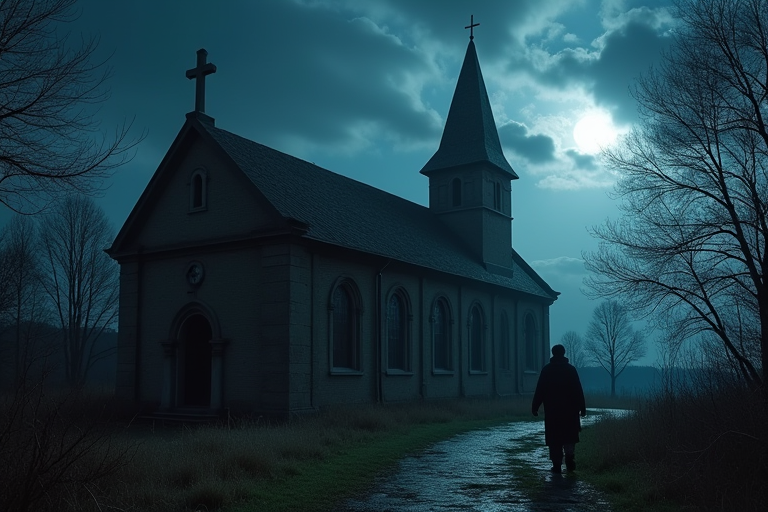
A Meeting at the Church
My name is Harold Brennan, and I am seventy-four years old. I have never considered myself a violent man. I spent the better part of my life volunteering at shelters, attending Sunday service, and trying to live by the principles my mother taught me. I say all this not to paint myself as a saint — I am far from it, as you will soon understand — but because I need you to know who I am before I tell you what happened the night I crossed paths with a man who called himself THE LIGHT.
I encountered him in January, roughly two months ago. It was a Tuesday, I remember that much, because I had just come from my weekly shift at the food kitchen on Mercer Street and was heading toward the bus stop. The city was cold and grey in the way it gets in mid-winter. I had my coat pulled tight and my head down, and I nearly walked right past him.
He was standing on an overturned crate.
There was a crowd gathered around him, larger than you would expect for that time of morning. Perhaps thirty people. Perhaps more. They stood in close formation, and they were quiet — which is what finally made me stop. You do not often see thirty people standing silent on a city sidewalk.
He was young. Young in a way that made his appearance all the more unsettling, because his body had clearly been through something that bodies should not have to endure. He had no hair at all — not on his head, not where his eyebrows should have been. His face was gaunt, the skin stretched too tight over the bones beneath it. He was thin in a way that brought to mind photographs I had seen of famine. Cancer was my first thought. This young man is dying of cancer. And yet there was something in the way he stood on that crate, something in the set of his shoulders and the steadiness of his voice, that made him seem larger than his wasted frame had any right to convey.
He was speaking about evil. About the way it was seeping into the world through the cracks that people did not think to watch. He said he had the answer. He said he had been given the means to drive it out.
As he spoke, he passed small slips of paper to the people at the front of the crowd, each one bearing a phone number. But what made my stomach tighten was what happened each time someone stepped forward to take one. He would look at them. Just look, for no more than a second or two. And then he would speak.
He told a heavyset woman in a yellow jacket that she had let her sister take the blame for a fire that the woman herself had started when she was nine years old. The sister had been beaten for it. The woman’s face went the color of ash.
He told a young man in a delivery uniform that he had been stealing money from his elderly employer for the better part of three years. The young man stepped back as if he had been pushed.
He forgave them each, after he spoke. He said the words plainly, without drama, and moved on to the next person. But the crowd around him had begun to shift. Some of the people who had not yet stepped forward were backing away slowly, the way you back away from something you are not certain is dangerous but are not willing to test. Others watched him with wide, flat eyes. Not the eyes of believers. The eyes of people who have just witnessed something they cannot explain and are not sure whether to call it a miracle or a threat.
I watched all of this and told myself it was a trick. I have seen men like this before — mentalists, cold readers, men who make a living studying human behavior closely enough to give the impression of something supernatural. The people he was exposing were almost certainly plants, I decided. Hired in advance to make the performance convincing.
I am a devout man of faith. I have been my entire life. I have read my Bible, attended my church, and tried to live by what I believe. And because of that, I will admit, I thought myself reasonably clean. I have not been a perfect man. But I have not done great harm. The minor transgressions of a long life felt like nothing I would need to be ashamed of before a crowd of strangers.
So I stepped forward.
THE LIGHT stopped speaking mid-sentence. He looked at me, and something in his expression shifted. Not surprise, exactly. More like recognition.
“This,” he said to the crowd, “is the man I came here for. This is why I am standing on this corner today.”
He said my name. He said it without having been told.
He told the crowd that I was a good man. That I had spent my life in the service of others and had kept myself, on the whole, remarkably clean. He said it with what sounded like genuine warmth. And then he paused, just briefly, and told them that my one great sin — the one that had cost me the oldest friendship of my life — was that I had stolen my best friend’s girl in high school.
The air went out of me.
My wife, Eleanor. Fifty-two years of marriage. She passed in October, just a few months before all of this. And it was true, every word of it. She had been Thomas Whitaker’s girl first, or at least Thomas had believed that. He had talked about her for months before I ever spoke to her myself. And then I had spoken to her, and that had been that. Thomas never spoke to me again. I had told myself for fifty years that I had not done anything wrong, that hearts could not be assigned like property. But I had known, somewhere underneath all of that reasoning, what I had done to him.
I asked THE LIGHT how he knew that.
He told me — and the crowd — that God had given him the power to find any truth. That his mission was divine. That he had been sent to prepare the world for the second coming of Christ, and that the truths he carried were the tools God had placed in his hands for that purpose. THE LIGHT was a name placed unto him by the divine hand of God, and it stood for The Lord’s Instrument of Grace.
I took one of the slips of paper. I did it almost without deciding to, the way you sometimes do things that your hands have already agreed to before your mind catches up.
Walking to the bus stop afterward, I told myself it was blasphemy. That this young dying man was either deeply deluded or something worse. That if any power was working through him, it was not a power I wanted to be close to. I folded the slip of paper and put it in my coat pocket and told myself I would throw it away when I got home.
I did not throw it away.
That night, past ten o’clock, I was sitting in the chair by the window that used to be Eleanor’s chair. The apartment was quiet in the way it had been quiet every night since October. I took the slip of paper out of my coat pocket and looked at the number on it for a long time.
I called.
He answered before the second ring, as if he had been sitting with the phone in his hand.
He said he was glad I called. He said that a man who had lived as clean a life as mine was rare, and that he needed people like me. That the work ahead would not be easy. That evil was real, and it was growing, and the only way to fight it was with truth.