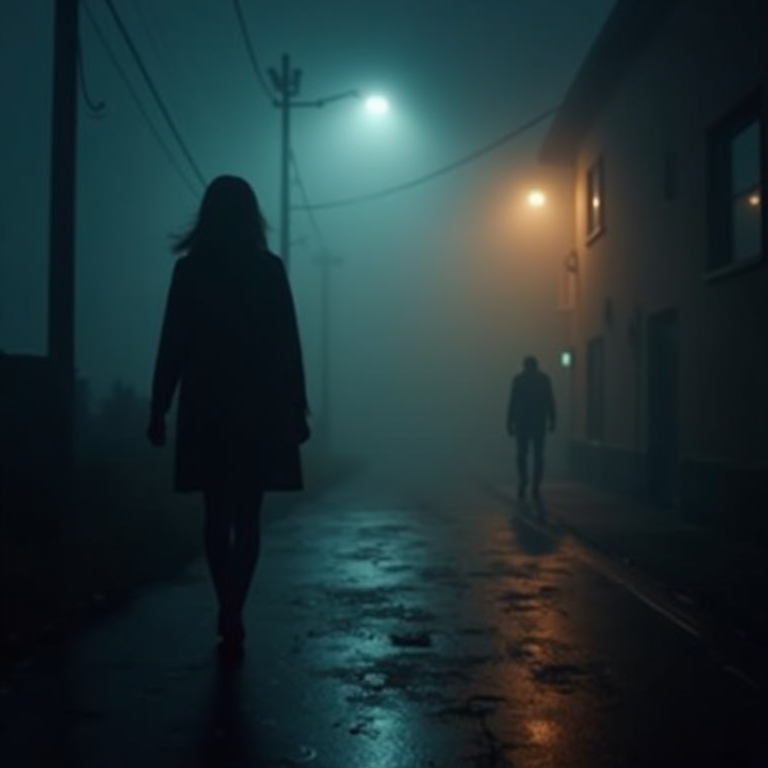
The Witness Who Vanished
The Witness Who Vanished
The lights in the corridor went out at the exact moment Marcus turned off his phone. He stood behind the iron door of the twelfth-floor fire escape, listening to the sound of his own heart slamming against his ribs.
Five minutes earlier, in the underground parking garage, he had received a message from an unknown number: “Don’t go home. She’s already inside.” No signature, no timestamp—just a photograph showing the full view of his apartment living room, the red throw pillow on the sofa positioned exactly where the one in his hand was from the same set.
He recognized that table, of course—the walnut coffee table, the floor lamp that cast its warm yellow glow in the evening. But the photo’s timestamp showed it was taken two hours ago. Which meant that while he was driving to work after leaving home, someone had been inside his apartment taking pictures.
The elevator stopped at the eleventh floor. The metallic door sound filtering through the fire door was crisp, like a signal. Marcus held his breath and pressed himself against the wall to listen downstairs. Heavy footsteps—not one person. Two, maybe three. The rhythm of dress shoes striking the terrazzo floor was uneven, carrying a certain casual nonchalance.
He didn’t recognize these people, but he knew why they were here—three months ago, there had been a commercial leak case involving him and his competitor, Mr. Chen, in a port expansion project they had both participated in. The police had closed the case. Everyone said it was a technical malfunction causing server data loss. Marcus had signed a settlement agreement, taken the compensation, thinking the matter was over.
Until three days ago, when he found a notebook at the bottom of his own drawer that didn’t belong to him. Blue hardcover, no writing inside, only a folded note with a name and phone number on it. The name was Rachel. His ex-wife.
The footsteps stopped. Someone was pressing the floor buttons. Tenth floor. Ninth. Eighth. Marcus counted, his fingers unconsciously tightening around the Swiss Army knife in his pocket. This wasn’t his first time facing danger, but every time felt like the first—the fear didn’t lessen just because he grew accustomed to it.
The elevator continued descending. Third floor. Then a soft click, like something had been activated. All the emergency lights in the building suddenly turned on, their cold white light pouring down from the ceiling, illuminating the entire corridor like a hospital operating room. Marcus instinctively retreated into the shadows, but it was too late. The sound of a key turning came from behind the iron door.
When he climbed out through the side window, his elbow scraped against the wall and bled. Rain struck his face, icy and sharp. This was a narrow alley in the old district, flanked by towering residential buildings, clotheslines hanging with yesterday’s laundry still dripping.
He ran desperately through the alley, his shoe soles splashing through puddles. After about two hundred meters, he turned into a dead end. Walls on all sides, the highest covered in dead ivy. He didn’t look back, but he knew his escape route was sealed. The sound of a car engine roared from the alley entrance, headlights sweeping across every inch of the ground.
“Marcus.” A woman’s voice came from the alley entrance, clear, calm, even with a hint of tenderness. “Don’t be afraid. I won’t hurt you.”
He recognized that voice. Rachel. Their divorce had been finalized two years and four months ago. He never expected to hear her speak again in a scene like this.
The light illuminated her silhouette—black windbreaker, white turtleneck sweater, hair shorter than two years ago, making her look sharper and more fragile at the same time. Three people stood before her—one was a middle-aged man in police uniform, the other two in suits that gave him an inexplicable sense of familiarity.
“You’ve been lying to me this whole time.” Rachel took a step forward, her high heels clicking on the cement. “What happened three months ago wasn’t an accident. You did it.”
Marcus opened his mouth, wanting to say something, but only a breath of air came from his throat. Rachel pulled out a voice recorder from her pocket and pressed play. His own voice came from the speaker, low and calm, as if discussing the weather: “I’ve already cleared the server logs. No one can trace this back to us.”
That was his voice, word for word. But he absolutely had never said those words.
“It wasn’t me.” He finally squeezed out three words. Rachel’s expression didn’t change, but her fingers trembled slightly. The middle-aged man in police uniform stepped forward, extending his hand: “Marcus, come with us. This matter is far more complicated than you think.”
At the instant his hand was about to touch Marcus’s shoulder, every light in the alley went out simultaneously. This time it wasn’t a fire or a power failure—something more thorough. The entire city fell into darkness. The distant skyline disappeared, nearby buildings becoming black silhouettes.
In the darkness, flashlight beams from mobile phones rose and swayed, pointing in different directions. Marcus saw six figures, not four. Two more.
“Run.” Rachel said. Not a request. A command. When these two words left her mouth, her tone was exactly the same as every time she used to催促 him to pay off his credit card bill. Marcus laughed—it was the first time he smiled tonight.
He charged toward the direction he came from, footsteps of pursuers behind him, mixed with fragmented conversations in multiple languages and the sound of gun bolts being pulled back. He remembered there was a twenty-four-hour convenience store at the end of this alley, the owner was an old man named Zhou who liked listening to storytelling shows while playing chess. If he was still there now, that was hope. If he wasn’t—
Marcus didn’t let himself think about it. He just ran, with everything he had, his lungs burning like two pieces of scorched iron in his chest. A point of light appeared ahead—yellow, warm. The convenience store sign was still on, the promotional posters on the glass door rustling in the wind.
When he pushed the door open, the bell jingled. The old man sat behind the counter, looked up, his expression calm as if waiting for a customer with an appointment.
“Good to see you,” he said, then pushed the shelf behind him aside. Behind it was a passage leading to the kitchen, and beyond that, to another street.
Marcus didn’t have time to ask any questions. He had already learned to stop asking.