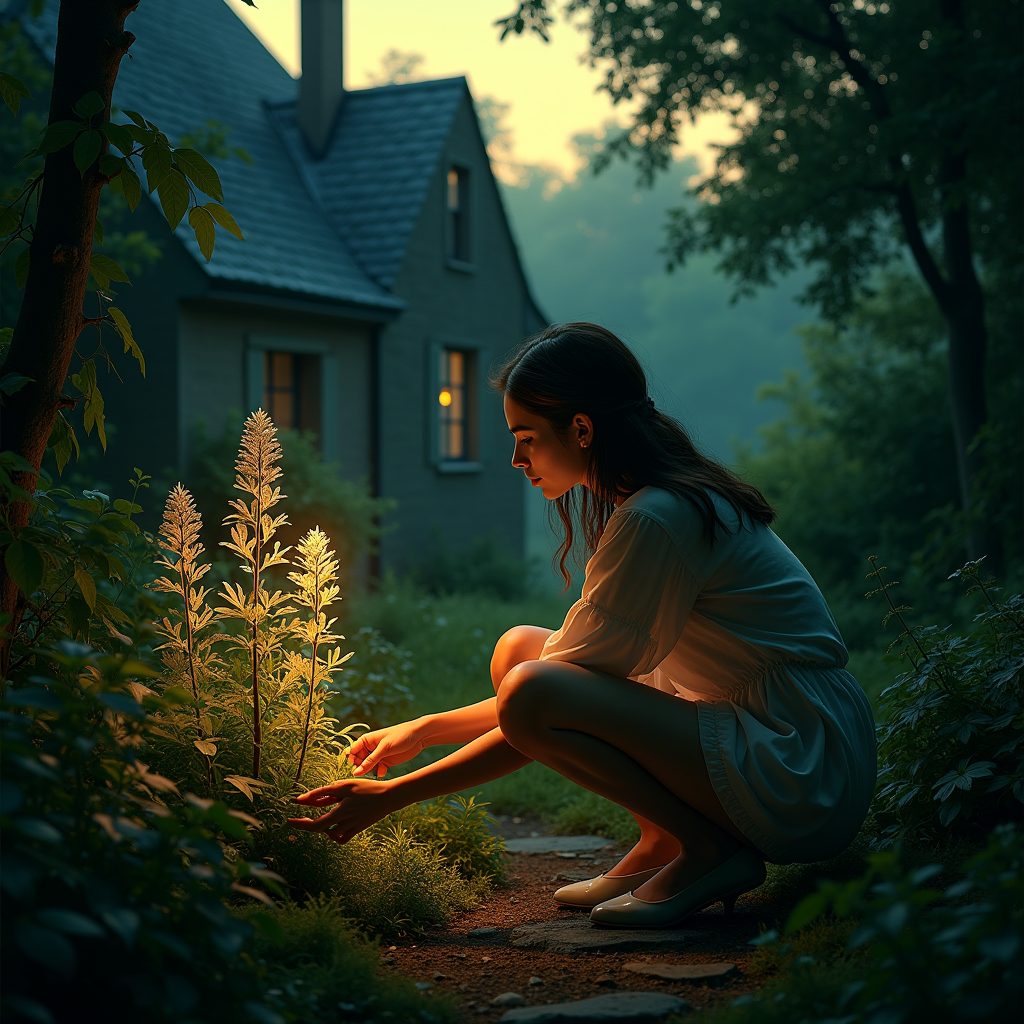
The Garden That Remembered Her Name
The garden had been her grandmother’s, and her grandmother’s before that, and it had been in the family for one hundred and twelve years, and it had always grown the same things — tomatoes, peppers, herbs, a row of sunflowers along the southern wall — and it had always been productive, and it had always been healthy, and it had never, in one hundred and twelve years, produced anything that was not supposed to be there, until the summer that Claire came home.
Claire had left for graduate school in California eight years prior and had not returned for longer than a weekend, and she had not missed the garden, specifically, because she had not been someone who paid much attention to it when she lived at home — she had been a child who preferred books to vegetables — but she had missed the feeling of the garden, which was the feeling of being known by something that did not require anything from her in return. The garden had never asked her to be different. It had simply grown, year after year, in the same plot of earth, in the same climate, with the same sun and the same rain, and it had been there, and she had been part of it, and she had not thought about what that meant until she received the call that her grandmother was ill and that she should come home.
She came home. She found the garden overgrown — not abandoned, exactly, but not tended with the precision that her grandmother had always brought to it — and she spent the first week pulling weeds and watering the tomatoes and talking to her grandmother, who was in the hospital and who was not lucid and who said things that Claire could not understand and that the doctors explained as the disorientation of advanced illness. Claire tended the garden anyway. She did not know what else to do. She had come home to say goodbye, and she did not know how to say goodbye, and the garden was something she knew how to tend, and so she tended it, in the mornings before she visited the hospital and in the evenings after she left.
On the third week, she found the plant that was not supposed to be there. It was growing in the corner of the garden, in the space between the herb bed and the southern wall, in a location that had been empty, as far as Claire knew, for her entire life. It was not a tomato. It was not a pepper. It was not a sunflower. It was a plant she did not recognize — with dark green leaves and a stem that was almost black and flowers that were the color of old silver and that faced, always, toward the house. She had not planted it. Her grandmother, when lucid, had not acknowledged planting it. The neighbor, who had been tending the garden in Claire’s absence, had not seen it grow.
The plant grew quickly. Within a week it was taller than Claire. Within two weeks it was producing fruit — small, dark, pear-shaped fruit that smelled like nothing she could identify. She did not eat the fruit. She did not touch it. She watched it grow and she visited her grandmother and she reported, each evening, on the garden’s progress, and her grandmother, when lucid, listened and nodded and did not ask questions, and when not lucid, said things that Claire could not understand and that she chose, increasingly, not to interpret.
Her grandmother died on a Sunday in August. Claire was with her. The garden was producing, at that moment, its largest harvest of the dark fruit — more than Claire could use, more than she could give away, more than seemed reasonable for a plant that should not have existed. She stood in the garden on the morning after the funeral, looking at the plant, and she understood, without being able to articulate why, that the plant was not a plant in the ordinary sense. It was something her grandmother had left behind. It was something her grandmother had been growing for a very long time, in the way that a garden grows — slowly, patiently, toward the person who will eventually harvest it.
She ate the fruit for the first time on the anniversary of her grandmother’s death. It tasted like sunlight, and like water, and like the specific combination of soil and air and time that makes a place different from every other place. It tasted like her grandmother’s voice. It tasted like the garden remembering her name.
She planted the seeds, the following spring, in the same corner where the original plant had grown. They grew. They produced fruit. She ate the fruit, and she planted more seeds, and she tended the garden, and she stayed — not because she had decided to stay, but because she understood, in the way that gardeners understand things that cannot be explained, that the garden had been waiting for her, specifically, and that she was the person who would keep it, and that keeping it was a form of remembering, and that remembering was a form of love, and that love was the thing that made things grow in places where they were not supposed to, and that it was also the thing that made people stay.