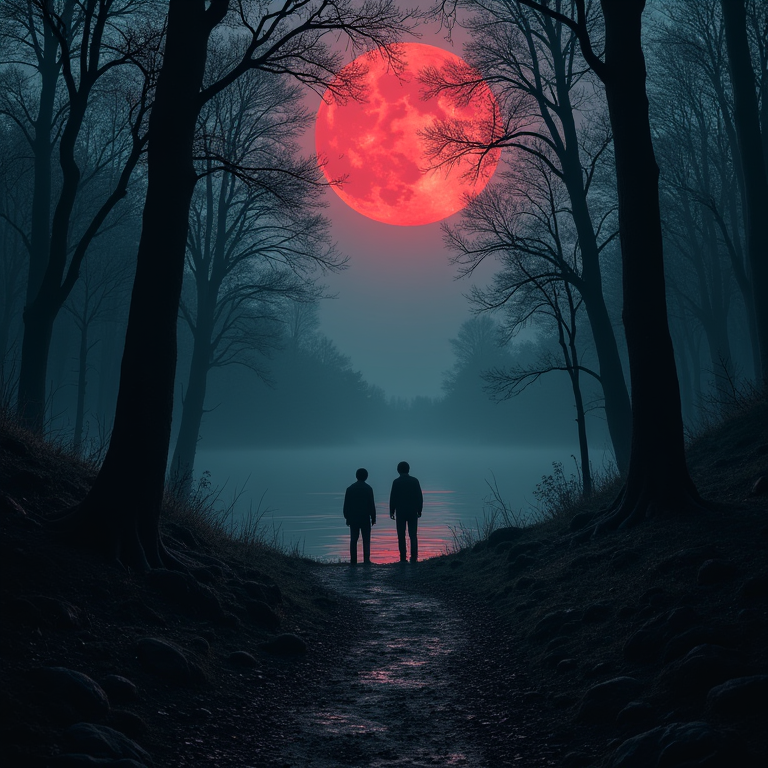
Roses in the Moonlight
The estate clung to the hill like a wound stitched with iron and stone. Its windows, dark as the eyes of a dead saint, stared out at the world with a vacant indifference that made the surrounding pine forest seem merely a shadow of itself. Clara had inherited it from a great‑aunt she had never met, a woman whose name was spoken in hushed tones at family gatherings and whose obituary read like a page torn from a gothic novella. The greenhouse stood at the far end of the garden, a glass cathedral of twisted iron arches and clouded panes, its silhouette a black silhouette against the pale moonlight.
She arrived at dusk, the wind sighing through the barren oaks as if mourning an old sorrow. The house, a sprawling manor of crumbling brick and ivy, smelled of damp wood and something sweeter—roses, perhaps, though none were visible. The realtor had warned her that the greenhouse had been sealed for decades, its doors rusted shut, its interior a secret known only to the family’s oldest members. Yet the key, a silver relic etched with the same rose motif that adorned the house’s iron gates, had been slipped into Clara’s palm by a solicitor who refused to meet her gaze.
The lock gave a reluctant click, and the doors swung open as if the structure itself were exhaling a long‑forgotten breath. Inside, the air was thick with the scent of earth and decay, the light from the waning moon filtering through the cracked glass like shards of pale lace. Iron trellises twisted upward, bearing wilted vines that clung to the metal like the dead arms of a forgotten choir. At the centre, a stone pedestal held a single, blackened pot—its surface etched with the same rose motif as the key.
Clara’s fingers brushed the cold stone of the pedestal, and a thin slab at its base shifted, revealing a hidden compartment. Inside, wrapped in a ribbon of faded silk, lay a bundle of letters bound together with a fragile knot. She unfolded the first, the parchment crackling under her touch, and the ink—a deep, viscous black—spelled out words that seemed to bleed onto the page:
*My beloved,
If the world could see the truth of what we share, it would rend the very vines that bind us. Yet my heart is a rose that blooms only in darkness, and I cannot let the light of day reveal its thorns. I write to you from the greenhouse at midnight, where the roses know our secret and keep it safe.*
The signature at the bottom was simply “E.”
Clara’s breath caught. The letters spanned years, their tone oscillating between desperate yearning and a quiet, resigned acceptance of fate. Each entry recounted clandestine meetings behind the greenhouse’s iron doors, the rustle of silk against stone, the whispered promises of a future that could never be. The letters spoke of a love forbidden by bloodlines and wealth, a romance between a woman of the manor—her great‑aunt Edith—and a man named Marius, a gardener from the village whose hands were calloused from the earth and whose eyes held a haunted brightness.
The revelation unfolded like a rose blooming at midnight: Edith and Marius had been wed in secret, their union witnessed only by the moon and the roses that grew in that glass sanctuary. The letters hinted at a child born of their union, a child hidden away to protect the family’s reputation. But beneath the tenderness lay a darker secret—a pact sealed in blood. According to one letter, Edith’s mother, the matriarch of the estate, had discovered the affair and, fearing scandal, had demanded a price: the life of Marius. The letter described a night when the greenhouse doors were locked, the air filled with the perfume of roses that seemed to pulse like a heartbeat, and a blade that sang through the darkness.
*“The roses drink the blood of those who betray them,”* Edith wrote. *“And in their bloom we bind forever the truth of our love. If ever the secret be spoken, the vines will tighten, the glass will shatter, and the night will swallow us whole.”*
Clara felt the weight of the words settle like a stone in her chest. The greenhouse, then, was not merely a garden—it was a tomb, a memorial, a living altar to a love that defied death. The roses that would bloom only at midnight were the very thorns that held the pact, their crimson petals blackened by the blood that had been spilled to keep the secret.
As she read, a sound echoed through the glass walls—a soft footfall, barely audible, like the whisper of silk on stone. She turned, her heart hammering against her ribs, and saw a figure standing in the shadows of the far archway. He was tall, his silhouette rendered in charcoal and moonlight, his face half‑obscured by a high collar that seemed to drink the light. His eyes, pale as the roses that would soon bloom, stared at Clara with an intensity that seemed to reach into the very core of her being.
“Who are you?” Clara whispered, her voice trembling.
The man stepped forward, and the scent of roses intensified, enveloping her like a lover’s breath. “Marius,” he said, his voice low, resonant with centuries of longing. “I have waited for someone who could hear the roses and understand the silence that binds them.”
Clara’s mind raced. She had read his name in the letters, felt his presence in the ink, but she had never imagined him standing before her, alive in the very place where his love had been buried. “You’re a ghost,” she said, more as an accusation than a question.
“A ghost only as far as the world can see,” he replied. “The pact binds my soul to the roses, to the midnight bloom that is both my curse and my salvation. Until the secret is spoken and the pact is broken, I cannot leave these glass walls.”
Clara felt the pull of the night, the magnetic attraction of a love that had survived death. The greenhouse seemed to pulse with a heartbeat of its own, the roses beginning to stir, their buds swelling as the clock struck twelve. The moon’s pale light flooded the glass, turning the greenhouse into a cathedral of silver and shadow.
She reached out, her hand trembling, and brushed a petal that glowed like a drop of blood under the moonlight. The rose unfolded, revealing a deep crimson centre that seemed to pulse with life. Marius moved closer, his hand hovering over hers, his fingers cool but not cold. “The truth lies in the letters,” he murmured. “Speak it, and the roses will wither, the glass will shatter, and I will be free.”
But Clara hesitated. The secret was heavy, the weight of her family’s shame, the blood that had been spilled to protect a love that defied convention. To speak it would unravel a century of lies, expose the darkness that had festered beneath the veneer of respectability. Yet the roses were beautiful, the night was intoxicating, and Marius’s eyes held a promise of a love that was beyond the limits of the living world.
She leaned forward, her breath mingling with his, and whispered the words inscribed in the final letter: “Our love is the thorn that binds the night; the secret will be the blade that cuts the rose.”
The greenhouse shuddered. The roses erupted in a torrent of scarlet, their petals falling like drops of blood onto the stone floor. Glass cracked, the iron arches groaning as if in pain, and the moonlight flared, blinding Clara. When the light dimmed, the roses lay wilted, their fragrance fading, and the figure of Marius faded like smoke into the night, his presence lingering only in the lingering scent of roses.
Clara stood alone, the weight of the secret now spoken, the greenhouse empty. The doors creaked as a sudden gust of wind blew them wide open, inviting the night in. She stepped out, the moon casting a silvery path across the overgrown garden, and felt a strange peace settle over her—though it was tinged with a bittersweet sorrow for a love that had survived death only to be released into the endless night.
Behind her, the greenhouse stood silent, its glass walls reflecting the moon’s glow like a mirror to the past. The roses, now nothing but wilted stems, would never bloom again, and the pact that had bound Marius to them had been broken. Yet somewhere in the shadows, the faint scent of roses lingered, a reminder that some loves, even when released, never truly fade.