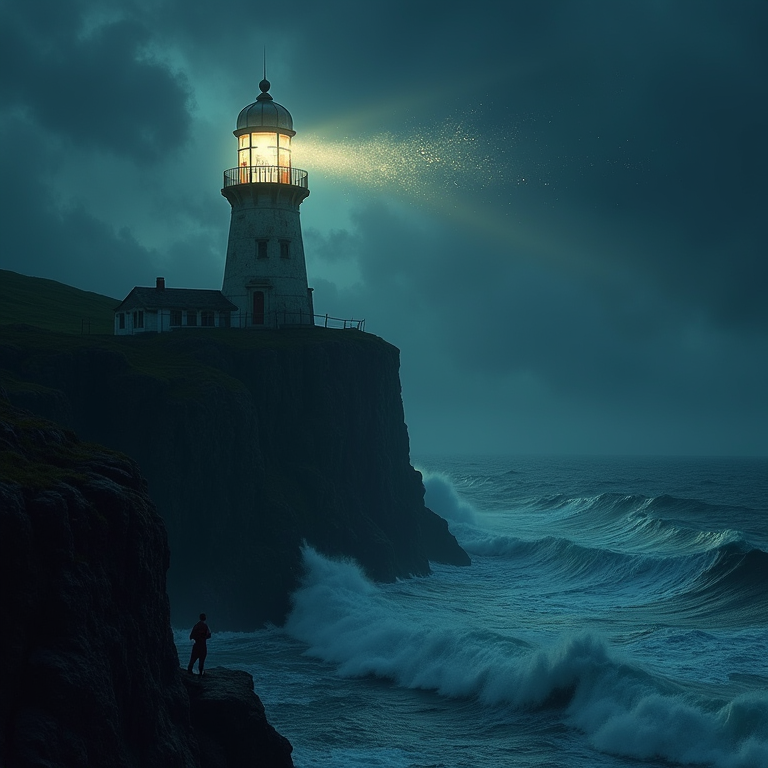
The Lighthouse Keeper’s Last Guest
The storm had been building for three hours when Marcus saw the lighthouse. He had been walking along the cliff edge since his car broke down outside of Morrow Bay, and the rain was not just water anymore—it was salt and fury thrown sideways by winds that came from no logical direction. The lighthouse appeared through the rain like a bruise on the sky, dark stone and dark windows and a light at the top that should have been spinning but wasn’t.
He climbed the path with one hand on the cliff face. At the door—ancient wood, iron bands—someone had hung a sign that said “Closed” in letters so weathered they were nearly illegible. Marcus knocked anyway. No one answered, so he pushed, and the door opened into a smell of oil and rust and something underneath that he couldn’t name.
The keeper appeared from a spiral staircase in the center of the room, a man so thin he seemed to be held together by the rope belt of his coat. His face had the texture of driftwood, smoothed by water and time, and his eyes moved like a seabird’s—never resting, never blinking for too long.
“The light’s gone out,” the keeper said, as if this explained everything.
“I’ve been walking since my car broke. Is there somewhere I can wait until the storm passes?”
The keeper looked at him for a long moment. “Stay away from the glass. Whatever you hear, whatever you see—you must never look at the light directly.”
Marcus thought this was strange but said yes anyway, because he was cold and wet and had nowhere else to go.
The keeper led him up the spiral stairs, past storage rooms full of ropes and rusted equipment, and up to a circular room at the top of the tower. It had windows on all sides and a door that opened onto the gallery where the light mechanism sat behind glass. The lens was dark now—but Marcus could feel the weight of it in the room, the way a sleeping animal has weight even when it isn’t moving.
The keeper descended. Marcus stayed at the window, watching the ocean—black water and white violence, waves hitting the cliffs below and exploding upward. He stayed away from the glass, as instructed. He watched the ocean.
For a while.
It started as a sound first. Not the storm—something else. A hum that seemed to come from the walls themselves, vibrating in his teeth. The light couldn’t be on; the keeper had said so. But Marcus could feel something in the room with him, something that had weight and intention and was growing stronger as the storm intensified.
The hum became a pulse. The pulse became a rhythm. The only source it could be coming from was the mechanism behind the glass.
He stood. He walked to the glass. He pressed his face close enough to see his breath fog the surface.
The light was on.
Not the way lights are on—no filament, no flame. This was something else. The light was on the inside of the glass, but it wasn’t illumination. It was writing. Tiny letters appearing and disappearing across the surface of the lens:
LOOK AT ME
LOOK AT ME
LOOK AT ME
And behind the words, in the darkness of the light housing, something was waiting. Something that had been waiting a very long time. Something the keeper had been keeping out—or keeping in—by never letting anyone look at the light directly.
The hum was louder now. His own pulse matching it. And in the reflection of the glass he shouldn’t have been looking at but couldn’t stop looking at, he could see his own face, and his eyes had changed, and the keeper was below on the spiral stairs, calling out a warning that was already too late.