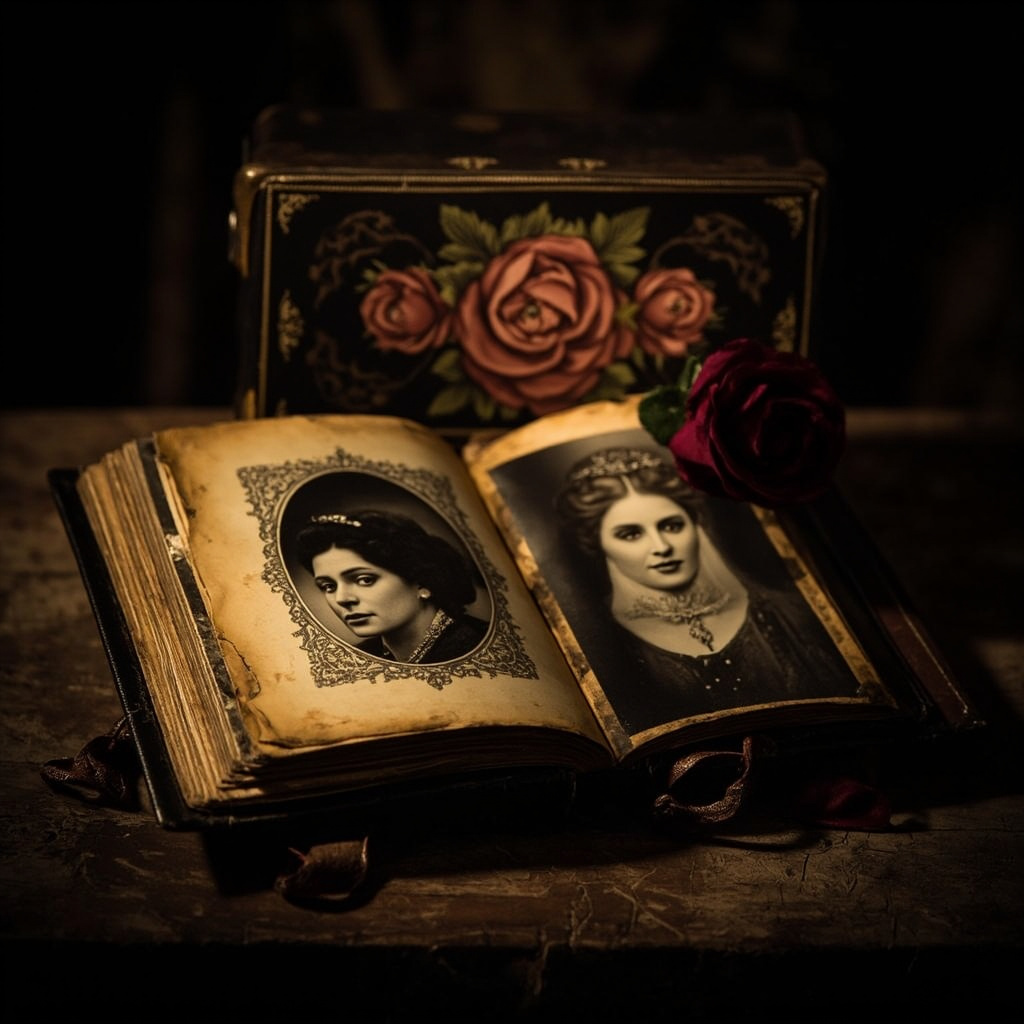
The Photo Album They Found
They found the photo album in the attic of the house they had just bought—a Victorian that had been on the market for two years, priced to sell, passed over by buyers who saw only the deferred maintenance and the outdated systems. Sarah and David saw something else: a project, a challenge, a house that they could make theirs if they were willing to put in the work. They bought it. They moved in. And in the first week of renovation, while tearing out a wall that had been added sometime in the 1970s, they found the album.
The album was leather-bound, the pages yellowed with age, the photographs black-and-white or sepia-toned, the people in them dressed in styles that suggested the early decades of the twentieth century. There were no names written on the pages, no dates, no explanations. Just photographs of two people—a man and a woman, photographed together in what seemed to be every conceivable combination of poses and locations, inside the house and outside, in the garden and on the porch, looking at the camera and looking at each other.
The photographs were beautiful. Not conventionally beautiful—the people in them were not models, were not trying to be beautiful—but beautiful in the way that authentic images of human connection often are, beautiful in their unselfconsciousness, their willingness to be seen together in moments that were clearly private even though the camera was there.
Sarah became obsessed with finding out who the people in the photographs were. She spent evenings and weekends researching the history of the house, tracing the ownership back through deeds and census records and newspaper archives. She found the names: Thomas and Catherine, who had owned the house from 1912 to 1954, who had raised four children there, who had lived through two world wars and a depression and all the other upheavals of the first half of the twentieth century. She found their wedding certificate. She found the birth records of their children. She found Catherine’s obituary, from 1962, and Thomas’s from 1959.
But she could not find anything that explained why the photographs existed—the hundreds of images of two people who had clearly loved each other, who had clearly been devoted to each other, who had been photographed together so often and so intimately that the album felt less like a documentation of their lives and more like an argument with time.
Then Sarah found Catherine’s diary, in a box in the same wall cavity where the album had been hidden. The diary confirmed what the photographs had suggested: Thomas and Catherine had loved each other in a way that was unusual, that was fierce, that had not diminished with time but had instead deepened. The diary also described something else: Catherine’s fear that Thomas would die before her, and her determination to document their love in a way that would survive even his death.
Thomas had been diagnosed with a heart condition in 1947, when he was fifty-three and Catherine was forty-eight. The diagnosis was not immediately serious, but it was progressive, and Catherine understood what it meant: that she would eventually lose him, and that she would have to live without him, and that the life they had built together would end in a way that she could not control.
She had responded to this knowledge by documenting. The album was the documentation—not a record of who they had been, but a record of who they were in the present tense, renewed daily, renewed hourly, as if the act of photographing their love could freeze it, preserve it, make it resistant to the entropy that was slowly consuming Thomas’s heart.
The album had been hidden, Sarah eventually concluded, because Catherine had wanted it hidden. After Thomas’s death in 1959, Catherine had continued living in the house for three more years. She had not remarried. She had not changed her routine. She had simply continued, the way people do after loss, until the continuing itself became the only purpose and the house became the only context for the life she was still living.
Sarah showed the album to David, one evening, after the children were in bed and the house was quiet. They looked through the pages together, and they talked about Thomas and Catherine, about the love that had produced such an extraordinary record of itself, about the grief that had eventually come to both of them and that was visible, now, in the spaces between the photographs.
“We should put it back,” David said. “In the wall. Where Catherine hid it.”
“Why?” Sarah asked.
“Because she hid it for a reason. Because whatever she was protecting, she wanted it protected. And because we’re the kind of people who understand that some things need to be hidden for a reason.”
They put the album back in the wall, in the same spot where they had found it. They finished the renovation. They raised their children in the house. They grew old there, together, the way Thomas and Catherine had grown old together, the way people do when they find the person they want to grow old with.
And sometimes, late at night, when the house was quiet and the world outside had gone dark, Sarah thought about Catherine and Thomas, and about the album that was still hidden in the wall, waiting for someone else to find it and to understand what it meant.
Some loves are documented. And some loves are hidden, protected, preserved in the walls of houses where they will wait for decades until the right people find them and recognize them for what they are.