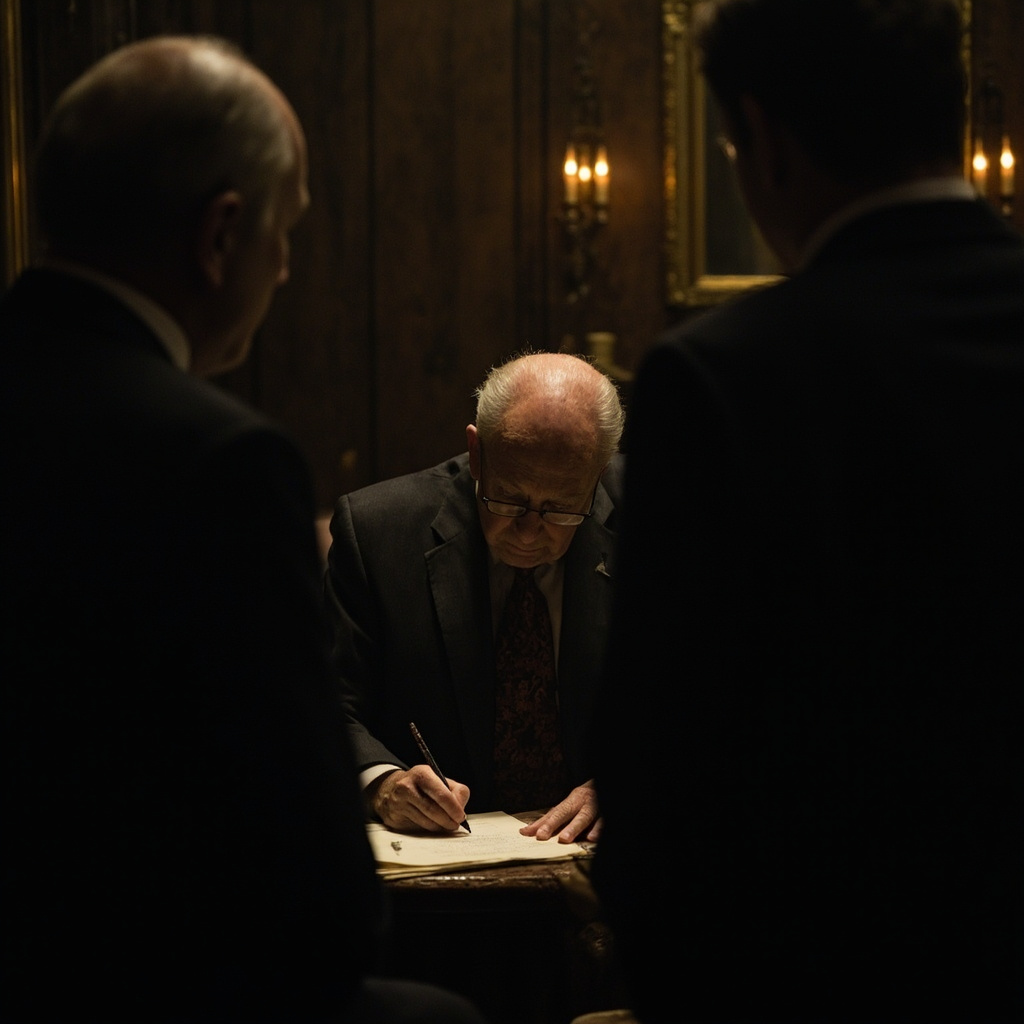
The Tycoon’s Final Wish
Richard Ashford possessed merely three months remaining. The physicians had articulated this with precision, employing terminology such as “aggressive,” “disseminated,” and “beyond remedial intervention.” Richard absorbed this intelligence, acknowledged it, and subsequently returned to his establishment, where he dedicated the subsequent twelve hours revising his final testament.
He was seventy-one years of age, valued at approximately eleven billion dollars, and had invested the preceding four decades constructing an enterprise controlling operations from maritime logistics to pharmaceuticals to communications. He maintained adversaries—in fact, he had cultivated adversaries the manner other individuals cultivated acquaintances—deliberately, strategically, and devoid of regret. When one commanded that extent of the global landscape, someone inevitably desired one’s elimination.
Now someone imminently would. However not prior to Richard settling certain accounts.
Richard had maintained a chronicle throughout the preceding three decades. Not a personal diary—nothing so emotional. This constituted a ledger, a permanent record of every individual who had wronged him, every transaction that had proceeded unfavorably, every indignity and damage and betrayal. Forty-seven designations existed in total. Certain were already deceased. Others commanded sufficient influence to necessitate cautious management.
However three designations distinguished themselves. The three men who had obliterated his sole offspring.
Gregory, his commercial associate of two decades, who had misappropriated three hundred million dollars and falsified evidence pinning the offense on young Theodore. Theodore had perished incarcerated, still asserting his innocence, still believing his father would rescue him. Richard had been attending a conference when the communication arrived. He had not canceled the conference. He had concluded the conference, subsequently traveling to his offspring’s memorial service three days subsequently.
William, the legal prosecutor who had concealed the evidence and permitted Gregory to escape consequence. William presently served as a legislator, invulnerable, leveraging his wrongful conviction record into a political trajectory constructed upon the remains of the innocent.
And Catherine, the magistrate who had dismissed the concluding appeal. Catherine had been Gregory’s companion during that period. She presently served as Chief Justice of the State Supreme Court.
Richard invested his remaining months initiating arrangements. He liquidated assets, transferred capital through offshore structures, and established a series of fiducient arrangements and charitable organizations that would persist beyond him by decades. He engaged the finest investigators, the finest legal representatives, and the finest operatives currency could procure—which communicated something, considering the extent of currency he possessed.
However that proved insufficient. Richard craved beyond their demises. He craved their suffering. He craved they experience total loss the manner his offspring had experienced loss—reputation, liberty, dignity, existence itself. He craved they comprehend, within their ultimate instants, that this transpired due to what they had perpetrated against Theodore Ashford.
Thus he instituted the Death Agreement. Three sealed containers, each containing documentation of the transgressions his three targets had committed. Each container was programmed to unseal automatically upon his death, distributing its contents to law enforcement, media, and the public simultaneously. No evasion. No negotiation. No alternative.
The initial to perish was Gregory. He suffocated on a grape at a charitable function six weeks subsequent to Richard’s death—precisely timed, precisely executed, the grape precisely calibrated to obstruct his respiratory passage without anyone suspecting premeditated action. His enterprise collapsed within days as Richard’s documentation was distributed, and he perished impoverished, despised by everyone he had ever known.
William persisted eight weeks. He was discovered in his establishment, surrounded by documentation of his transgressions, a tumbler of whiskey in his grasp and a projectile in his cranial structure. The self-incriminating correspondence he left bore his own handwriting, confessing to everything, though Richard’s operatives had composed it for him. The documentation proved too incriminating for anyone to challenge the determination.
Catherine was final. She witnessed what had transpired to the others. She recognized she was subsequently imminent. She endeavored to flee, endeavored to conceal herself, endeavored to leverage her connections to locate Richard’s operatives and propose them greater compensation than Richard had disbursed. However Richard had anticipated this. The investigators he retained proved not motivated by currency. They proved motivated by something considerably more dependable: justice deferred, justice denied, justice that had awaited four decades for this instant.
Part Five: The Judgment
Catherine was discovered in her chambers on the day of her retirement commemoration, surrounded by her family, her colleagues, the individuals who had commemorated her vocation. She perished with a smile adorning her features and a syringe in her arm—the identical combination of substances that had been administered to execute capital punishment in her jurisdiction for decades. The postmortem examination classified it as natural causes, triggered by the strain of recent occurrences.
Richard had prevailed. His offspring had received retribution. The men and women who had obliterated Theodore Ashford had remitted with their existences, their reputations, everything they had constructed upon his offspring’s remains.
However Richard had not remained alive to witness it. He had perished three months subsequent to diagnosis, in his residence, unaccompanied, surrounded by nothing however his currency and his animosity. His legal representatives discovered him bearing a smile and a transcript of his offspring’s incarceration correspondence in his grasp—the concluding correspondence Theodore had authored, the one Richard had never responded to because he had been excessively occupied with a conference.
The correspondence communicated: “I recognize you shall rescue me, Father. You invariably do.”
Richard had not rescued him. However he had, in his own distorted methodology, guaranteed someone else would remit. Whether that constituted justice or simply another classification of transgression, Richard had not lingered sufficiently to ascertain.