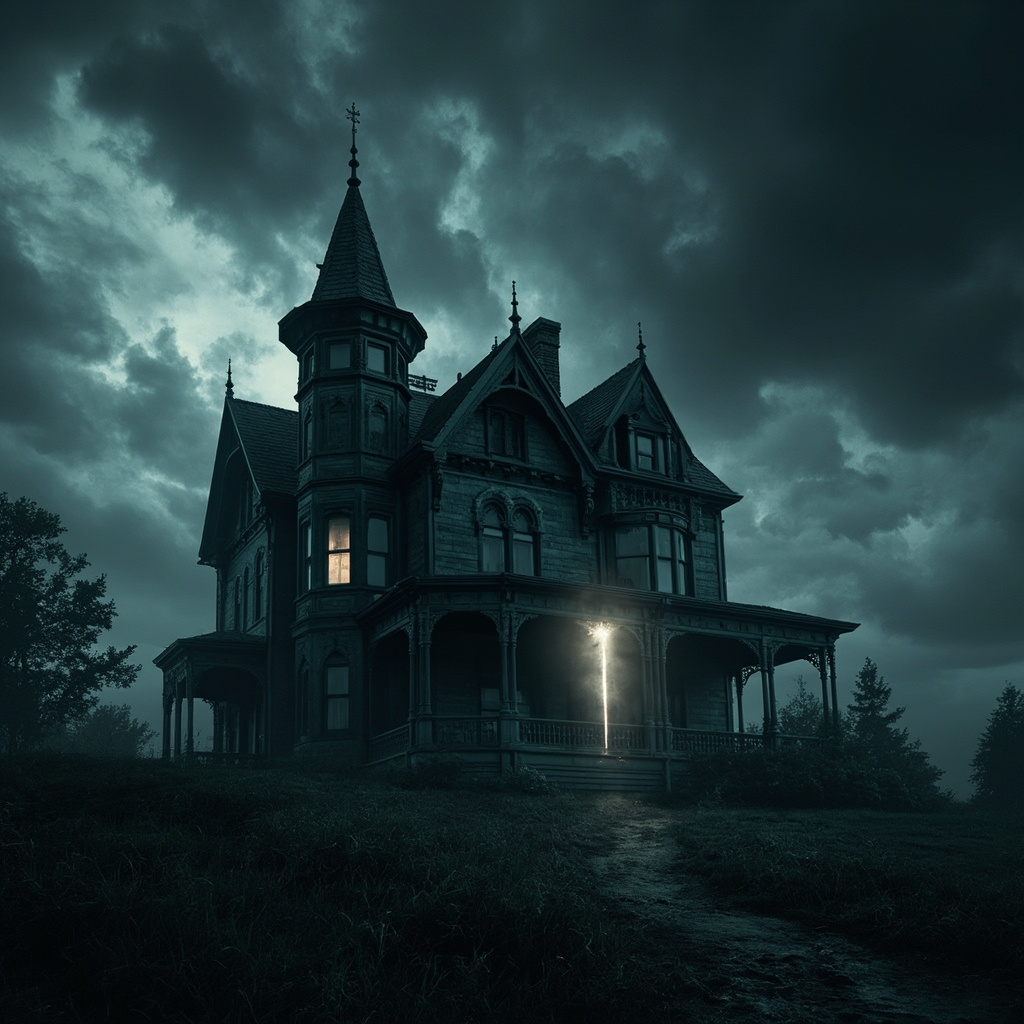
The Inheritance They Forgot
Jenna Marlowe was thirty-four years old and drowning in debt when she received the letter informing her that a distant aunt she had never heard of had died and left her everything. The estate was called Thornwood Hall, located in a county Jenna had never visited, and according to the solicitor’s estimate, it was worth approximately two million pounds.
Jenna had spent her entire adult life working jobs that paid poorly and led nowhere. She had student loans that seemed to multiply faster than she could pay them off. She had a sister who wouldn’t speak to her and a mother who had died two years ago, leaving nothing but memories and a small box of photographs that Jenna couldn’t bear to look at.
Two million pounds would solve all of her problems. It would pay off her debts, give her a fresh start, maybe even allow her to pursue the career she’d always wanted but couldn’t afford.
The letter said there was one condition: she had to live in Thornwood Hall for one full year before she could sell it. If she left before the year was up, she would forfeit the entire inheritance.
Jenna didn’t hesitate. She gave notice at work, packed her belongings, and drove to Thornwood Hall the following week.
Thornwood Hall was even more impressive than the photographs suggested. It was a Victorian manor surrounded by forty acres of forest, with a lake to the east and a mountain range visible to the north. The nearest town was twenty miles away, and the nearest neighbor was a farmer named Thomas who kept to himself.
The solicitor met Jenna at the door and handed her a ring of keys—eleven in total, each one labeled with a different room. “The estate has been maintained by a caretaker for the last thirty years,” he explained. “Your aunt was… particular about certain rooms. She kept them locked at all times. The keys are yours now, of course, but I should mention that the insurance policy specifically forbids access to Rooms 7, 8, and 9 on the second floor.”
“Why?”
The solicitor’s smile didn’t waver, but something in his eyes did. “Old houses have their quirks. Some rooms hold memories that are better left undisturbed.”
He left shortly after, driving away down the long gravel driveway, leaving Jenna alone in a mansion that was now legally hers.
The first three months at Thornwood Hall were the happiest Jenna had ever known. She explored the sixty-two rooms, the extensive grounds, the greenhouse full of exotic plants that seemed to bloom year-round. She read books from her aunt’s library, swam in the lake, learned to cook with ingredients from the extensive vegetable garden.
She didn’t think about the locked rooms. She didn’t wonder what her aunt had been hiding. She told herself that some mysteries were better left unsolved.
Then she found the journal.
It was in the library, hidden behind a false panel that Jenna discovered only because a book fell and hit the wall at exactly the right angle. The journal belonged to her aunt, and it began with a single entry dated forty years ago:
“They think I don’t know about the rooms. They think the locks will keep me out forever. But I found the key to Room 7, and what I’ve seen inside has changed everything. The inheritance isn’t money. The inheritance is a choice. And I have forty years to decide whether to make it.”
The journal chronicled forty years of research, of secret experiments, of growing understanding. Jenna’s aunt had discovered that Thornwood Hall was built on something ancient—something that predated human civilization by millennia. That something was still there, beneath the foundation, waiting.
Room 7 contained a doorway. Room 8 contained the mechanism to open it. Room 9 contained the warning about what lay on the other side.
According to the journal, every generation of the family had faced the same choice: release what was beneath the hall, or keep it contained forever. Those who released it gained wealth beyond imagination—but at a cost that the journal described in clinical detail. Those who kept it contained lived ordinary lives, never knowing what they had sacrificed.
Jenna’s aunt had spent forty years trying to find a third option. She had failed.
“The choice will be yours when you’ve been there a year,” the final entry said. “I’ve done what I can. The rest is up to you. Choose wisely. Choose carefully. And whatever you do, don’t open the door just because you’re curious. Some things are better left in the dark.”
Jenna spent the last month before her year deadline in a state of constant anxiety. She read and reread the journal. She visited the locked rooms, ran her hands over the doors, tried to imagine what could be worth building a mansion on top of—and worth keeping hidden for generations.
The solicitor visited her twice during that month, each time asking if she had made her decision. She told him she was still thinking. She told herself the same thing.
On the anniversary of her arrival, Jenna stood in front of Room 7 with all eleven keys in her hand. The solicitor was waiting in the foyer, ready to drive her to the solicitor’s office to sign the papers that would complete the sale of Thornwood Hall.
She could sell the house, take the money, walk away from whatever her aunt had discovered. Two million pounds. Freedom from debt. A new life.
Or she could open the door. See what her aunt had spent forty years protecting. Make the choice that every generation before her had faced.
The keys were cold in her hand. The hallway was silent. And from somewhere deep beneath the floor, Jenna could have sworn she heard something breathing.
She put the key in the lock. Then she turned around, walked down the stairs, and handed the solicitor the keys.
“I need more time,” she said. “The year isn’t up yet.”
But it was. She knew it was. And somewhere beneath Thornwood Hall, the thing that had been waiting for forty years knew it too.