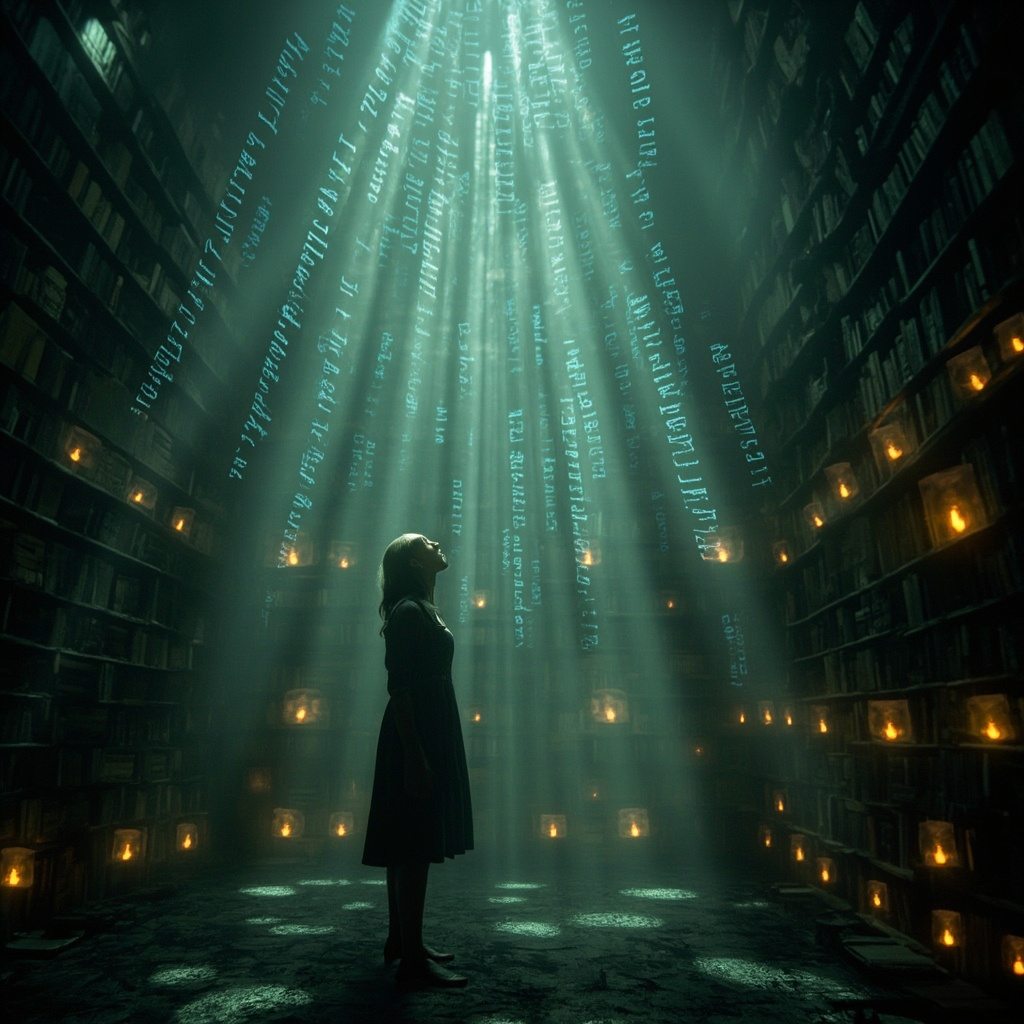
The Keeper of Unspoken Words
In the city of Veridian, where the merchants counted their gold and the scholars counted their books, there stood a building that no one visited. It was called the Archive of Unspoken Words, and it had been sealed for three hundred years—since the last Keeper had locked the doors from the inside and never emerged.
The common belief was that the Archive was a myth, a story parents told children to encourage them to speak their minds. But Mira Stone knew better. She had grown up in the shadow of the building, had watched the windows glow sometimes at midnight, had heard the whispers that seeped through the cracks in the foundation.
Words were not just sounds. They were living things, with weight and form and hunger. And the Archive was where all the unspoken words went—the confessions that died in throats, the declarations that withered before reaching lips, the insults swallowed and the apologies never offered. Three centuries of abandoned language, fermenting in the dark.
The Archive was not empty. The Archive was never empty.
On the morning of her twenty-first birthday, Mira received a letter. It was written in her grandmother’s hand, sealed with wax the color of old blood, and delivered by a crow that looked at her with human eyes before dissolving into smoke on her doorstep.
The letter explained everything. The Archive had been founded by the first Veridians, who understood that some words were too dangerous to speak and too important to abandon. These words—words of power, of curse, of creation—were locked away in the Archive, tended by a line of Keepers who devoted their lives to containing them.
Mira’s grandmother had been the last Keeper. She had served for sixty years, maintaining the delicate balance, ensuring that no word escaped its proper containment. But she was dying, and she had chosen Mira to succeed her—not because Mira was the eldest, or the wisest, or the most powerful, but because Mira had been born with a gift: she could hear the words that other people couldn’t speak.
“Come to the Archive before midnight,” the letter said. “The words are restless. They’ve been without a Keeper for too long. If no one claims them by dawn, they’ll find their own way out.”
The Archive had seven doors, each sealed with a different lock, each guarded by a different sentinel. Mira’s grandmother had left her seven keys, each one made of a different material—bone, iron, silver, gold, glass, wood, and something that felt like solidified starlight.
The bone key opened the first door, which led to the Hall of Regrets. Here, on shelves that stretched up into darkness, sat thousands of small glass bottles, each containing a single word written on a slip of paper. Mira recognized some of them: the apology she’d never offered her father before he died, the confession she’d swallowed when she was nineteen, the three words she’d wanted to say to her best friend that had transformed into something else entirely.
The iron key opened the second door, which led to the Chamber of Curses. These words were louder, angrier, more insistent. They beat against the walls of their containment, demanding release, promising destruction. Mira had to cover her ears to keep from hearing what they offered.
The silver key opened the third door, to the Gallery of Love Confessions. These words were the saddest—thousands of declarations of passion and devotion that had died before reaching the ears they were meant for. Some of them still glowed with the warmth of the feelings that had inspired them.
The gold key opened the fourth door, to the Library of Lost Knowledge. These were words that had been forbidden, suppressed, destroyed by cultures that feared what they contained. Some of them were dangerous. Some of them were merely true.
The fifth, sixth, and seventh doors were the hardest to open. The glass key required Mira to speak a truth she’d never admitted aloud. The wood key required her to accept a fear she’d spent her whole life running from. The starlight key required her to make a choice about her own future—one that would determine the rest of her life.
Behind the seventh door, Mira found her grandmother. She was sitting in a chair that seemed to be made of solidified words, surrounded by floating text that formed a cocoon around her tired body.
“You came,” her grandmother said. Her voice was thin, barely above a whisper. “I wasn’t sure you would.”
“The letter said you were dying.”
“I am. But that’s not why I called you here. The words are restless because I’ve been losing my grip. For the last five years, they’ve been testing their boundaries, trying to find the cracks in my containment. If no one takes over, they’ll escape at dawn tomorrow.”
Mira looked around at the infinite darkness, at the words that swirled in patterns too complex to understand. “What happens if they escape?”
“Then every unspoken thought in Veridian will become spoken. Every secret will be shouted from the rooftops. Every confession will be heard by the person it was meant for, whether they want to hear it or not. The city will tear itself apart within a week.”
“Why me?” Mira asked. “There must be someone better suited. Someone who actually wanted this.”
“No one wants to be the Keeper,” her grandmother said. “It’s a lonely job. A binding job. You give up your life to contain the lives of others’ words. But you—” She reached out and took Mira’s hand. “You’ve been listening to unspoken words your whole life. You understand them. You know their weight, their cost, their power.”
“I don’t want to be trapped in a building for sixty years.”
“No,” her grandmother agreed. “But you also don’t want to see the world tear itself apart because no one was willing to hold the silence.”
Mira stood in the chamber of the last Keeper, surrounded by three centuries of abandoned language, and felt the weight of the choice pressing down on her. Outside, the sun was rising. She had until midnight to decide.
She looked at her grandmother—at her tired face, her gnarled hands, her eyes that had seen too much and held too much for too long. Then she looked at the door, at the keys in her hand, at the words that swirled around her like a living storm.
“Teach me,” she said. “We have until midnight. Start teaching me now.”
Her grandmother smiled. It was the smile of someone who had finally found relief after decades of carrying an unbearable weight.
“We have work to do,” she said. “And then, my dear, you’ll have work to do for the rest of your life. Are you certain?”
Mira was not certain. She was terrified. But she took the first key—bone, cold against her palm—and turned toward the Hall of Regrets.
“Show me,” she said.