The Collector’s Last Breaths
Dr. Nathaniel Cross had spent two decades at St. Catherine’s Hospice, holding the hands of the dying as they took their final moments. It was intimate work—witnessing the threshold between existence and oblivion. Most physicians looked away at that final instant. Nathaniel never did.
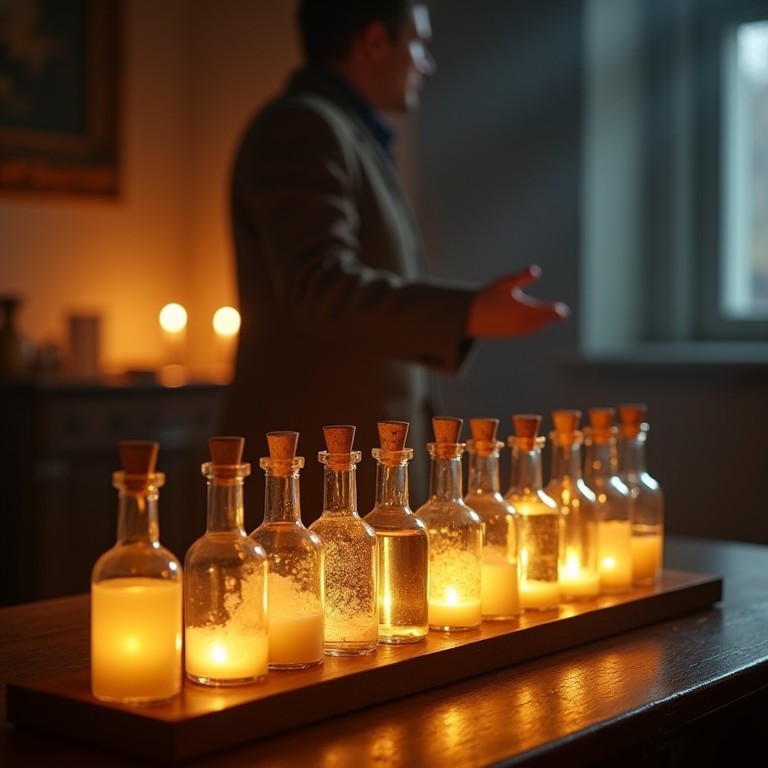
What no one knew—what Nathaniel had shared with no living soul—was that he gathered something from each passing. Not keepsakes. Not money. Not stories. He collected the breath itself. The last exhalation, captured in a small glass vessel sealed with cork, marked with the date and the name of whoever had exhaled it.
He didn’t understand his own compulsion. He didn’t know what he intended to do with them. But he knew he couldn’t stop.
There were 847 vessels in his collection when she arrived. 847 final breaths, 847 last moments, 847 tiny expirations that his patients had released into the world without realizing anyone was listening. He kept them in a mahogany cabinet in his study, arranged chronologically—a library of endings.
Her name was Margot. She was forty-three. She had perhaps six months, perhaps less. The malignancy had spread beyond any intervention capable of saving her. She was a painter, she explained during their first consultation. She painted the way she breathed—naturally, compulsively, with complete devotion to creation itself.
“I need you to promise me something,” she said. “When I go, I want my final breath to have meaning. I want someone to remember that I existed. That I created things. That I mattered.”
Nathaniel promised. He did not tell her about the collection.
Margot passed on a Thursday evening, rain pattering against the windows, her fingers intertwined with his. She departed peacefully, the way some do—as though dying was a relief, an emancipation, a final release. Her last breath departed her body in a long, gentle exhalation, and Nathaniel captured it in his vessel without thinking, as he always did.
But this occasion was different. He sensed something as the breath entered the glass. Not merely air. Not simply the chemistry of a failing body. Something additional. Something that hummed against his palm like something alive.
That night, he opened the vessel. The breath had transformed—it was no longer invisible but faintly luminescent, a pale golden glow that pulsed once, twice, then settled into stillness. And when he inhaled it, just slightly, just enough to taste, he saw her.
Margot. Not deceased. Not alive. But present. Standing in his study, between the cabinet and the window, observing the collection with an expression he couldn’t interpret.
“You gather us,” Margot said. “The breath of the dying. You keep us in vessels like specimens.”
“I don’t know why I do it,” Nathaniel said. “I never have.”
“It’s a form of love, isn’t it? The only way you know how to love the dead is to keep them. To possess their final instant. To ensure they aren’t entirely gone.”
“Yes,” he said. “I suppose it is.”
Margot smiled. It was the same expression she had worn during her final hours—weary, knowing, unbearably sad. “I don’t want to be kept. I want to be freed. But I’m prepared to make an arrangement. You release me—not into nothing, but into something. You open every vessel, you exhale every soul you’ve gathered, and you let them move forward. And in exchange, I will be the final one. I will remain. I will keep you company in this study for whatever time you have left. And when you die, we will depart together.”
Nathaniel looked at the cabinet. At 847 vessels. At 847 souls he had unknowingly imprisoned in glass, each one awaiting precisely what Margot was offering.
“It will require time,” he said. “A lifetime, perhaps.”
“Excellent,” Margot said. “Then we have a lifetime together.”
It required eleven years. He opened each vessel in sequence, from the first to the last. With each one he released a soul—the breath of an elderly man who had died thinking of his spouse, the breath of a child who had died requesting ice cream, the breath of a woman who had died laughing at a joke her son had told. He released them all. And with each release, he felt lighter, emptier, more free.
Margot remained. She was there every evening in his study, seated by the fireplace, observing him write in his journal about the lessons he had learned from the dying. She never aged. She never fatigued. She never requested anything except his presence.
When Nathaniel finally died—old, peaceful, in his own bed with Margot beside him—his final breath was the brightest of all. It filled the room with golden light and the sound of voices, 847 souls welcoming him home, and Margot clasping his hand the way he had clasped hers all those years prior.
The vessels were empty. The cabinet was merely a cabinet. But the room smelled of lavender and turpentine and something else—something that might have been closure, or might have been the commencement of something that had no name.