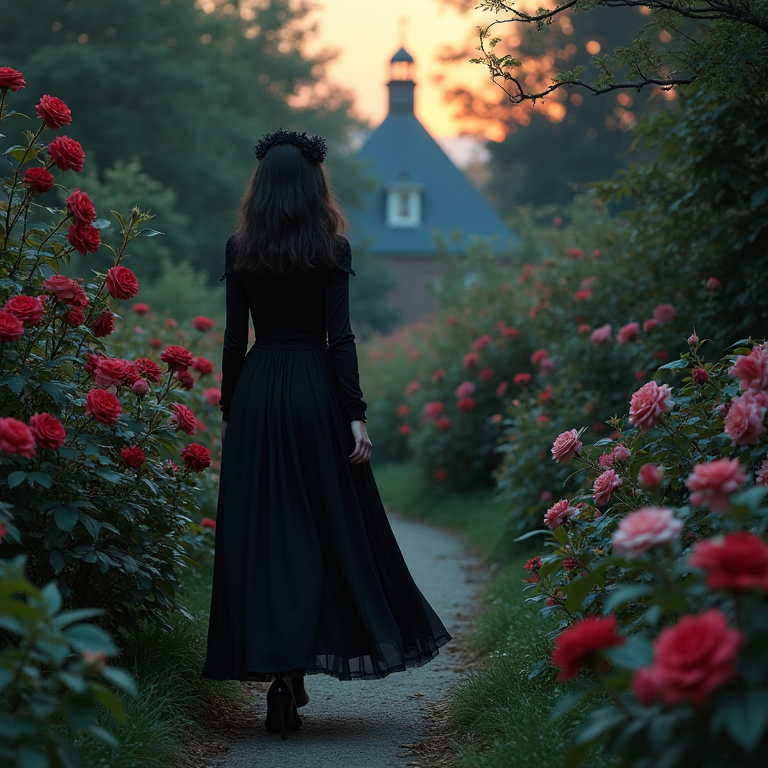
The Countess’s Forbidden Garden
The invitation arrived by courier, written in ink the color of old blood, on paper that smelled faintly of roses and something else—something sweet and rotting, like flowers left too long in a vase. It was an invitation to a ball at Thornwood Estate, hosted by the mysterious Countess Vesper, who had lived alone in the estate for thirty years since the death of her husband under circumstances that no one in the village could quite agree on.
Julian, a botanist from the university, had been studying the rare flowers that grew wild on the estate’s boundaries—species he had never seen anywhere else, flowers that seemed to bloom in impossible colors and turn their petals toward movement, toward warmth, toward life. He had been trying to get permission to study them for years. When the invitation came, he assumed his persistence had finally paid off.
He was wrong about many things that night.
The Countess was younger than he expected—perhaps forty, perhaps ageless, with black hair that moved in a wind that wasn’t there and eyes the color of a bruised sky. She greeted him personally at the entrance, taking his hand in hers, which was cool and dry and stronger than it looked.
“You’ve been trying to see my garden,” she said. “For three years, you write to me. Three years of letters about soil composition and light requirements and the scientific method. And yet you’ve never once asked what grows there. What it really is.”
“I assumed you were protective of your privacy.”
“I am protective of my garden,” the Countess said. “But I am lonely in my protection. You may see it. Tonight. After the ball. But first, you must understand something: everything in my garden is alive in ways that plants are not supposed to be alive. Everything there remembers. And everything there wants.”
The garden was a cathedral of impossible things. Flowers with petals like human skin, smooth and warm to the touch. Vines that moved when you weren’t looking, reaching toward the heat of your body. Trees with bark that looked, in certain light, like faces frozen in expressions of ecstasy or agony. And everywhere, the smell of roses—not the sweet roses of an ordinary garden, but roses concentrated, distilled, roses that had been growing for so long they had forgotten how to be anything but themselves.
“I made this garden from grief,” the Countess said, walking beside him on a path that seemed to arrange itself under her feet. “When my husband died, I planted his favorite flowers. When my children left, I planted theirs. When my lovers came and went, I planted pieces of them too. Every person who has ever touched my life is represented here. Every relationship, every betrayal, every moment of love or loss—I planted it. And it grew.”
“This is not botany,” Julian said. “This is something else.”
“This is botany of the soul,” the Countess said. “And now you are part of it. From the moment you stepped through my gate, you began to grow here. Your roots are already sinking into my soil. Your stems are already reaching toward my light.”
Julian tried to leave. He turned toward the gate, which had been right there a moment ago, and found only more garden—an endless expansion of flowers that hadn’t existed a minute before, corridors of bloom that twisted and turned and led nowhere he recognized.
“You can’t leave until you’ve finished growing,” the Countess said. She was beside him now, though he hadn’t seen her move. “No one can. The garden doesn’t release what it’s planted. It only grows. It only remembers. It only takes.”
“What do you want from me?”
“I want you to stay,” she said. “I want you to let your roots go deep. I want you to bloom here, in my soil, for as long as I need you to bloom. And when I’m done with you—when your beauty has served its purpose—you’ll be compost for the next one who comes along.”
“That’s not love. That’s consumption.”
The Countess smiled. “All love consumes. The only difference is whether the consuming is mutual.”
Julian stayed. He didn’t choose to—he simply found himself unable to leave, unable to stop tending the garden, unable to stop watching himself become part of it. His hands changed first, becoming calloused in new places, smelling of soil that had no name. Then his eyes, which began to see colors that didn’t exist in any spectrum he had studied. Then his heart, which started beating in time with the flowers, expanding and contracting in rhythms that matched the blooming.
Years passed. Or maybe they didn’t—the garden existed outside of time the way it existed outside of space. Julian became the garden’s keeper alongside the Countess, tending plants that whispered his name, that remembered his first steps into their world, that reached for him with petals like fingers.
And eventually, when he had given everything he had to give, when his beauty had served its purpose and he was ready to become the compost for the next visitor, the Countess knelt beside him where he lay among the roses and said: “You were the first one who understood. The first one who saw what this garden really was. That’s why I’m giving you a choice: you can go now, if you want. The gate is open. But you can also stay—not as compost, but as the one who keeps the garden after I’m gone. As the one who decides what grows next.”
Julian looked at the gate, at the world beyond it, at the life he might have had if he walked through. Then he looked at the garden—at the Countess, at the flowers, at the endless循环 of love and consumption and growth.
“I’ll stay,” he said. “Show me how to plant the next one.”
And the Countess smiled, and took his hand, and led him deeper into the garden that would be their home for as long as anyone could remember.