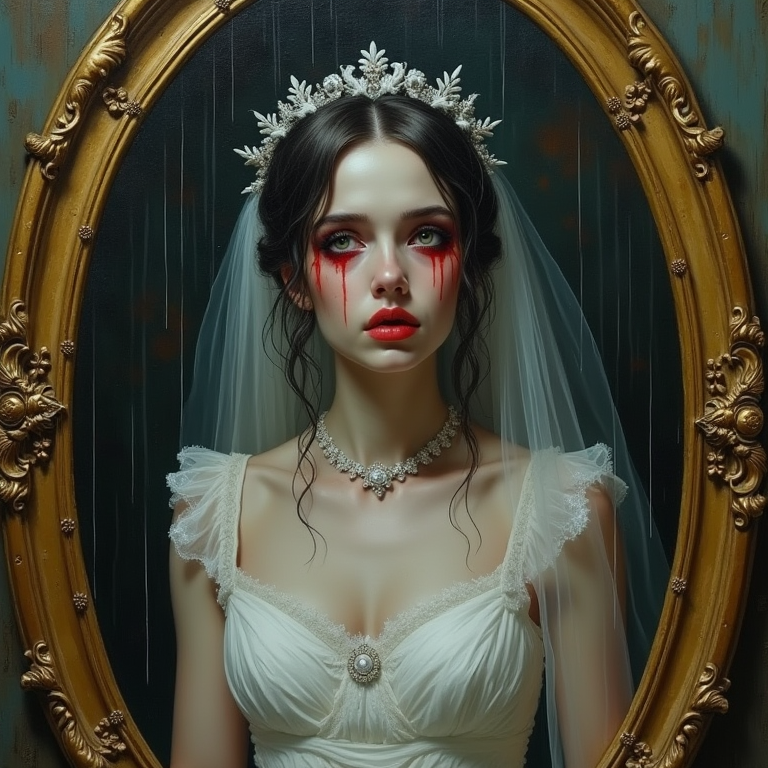
The Portrait That Wept Blood
The lawyer’s letter arrived on a Tuesday, which seemed too ordinary a day for the news it contained. Clara was the sole heir to her great-aunt’s estate—a house in Cornwall that had been abandoned for forty years. The catch: she had to live in it for one full year before she could sell. The house, according to the lawyer, was “structurally sound but emotionally complicated.”
She should have asked what that meant. She didn’t. She packed her bags and drove six hours through increasingly narrow roads until she reached a village so small it didn’t appear on her GPS. The house sat on a cliff overlooking the sea, a gray stone manor with windows like closed eyes.
The portrait was the first thing she noticed. It hung in the foyer, directly above a marble fireplace that hadn’t been lit in decades. A woman in a white wedding dress, her face serene, her eyes—Clara looked closer—the eyes were wet. Actual tears, running down the canvas, pooling at the bottom where the frame met the wall.
Clara wiped the tears with her sleeve, thinking it was condensation from the damp air. The next morning, they were back. Fresh ones, as if someone had just cried them. She watched for an hour, making coffee and pretending to read, until she saw a single tear slide down the painted cheek and drip onto the floor.
She removed the portrait that afternoon. It was heavier than it looked, and when she pulled it from the wall, she found scratches on the wallpaper underneath—long, desperate gouges, as if someone had clawed at the wall trying to escape.
The back of the portrait was covered in handwriting. Dozens of names, written over each other, some in ink, some scratched in with fingernails. The most recent one, written in what looked like fresh blood, said: “She knows what I did. The portrait knows. It always knows.”
Clara found the local records in the village church basement. The house had belonged to the Ashford family for three generations. The last Ashford—her great-aunt—had been found dead in her bedroom at age ninety-two, her eyes open, her expression frozen in absolute terror. The official cause was heart failure, but the coroner’s notes used the phrase “extreme psychological distress” no fewer than six times.
The wedding portrait, according to parish records, showed Eleanor Ashford on her wedding day in 1923. She had married a man named Thomas Whitmore. Thomas Whitmore had disappeared three weeks after the wedding. His body was never found. Eleanor had remained in the house until her death, never leaving, never remarrying, never speaking to anyone except the portrait—which local folklore claimed she talked to every night at midnight.
The portrait showed Clara things she didn’t want to see. At first, she thought it was her imagination—a trick of the candlelight, the way shadows moved in old houses. But no imagination could produce what she witnessed on the third night: Thomas Whitmore, standing behind Eleanor in the portrait, his hands around her throat, squeezing, while she clawed at the wall behind her, trying to escape.
The portrait wept because Eleanor was reliving her death every night, trapped in the moment of her murder, unable to move forward, unable to rest. Clara understood now why her great-aunt had never left the house. You couldn’t leave if you were painted into the moment of your death.
“Do you see it too?” Clara whispered to the portrait. The tears stopped. For the first time in forty years, Eleanor Ashford’s painted eyes moved, focusing directly on Clara.
“Finally,” the portrait seemed to say, though its lips didn’t move. “Someone who sees.”
Clara burned the portrait at midnight on the winter solstice—the darkest night of the year. She didn’t know why she chose that night, only that it felt right, as if the darkness itself was a partner in what she was about to do.
As the flames consumed the canvas, a scream echoed through the house—not from the painting, but from everywhere, from the walls themselves, from the sea beyond the cliffs, from the very air. Thomas Whitmore’s face appeared in the fire, contorted in rage, and then was gone. When Clara looked at the fireplace, only ash remained. No frame. No canvas. No trace of Eleanor or Thomas.
She stayed in the house for the remainder of the year, as promised. She never saw the portrait again, but sometimes, late at night, she heard footsteps in empty rooms, and a woman’s voice whispering: “Thank you. Thank you. Thank you.”
The house sold quickly when she finally listed it. The new owners never mentioned any strange occurrences. Perhaps they were lucky. Perhaps Eleanor had finally found peace. Or perhaps, Clara thought as she drove away for the last time, some houses simply choose who gets to see their ghosts.