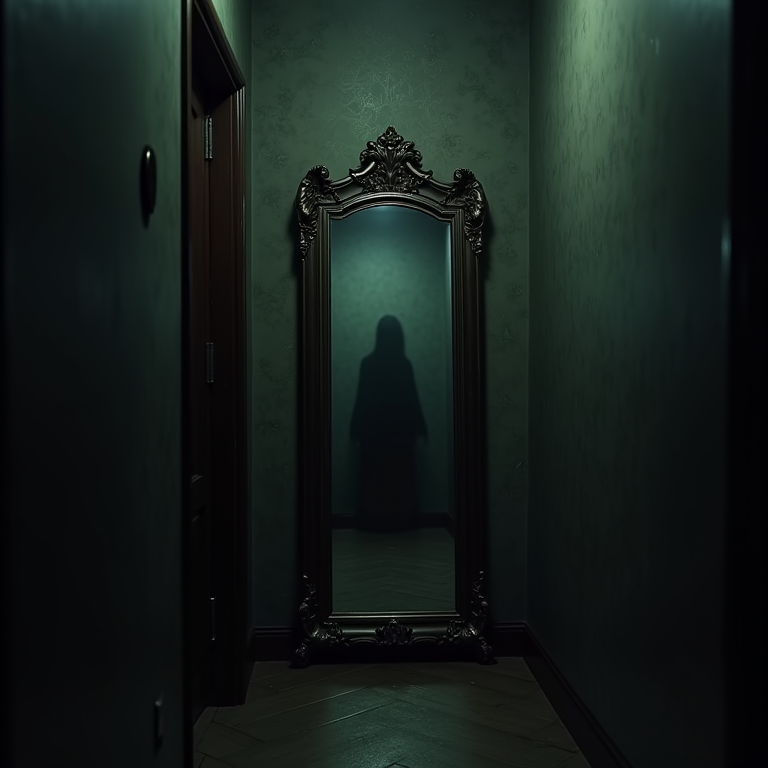
The Mirror Tenant
Mira found the apartment listing by accident at two in the morning. A studio in a building that had no website, no photos beyond one grainy image of a hallway, and a rent so low it should have been a red flag. But Mira was thirty-two, broke, and three weeks away from sleeping in her car. Red flags were a luxury she could no longer afford.
The landlord met her at noon. He was a thin man with pale eyes and a habit of looking just past people instead of at them. The apartment was on the seventh floor. The building smelled of lemon cleaner and something underneath it that Mira could not name. Old paper, maybe. Or dried flowers left too long in a vase.
“The last tenant left in a hurry,” he said as he unlocked the door. “Left everything behind. Furniture, clothes, even—” He stopped. “You’ll see.”
The apartment was small but clean. A narrow living room with a kitchenette. A bathroom with a shower curtain patterned in faded peonies. And in the living room, leaning against the far wall, a full-length mirror in a tarnished brass frame. It was the kind of mirror that should have been too heavy for one person to move, but there it stood, as if it had grown out of the floorboards.
“I’ll take it,” Mira said before he had finished the tour.
She moved in that afternoon. By evening, the mirror was the only thing in the apartment that felt alive.
The First Night
At midnight, Mira woke to a sound like fingernails on glass. She sat up in the narrow bed she had dragged into the living room and stared at the mirror. Her reflection stared back—dark hair tangled, eyes wide with the kind of fear she had not felt since childhood, when she used to lie awake listening to her parents argue through thin walls.
But the reflection was wrong.
It was not moving in perfect sync with her. There was a lag—perhaps half a second, perhaps less—but enough that when she raised her hand, the reflection’s hand rose a fraction of a moment later. When she held her breath, the reflection’s chest continued to rise and fall for one beat too long.
She crossed the room and touched the glass. It was warm. Warmer than glass should be at midnight in an unheated apartment. And beneath her fingertips, she felt something that could only be described as a pulse.
The Second Night
She set up her phone to record the mirror while she slept. At dawn, she watched the footage. For the first four hours, nothing. Then, at 3:17 AM, her reflection sat up in the recording while the real Mira lay still. The reflection turned its head slowly toward the camera and smiled. It was not her smile. It was wider. It had too many teeth.
The reflection mouthed words. Mira replayed the clip five times before she could read lips well enough to understand them: I’ve been waiting so long for someone to come home.
She packed a bag and left for work without looking back. She told herself she would come home, clean out the apartment, and leave. She would forfeit the deposit. She would sleep on a friend’s couch for a week if she had to. Anything was better than that apartment, that mirror, that thing wearing her face.
But when she returned at seven, the door was locked from the inside. The chain was on. She knocked. No one answered. She knocked harder, shouted, rattled the handle. Nothing.
The super came up with a key. The apartment was empty. The mirror was covered with a sheet she did not remember putting there. Her bag was on the bed, unpacked. Her phone was on the counter, recording had stopped. Everything was exactly as she had left it except for one thing: the mirror now reflected a room that was not her apartment. It showed a hallway—this hallway, but older, the wallpaper different, the light yellow and thick like honey. And standing at the far end of that reflected hallway was a woman in a dress from another era, her face blurred as if seen through water.
“This building,” the super said quietly, not looking at the mirror. “It has a history. The last tenant, she said the same thing. Said the apartment was occupied when she came back. Said someone was living inside the glass.”
“Where is she now?” Mira asked.
The super did not answer. He left. She heard the door lock behind him. And from the mirror came the sound of breathing that was not her own.
The Truth
She researched the building at the library. It had been constructed in 1923. The architect had died before completion. The original owner had vanished in 1947. There were seventeen recorded disappearances over ninety years, all in the same apartment, all on the seventh floor. Every single one of them had reported the same thing: the mirror showed a room that was not theirs, and someone was living in it.
The mirror was not a mirror. It was a door. And whatever was on the other side had been waiting for a tenant who would not leave.
She returned to the apartment one last time. The mirror was uncovered. The woman in the dress was closer now—close enough that Mira could see her eyes. They were the same shape as hers. The same color. The same tired, hollow look of someone who had not slept in days.
The woman raised her hand and pressed it against the glass from the inside. Mira, trembling, raised her own hand and matched it palm to palm through the barrier. The glass was warm. The pulse was stronger now. It matched her own heartbeat exactly.
And then she understood. The woman in the mirror was not a stranger. She was the last tenant. And she was not trapped. She was waiting. Waiting for Mira to touch the glass. Waiting for the barrier to thin. Waiting for the exchange to begin.
Mira pulled her hand back. Too late. The glass had already accepted the contact. She felt a pulling sensation—not physical, not pain, but a deep, hollow suction, as if something inside her chest was being drawn through the glass by a thread she could not see.
She ran. She did not stop running until she was three blocks away, sitting on a bench in the rain, shaking, her hands pressed against her chest as if to hold something in. Her reflection in the shop windows across the street looked normal. Tired, frightened, but normal.
She never went back to the apartment. She left everything—her clothes, her books, her phone charger, the life she had been trying to rebuild. She moved to a shelter. She found work at a diner. She stopped looking at mirrors for three months.
But on the ninety-third day, she caught her reflection in the chrome surface of the espresso machine. And for just a moment, the reflection smiled. It was not her smile. It was wider. It had too many teeth.