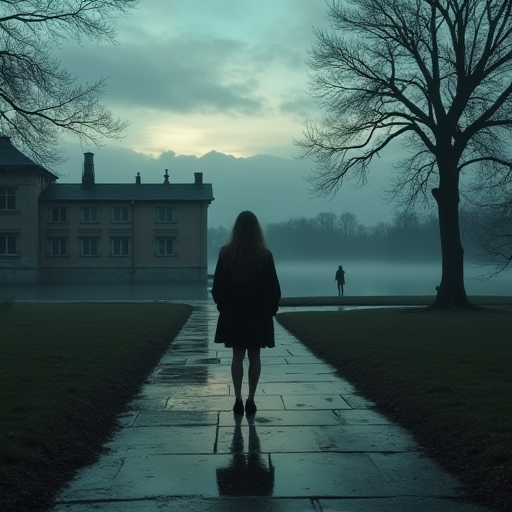
Ghost Corridor Unit 13: What Stayed Quiet
That was perhaps the most institutional part of the entire affair.
Not the secrecy.
Not the fragmentation of records.
Not even the generations of administrative cowardice that had let one layer of haunting settle over another until dead girls became campus topology.
No, the most institutional part was what came after:
the determination to translate rupture into maintenance language.
A cracked substructure beneath Classroom Block One became “an old foundation stress issue.”
The sealed side hall became “temporarily inaccessible due to repair concerns.”
The reading annex was reopened after a month with new lighting and a fresh coat of paint, as if brightness could negotiate with what had once used that room for assessment.
East Lake received additional railing and a warning sign.
Horse Field remained abandoned, now for budgetary reasons no one bothered pretending to believe.
And the island?
The island got nothing.
Which was fitting.
It had always been the prettiest lie in the whole chain, and pretty lies recover fastest.
From a distance, the university looked normal again before the term was even fully over. Students hurried to lectures, copied assignments, complained about cafeteria food, fell in and out of love, borrowed chargers, failed exams, got drunk, got anxious, got bored, and did all the little things young people do in places too old to deserve them.
That, Claire Morgan would later think, was the strangest part.
The world does not stop for the truth.
It only absorbs it badly.
⸻
There was no formal agreement among the four of them afterward.
No vow.
No blood-oath.
No sentimental promise to remain forever bound by shared horror.
They were too exhausted for theater.
Instead, what held was simpler.
They did not let anyone retell it beautifully.
That became the rule.
If some second-year student tried to romanticize the Red Woman, Quinn Hale would cut in with enough archival dryness to make the story collapse under its own self-importance.
If someone spoke of Adrian Wynn as if he had “chosen death” in some tragic poetic sense, Evan Cross would state the facts so flatly that poetry died on contact.
If whispers began again about the seventh-floor child or the most beautiful ghost on campus, Claire would ask one practical question too many and force the room to confront how much of its fascination depended on women being easier to mythologize than to mourn honestly.
And if anyone tried to drag Leo Grant into one of those late-night tell-us-what-really-happened circles, he developed the useful habit of leaving before curiosity could become performance.
That was how they kept the witness chain from knitting itself back together.
Not by silence.
By ugliness.
No clean legend.
No elegant version.
No satisfying structure for new students to rehearse in the dark until the old mechanism recognized itself in their mouths again.
If the system beneath the school had survived on coherent retelling, then the only ethical aftermath was to make coherence expensive.
⸻
Claire cut her hair shorter that summer.
Nobody commented on it directly, which was how she preferred it. The change was not symbolic in any ritual sense, though other people tried to make it so. It was practical. A refusal of continuity. A private insistence that the face the system had wanted was not available in archived form anymore, not to the extent hair and posture and self-presentation still belonged to her.
She also stopped looking into dark windows at night.
That was less symbolic and more learned instinct.
Sometimes survival leaves behind habits that look superstitious only to people who were never asked to become a suitable wearer for the dead.
She did not become softer after that spring.
But she became clearer.
Before, she had still been the sort of person who believed enough honesty and courage could untangle most disasters if applied early enough. Afterward, she learned a harsher and far more useful rule:
systems built on suffering do not dissolve when exposed.
They weaken when denied clean continuation.
That principle changed her more than fear ever could.
When younger students later came to her with rumors, she listened carefully—not because she loved ghost stories, but because she had learned how often institutions teach the vulnerable to describe structural danger as superstition first. She became, to her own irritation, a person others trusted with early strange things.
She did not like that role.
She took it anyway.
⸻
Evan Cross never called what happened a victory.
Claire noticed that before anyone else did.
He used other phrases instead:
it held,
the line broke there,
the system lost coherence,
that route no longer works the same way.
Never:
we beat it.
This was one of the reasons she trusted him more afterward, though she would rather have bitten through glass than say it in those words.
He understood what had actually changed and what had not.
The succession line through Claire had been broken.
The eye-fastener had shattered.
The gate had refused completion.
The school’s later legends no longer fit together cleanly enough to function as one efficient chain.
All true.
Also true:
the stone gate still existed,
the seal was damaged rather than restored,
and older land does not forget being used merely because a generation of students manages, once, to interrupt the shape of use.
So Evan did what he always did when faced with an incomplete ending:
he kept records.
Not in the obvious way.
Not in files labeled haunting evidence like an idiot.
He split notes across notebooks, coded site sketches into architectural study folders, buried dates inside class timetables, and stored one sealed envelope in a place Claire never asked about and Quinn almost certainly found anyway.
He also visited his teacher again before term’s end.
When he came back, he said only one thing that mattered:
“Seals don’t heal. They only hold better or worse depending on what the living feed them.”
That was not comfort.
It was instruction.
So he treated the school accordingly.
He stayed alert around repetition.
He watched for linked-site reactivation.
He took freshmen rumors more seriously than administrators did and less dramatically than students wanted him to.
And every now and then, on mornings when the air around Classroom Block One felt too still, he walked the old side hall alone just to make sure silence there remained merely silence.
He never admitted whether he was checking for the dead or for himself.
With Evan, the distinction was often less stable than people thought.
⸻
Quinn Hale graduated with honors and the private satisfaction of knowing that bureaucracies, like hauntings, become legible once you stop granting them moral neutrality.
Of the four of them, she was perhaps the most visibly changed.
Not emotionally—she had always been harder to read than the others wanted—but methodologically. Before that year, she treated archives as containers. Afterward, she treated them as terrain.
She had seen too clearly how filing systems can perpetuate violence under the guise of order.
How categories decide what gets linked and what gets lost.
How institutions can turn dead women into separate stories simply by distributing records across enough cabinets that nobody alive reads them in sequence.
Once you know that, paperwork stops feeling harmless forever.
So Quinn built what she privately called her counter-archive.
Not a heroic dossier.
Not a conspiracy wall.
A survival architecture of notes, duplicates, cross-references, unofficial maps, witness inconsistencies, committee language, and one especially vicious index of euphemisms universities use when they mean we know but would rather not know together.
She never showed the whole thing to anyone.
That, Claire thought, was probably wise.
The school’s official files had once fed the machine by dividing too much.
Quinn’s private archive prevented the opposite mistake—reassembling it too beautifully for later people to use as a ready-made legend.
She kept truth available,
not convenient.
That difference mattered.
⸻
Leo Grant transferred at the start of the next academic year.
No dramatic farewell.
No clean severance.
He told people the department change made more sense for his future. That was close enough to a lie to function and close enough to the truth to remain tolerable.
He had no appetite left for the campus after East Lake.
Water did that to some people.
Not the lake itself, perhaps.
The knowledge that he had obeyed too quickly, lied too weakly, and nearly helped carry a sequence forward because fear made him easier to route than to resist.
He never fully forgave himself for Adrian.
Or for Claire.
Or for the first half-dozen moments when he could have spoken sooner and chose the coward’s version of delay instead.
But guilt, when not aestheticized, can mature into usefulness.
Leo became careful after that.
Not braver.
Careful.
He developed an allergy to dramatic secrets.
He stopped mistaking urgency for intimacy.
He learned to distrust any situation in which being chosen first felt flattering.
That last lesson alone probably saved him from becoming several different kinds of man.
Claire heard from him occasionally.
Quinn heard from him more.
Evan almost certainly heard more than he admitted.
What mattered was this:
he lived,
which in stories like theirs should never be dismissed as the lesser outcome simply because it lacks beauty.
⸻
And Adrian Wynn?
He remained the most difficult among them to place.
Not because they forgot him.
Because they remembered him too accurately.
He was the hinge.
The first body in the sequence they recognized while it was still close enough to call by name.
The boy who had smiled at the crosswalk not like someone resigning himself to death, but like someone already standing one step into another arrangement.
The one who accepted cold rice, before-dawn instructions, reflected corrections, and preparation itself until public death turned him from private process into communal witness.
Claire visited his grave only once.
Not out of affection.
Out of responsibility.
There was no haunting there.
No pressure.
No sign.
Only a stone, flowers someone else had brought, and the crude fairness of weather wearing everything down at the same rate.
She stood there for a long time and finally understood something she had resisted while he was still central to the horror:
Adrian was not the origin.
Not the villain.
Not even the true intended vessel.
He was the boy the system found first who could be taught how to carry a line one stage further.
That did not absolve him.
But it returned him, partially, to scale.
After that, she could think of him without hearing the crosswalk in every memory.
That mattered more than forgiveness would have.
⸻
As for Mara—
it became easier, over time, not to think of her as the oldest ghost.
That was too simple.
Too romantic.
Too flattering to the structure that had used her.
Claire thought of her instead as the earliest recoverable refusal.
A woman made to keep seeing after she should have been allowed not to. A woman injured into function, then inherited through later arrangements because no generation powerful enough to stop the line stopped it soon enough. The gate did not belong to her. The vacancy did not begin with her. But through her, the system had learned something repeatable.
That was the true obscenity.
And yet, when the line broke through Claire instead of continuing, Claire sometimes wondered whether Mara’s face in the lake had smiled at refusal not because it hated being denied—but because denial was the first honest answer the structure had received in a very long time.
She never said that to Evan.
He would have called it conjecture.
Quinn would have called it dangerous sentimentality.
Leo would have looked frightened and changed the subject.
Still, she kept the thought.
Not as comfort.
As possibility.
There is a difference.
⸻
Years later, incoming students still heard stories.
Of course they did.
Schools produce legends the way old pipes produce damp.
They heard about a classroom once used as a wake room.
About a corridor on the third floor where calls for help used to go unanswered at a cost.
About a woman in red on the island.
About East Lake and the face beneath still water.
About a light under the school no one should follow.
But the stories no longer connected cleanly.
One freshman would insist the island woman predated the dormitory death.
Another swore the corridor child belonged to an entirely different decade.
A third said the whole thing centered on the annex, not the lake.
Someone else claimed the haunting had ended when the old west lamp burst.
None of them could agree on the names.
None of them could keep the sequence straight.
Every retelling contradicted the last just enough to break the line before it settled into proper inherited machinery again.
That was the final countermeasure.
Not truth exactly.
Not forgetting.
Disordered survival.
Claire heard one first-year once complain that the campus ghost lore had become “messy and unsatisfying.”
She almost laughed out loud.
Good, she thought.
Let it stay that way.
Because some stories become safer only when they stop working well as stories.