Ghost Corridor Unit 8: Viability
Bait.
Claire Morgan knew that, of course.
She let them keep the cleaner term because everyone in the room was already carrying enough shame to make precision feel unkind. Quinn Hale could hide behind dry language, Evan Cross behind procedure, Leo Grant behind nausea and regret, but Claire no longer had that luxury. If the school’s machinery had spent days or weeks circling her as a possible wearer, then “waiting to see what it did next” was just cowardice dressed as caution.
So they built the test.
Not at midnight.
Not in the seventh-floor corridor.
Not by East Lake.
Not anywhere with a legend already attached strongly enough to do half the haunting’s work for it.
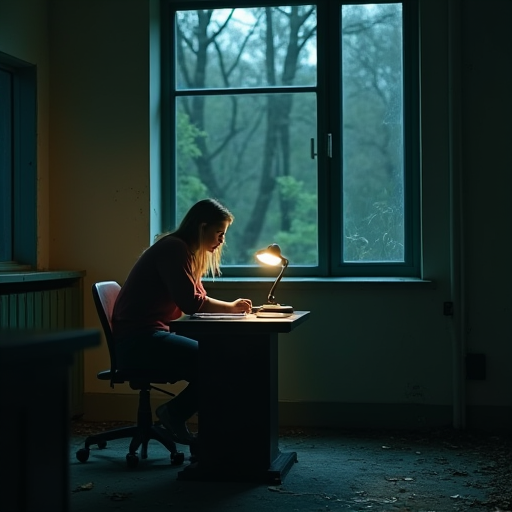
They chose the old reading room annex beside the library instead—a place dull enough to offend superstition, but close enough to the older campus lines that whatever was watching would still recognize adjacency. A place of desks, weak overhead lamps, stained windows, and shelves mostly emptied after mold damage had forced the university to relocate the real books years earlier. It was almost never used now except by students who wanted quiet and by custodians who had lost arguments elsewhere.
That was exactly why Quinn approved it.
“If this thing depends on sequence and symbolism,” she said, spreading an old campus plan over the desk, “then we give it Claire without giving it the stage it prefers.”
Evan adjusted one of the circles he had drawn over the map.
“No mirrors. No reflective screens. One point of entry. Two visible exits. We keep all phones off except one.”
“Mine,” Claire said.
Leo looked immediately uneasy.
“Do you have to be alone?”
“No,” Claire said. “I have to look alone.”
That was the compromise they had landed on after an hour of arguments and one nearly useless detour into whether pretending normalcy could still work in a school where the dead had started editing caller ID.
Claire would sit by herself at the center desk beneath the west lamp, visible through the cracked interior glass from the adjoining side room. Evan and Quinn would watch from there, hidden but close enough to intervene. Leo would remain in the hall, not because anyone trusted him most, but because his fear had become the most sensitive instrument they had.
He heard things before the rest of them admitted there was anything to hear.
Nobody said that kindly.
⸻
The annex looked harmless at dusk.
That made it worse.
A place can be full of old unease and still pass for neglected institutional space under the right light. Dust gathered in the corners, the window frames had peeled down to older coats of paint, and one section of ceiling bore the yellow-brown tide line of an old leak that no repair had ever fully erased. The tables were scarred with initials, carved arrows, and the general archaeology of student boredom. If not for what they were waiting for, Claire might have found the room almost comforting.
Instead it felt like a stage stripped of decoration.
Quinn checked the sightlines twice, then once more because anxiety in her always took the form of competence.
Evan wrapped the eye-fastener again and kept it in his satchel, not in the annex itself.
That had become a rule without anyone formally naming it: the object did not remain in the same room as Claire unless absolutely necessary.
Leo stood by the hall door and asked no useful questions at all for nearly five minutes.
Then, finally:
“What exactly are we testing?”
Claire answered before Evan could.
“What ‘not yet’ means.”
Leo looked as though he wished the sentence had remained theoretical forever.
Quinn spared him a glance.
“More specifically,” she said, “whether ‘viability’ is behavioral, spatial, symbolic, or physical.”
Leo blinked.
Claire almost smiled.
“That was for us,” she told him, “not you.”
The smile vanished as quickly as it came.
Evan checked his watch.
“Once we start, no improvising.”
Claire raised an eyebrow.
“That instruction is aimed mostly at you.”
“Yes,” he said. “And I’m obeying it.”
For a second the room softened around that in the smallest possible way. Then he nodded once, and everyone moved into position.
Claire sat at the center desk with the only active phone face-down in front of her.
Quinn and Evan withdrew into the side room beyond the cracked glass partition.
Leo stayed outside in the corridor, where he could watch the entrance and panic privately if needed.
The annex lights hummed.
The campus evening settled.
Nothing happened.
For eleven full minutes, nothing happened.
That was longer than Claire expected and somehow more unnerving than immediate disturbance would have been. Waiting creates its own haunting. Every tiny sound becomes a candidate: the electrical buzz in the lamp, the radiator tick in the wall, footsteps somewhere two floors below, a distant laugh from the main quadrangle already half swallowed by dusk.
Then the phone vibrated once.
Not a call.
A message.
Claire looked down.
No sender name.
No number.
Just a blank thread opening itself with one line:
still not ready
She did not touch the screen.
Through the glass she saw Evan go very still.
Quinn, beside him, wrote something quickly on the page in her lap: initiates contact without live response needed.
Claire hated how helpful that observation was.
Another vibration.
Second message:
better light this time
Her whole body tightened.
The west lamp above her desk flickered once, recovered, then brightened by a fraction too much—enough to make the rest of the room seem dimmer around it.
Claire did not look toward the side room.
Did not call out.
Did not move.
That had been part of the plan: no response to provocation until a pattern emerged.
Third vibration.
turn around
She shut her eyes for one second.
When she opened them again, the annex was unchanged.
Desk.
Dust.
Shelves.
Lamp.
But in the dark window beyond the stacks, where the glass reflected the room back in blackened reverse, a figure now sat at the far table behind her.
Same posture.
Same tilt of shoulders.
Same hair falling along one side of the face.
Claire.
Or the version the system was trying to finish.
She did not turn.
From the side room, Quinn lifted one hand sharply—stay with the plan.
The phone vibrated again.
good
Claire felt that word all the way down her spine.
⸻
Later, when they reconstructed the sequence, this was the point Evan said the test truly began.
Not with the first message.
Not with the lamp.
Not even with the reflected double.
With the approval.
good
Because that meant the thing behind the contact was not merely reaching. It was scoring.
Evaluating behavior against expectation.
Which transformed “haunting” into something closer to onboarding.
Claire knew none of that in real time. What she knew was simpler and more primal: if she turned around too fast, she would be doing exactly what it wanted; if she sat there too long, she would be permitting it to define the pace.
So she chose a third option.
She spoke without moving.
“You don’t get to train me.”
The words came out calmer than she felt.
The figure in the window did not visibly react.
The phone did.
Another message appeared so fast it might have been waiting already typed:
you already know how
That broke something in Leo.
From the hall came the sudden sound of his shoes scraping backward across the floor, followed by a sharp involuntary curse. Claire half-turned before catching herself. Through the partition she saw Evan already moving toward the corridor, Quinn reaching for his sleeve and missing.
No improvising, he had said.
And there he was, improvising.
Claire stayed where she was.
That mattered later.
Because if she had risen with the others, the pattern would have fragmented. Instead, the annex held.
Leo stumbled into view at the door, face white.
“There’s someone outside,” he said.
Evan appeared behind him at once.
“Who?”
Leo shook his head too violently.
“Not who. Just—outside. Standing where the glass in the door should show the path. I can’t see a face. It’s too close.”
Quinn came out next, jaw tight with anger.
“At least be specific while panicking.”
Claire had not yet moved from the center desk.
“Is it me?” she asked.
Leo looked at her and then away.
“Yes.”
No one laughed.
No one denied it.
Because by then the school had long since exhausted all polite uses for disbelief.
⸻
Evan changed the test in that moment.
He had to.
Not because the plan failed, but because it succeeded too well. They now had evidence of at least three concurrent behaviors:
indirect text contact,
reflective duplication,
and spatial manifestation at the threshold.
That was enough to prove “viability” involved more than passive resemblance. The system was checking Claire’s responses to direction, isolation, and self-recognition all at once.
“New rule,” Evan said. “No one opens that door.”
Leo almost snapped at him.
“As if I was planning to.”
Quinn ignored both of them and looked at Claire.
“Can you stay seated?”
Claire took one breath.
“Yes.”
Good.
Because now the room had become a lab whether any of them wanted that or not.
The phone vibrated again.
This time the message was longer.
come see if it fits
That was the ugliest one yet.
Not poetic.
Not threatening.
Practical.
The language of fitting rooms, jewelry, clothes, masks.
Wearer language.
Claire felt suddenly, violently angry.
Not afraid.
Not even mostly.
Angry.
At Adrian for smiling.
At Leo for lying.
At Evan for being right too often.
At the whole damned school for turning dead girls into systems and living girls into candidates.
So she did the one thing none of them had predicted precisely because it was neither compliance nor caution.
She picked up the phone, switched the camera to front-facing mode, and held it up toward the dark window without looking directly back.
For one second the screen filled with her own face.
Then another face slid into frame behind it.
Not fully hers.
Not fully anyone’s.
A composite:
her mouth,
someone else’s cheekbones,
the exhausted eyes of Faye Hart,
and around one eye the faint circular shadow where an eye-fastener might once have rested long enough to leave memory in the skin.
Claire did not scream.
She hit record.
That, more than anything else, is what saved the night.
Because systems built on witness are often less stable when witness becomes evidence instead of performance.
The image on the screen convulsed.
The lamp flared.
The hallway outside the door filled with one violent impact as if the thing at the threshold had slammed itself against the glass and lost patience with form.
Leo cried out.
Quinn swore.
Evan shouted Claire’s name.
And still Claire kept recording.
The face on the screen distorted further, features losing coherence as if multiple dead women were all suddenly resisting being worn in the same arrangement. Faye. The red woman. The child from the seventh-floor corridor. Someone older beneath them all. For an instant the whole machinery of selection became visible precisely because the camera refused to romanticize it.
Then the phone screen went black.
The west lamp burst.
And every person in the annex was thrown into the same total dark.
⸻
The next few seconds survived only in fragments.
Leo flattening himself against the corridor wall.
Quinn grabbing Claire’s shoulder hard enough to bruise.
Evan kicking the door shut as something struck it once from outside.
The smell of overheated wire and dust.
The sound of Claire’s dead phone skidding across the tabletop and onto the floor.
Then emergency light from the side corridor bled under the door and turned the room into a dim red geometry.
No one spoke first.
They were all listening.
Nothing moved outside now.
No footsteps.
No breathing.
No pressure on the door.
Just the old annex, the red emergency glow, and four people discovering the world had not ended merely because it had tried harder than before.
Quinn found the phone first.
The screen was cracked but not shattered.
The recording remained.
That was the real result of Unit 8.
Not victory.
Not safety.
Proof.
When they replayed it later—once, only once, with all four of them watching—they saw enough to confirm what the messages had implied:
the school’s mechanism was not trying to kill Claire at random.
It was trying to assess whether her face, her reactions, and her relation to witness made her suitable for occupation.
Viability, in other words, meant three things:
resemblance,
responsiveness,
and the capacity to hold more than one dead narrative at once without breaking visibly to outsiders.
Claire met all three criteria too well.
That should have devastated her.
Instead it clarified everything.
At the end of the replay, she looked at the others and said, very evenly:
“Then the next move is mine.”
And this time, for once, no one told her no.