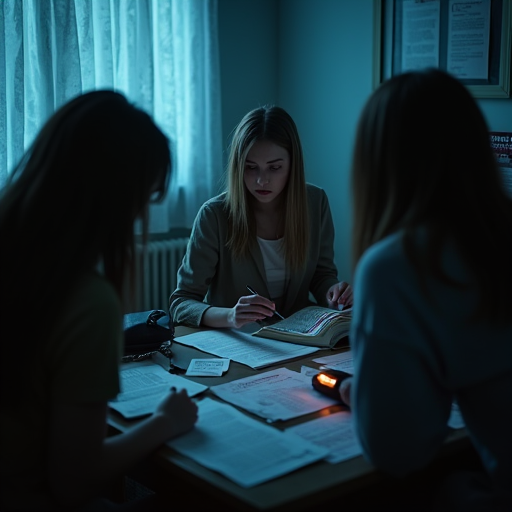
Ghost Corridor Unit 7: The Intended Face
That was the problem with certain theories: even before they were proven, they altered the behavior around them.
Leo Grant stopped looking directly at her unless forced.
Quinn Hale became more protective in the driest, least sentimental ways possible.
And Evan Cross—though he would have denied it if cornered—began measuring rooms not just for exits and sightlines, but for angles around Claire’s body inside them.
She noticed all of it.
She resented all of it.
And beneath the resentment sat the much uglier fact that she no longer trusted her own reflection enough to dismiss them.
The eye-fastener had shifted the whole frame.
Before, Claire had still been able to imagine herself adjacent to the pattern: important, perhaps; noticed, yes; implicated through proximity to Adrian Wynn’s death and the school’s old legends. But adjacency is survivable. Adjacency still lets you believe the thing itself is happening elsewhere.
Now the pattern pointed inward.
If Adrian had been carrying the object rather than meant to wear it, if the lake retrieval had continued sequence rather than ended it, if Leo’s first instinct after bringing it back had been to pull Claire aside alone, then the whole ugly machinery of preparation might have been circling her long before anyone in the room had the courage to say so.
She hated how plausible that felt.
Not because it flattered her.
Because it explained too much.
Adrian asking where she was.
That strange smile at the crosswalk.
The sense, afterward, that his last glance had not been farewell but alignment.
The way the school’s disturbances seemed always to become slightly more precise when she entered their orbit.
Claire stood at the dorm window and watched campus morning drag itself reluctantly into shape.
Students crossing the paths.
Bicycles.
Steam from food stalls.
Normality performing itself with the same arrogant confidence it always had.
Behind her, Evan was still at the desk with the eye-fastener and Quinn’s copied records.
“Say it plainly,” she said without turning around.
Neither of them answered.
Claire did turn then.
“I’m serious. I’m tired of watching both of you have the same thought with different facial expressions.” She folded her arms. “If I’m the target, say target.”
Quinn glanced once at Evan, then spared him the burden.
“All right,” she said. “You may be the intended face.”
The sentence entered the room like bad weather.
Leo looked down immediately.
Evan did not correct it.
That, Claire thought, was answer enough.
⸻
They spent the morning trying to determine why.
Not in the abstract sense—why do hauntings choose, why do dead systems prefer one body over another—but specifically, materially, and with whatever dignity remained to them:
why Claire.
Quinn approached it first through records.
Evan through sequence.
Leo, when forced to contribute, through memory.
Claire herself hated all three methods because each one required her to sit in the middle of the room like an unsolved problem.
“Let’s start with resemblance,” Quinn said.
Claire gave her a look.
“I’m not thrilled with that category.”
“Neither am I, but the dead don’t ask permission before sorting.”
So they did.
Not by vanity, nor by the crude logic of “pretty girl resembles dead girl” that lesser ghost stories would have been content with. The school’s older mechanism was too elaborate for that. This was not about beauty in the simple sense. It was about fit.
Ages.
Bone structure.
Eye line.
Hair length in certain years.
Photographic similarity under low light.
Position within school networks.
Visibility without complete social centrality.
That last criterion, oddly enough, mattered most to Evan.
“If this thing survives through witness and retelling,” he said, “then it doesn’t want someone invisible. But it also doesn’t want someone so dominant that every change would be noticed immediately.”
Claire understood at once.
Not the most beloved girl on campus.
Not the most isolated.
Someone who could move through dorms, corridors, student functions, memorial events, and rumors without seeming misplaced.
Someone people would already accept as a recurring figure in many scenes.
Someone like a class representative.
Someone like Claire.
She sat down slowly.
“Wonderful.”
Nobody tried to reassure her.
That helped more than reassurance would have.
⸻
Then Leo contributed the memory he should have mentioned sooner.
That, too, was becoming a pattern.
He only ever remembered the most useful thing after the room had already become unbearable enough to strip pride away.
“The week before Adrian died,” he said, “I heard him say your name.”
Claire looked up sharply.
“You already said he asked where I was.”
“No. I mean your name. By itself.”
Evan leaned forward.
“When?”
“Night. Late. I woke up because I thought he was on the phone.” Leo rubbed at his eyes as if trying to get the image back into focus. “He was sitting up in bed, looking toward the window. I couldn’t hear the other side—if there was another side. But I heard him say, ‘Claire isn’t ready yet.’”
The room went perfectly still.
Not because the line was loud.
Because it fit too cleanly.
Claire felt the blood leave her hands.
“Why didn’t you say that earlier?”
Leo winced.
“Because I didn’t want to hear how it sounded once I said it.”
That was, unfortunately, understandable.
Evan spoke before Claire could.
“And after that?”
Leo swallowed.
“Nothing. He just went quiet. Then lay down.”
Quinn picked up the thread immediately.
“So Adrian wasn’t simply being instructed. He was being updated.”
No one objected to the phrasing.
Claire stared at the desk.
Claire isn’t ready yet.
Not who is Claire?
Not where is she?
Not even bring her.
The line implied staging.
Timing.
Progress through thresholds.
The eye-fastener. The lake. The cold rice. The wake.
All of it now belonged to a grammar she was no longer merely overhearing.
She was inside the sentence.
⸻
Evan took her out of the dorm before noon.
Not far.
Just out.
To the old campus paths between the library and the western classroom buildings, where movement and weather made conversation feel less trapped than inside the room. Claire knew at once this wasn’t comfort. Evan did not take walks for comfort. He took them when he needed a mind to move while it was being cornered.
For a while they said nothing.
Then Claire broke first.
“You think this started before Adrian.”
“Yes.”
“With me.”
“Yes.”
She looked straight ahead.
“That sounds ridiculous.”
“It sounds structured.”
She almost laughed at that.
“Do you hear yourself?”
“All the time. It’s one of my worse qualities.”
That got the smallest breath of something out of her, not quite humor.
Then he said the next part more quietly.
“I don’t think you were chosen because of Adrian. I think Adrian was chosen because he could be used to reach you.”
Claire stopped walking.
Students passed at the far end of the path, too distant to overhear.
She turned to him.
“That’s worse.”
“I know.”
“No, Evan, I mean materially worse. If Adrian was part of the path rather than the origin, then whatever this thing is has been arranging longer than we thought.”
He held her gaze.
“Yes.”
There it was again—that refusal to soften. She hated it and depended on it in equal measure.
Claire looked away first.
“What do I do?”
That was the first truly honest question she had asked him since the eye-fastener came out of the lake.
Evan answered just as honestly.
“Nothing it would expect.”
⸻
By evening that became policy.
No solitary walks.
No answering calls from unknown numbers.
No mirrors uncovered after dark.
No direct engagement with any voice using prior knowledge as bait.
No letting Claire remain physically central during ritual reconstructions.
It all sounded absurd written down.
That was another reason Quinn insisted on writing it down anyway.
“If this is a system,” she said, “then systems are weakened by boring rules followed consistently.”
So they made rules.
Leo hated them because rules turned his earlier failure into precedent.
Claire hated them because they made her feel handled.
Evan liked them more than he should have because rules are one of the few things stronger than dread when properly enforced.
Then the first test came.
At 8:17 that night, while all four of them were in the dorm, Claire’s phone rang.
Unknown number.
They all heard it.
They all looked.
Claire felt the whole room tighten around that single sound.
The number meant nothing.
That was the point.
“Don’t answer,” Quinn said immediately.
Claire already knew that.
The problem was that the screen was changing.
Not the number. The display name.
For one second: blank.
Then: Adrian.
Then: Claire.
Her own name looking back at her from the caller line.
Leo made a strangled sound.
Quinn swore.
Evan took one step forward and stopped himself, as if interfering physically might somehow complete the exact wrong action.
The phone kept ringing.
Claire stared at it.
She did not answer.
At the fifth ring, the display settled into a single line of text:
ready now?
Then the call stopped.
No voicemail.
No follow-up.
Only the ordinary dorm room and four breathing people trying not to make the fear worse by speaking too quickly.
Quinn recovered first.
“Good,” she said, voice too sharp. “That’s very good.”
Claire looked at her as if she’d lost her mind.
“How is that good?”
“Because now we know it probes.”
Evan nodded once.
“Yes.”
Leo still looked sick.
“That’s your definition of good?”
“It tried the shortest path,” Evan said, still watching the black phone screen. “Direct call. Name substitution. Time pressure. If this were random haunting behavior, it wouldn’t iterate like that.”
Claire lowered herself slowly into the chair.
“So what am I supposed to take from this?”
Evan’s answer came without hesitation.
“That it’s impatient.”
That, strangely, helped.
Not because impatience was comforting.
Because impatience meant pressure.
Pressure meant limits.
Limits meant the thing wanting her did not yet have her.
Not fully.
⸻
The next clue came from Quinn’s files just before midnight.
A personnel note from an old student-union subcommittee, miscategorized under event safety of all things, containing one sentence that made every prior fear more exact:
When a recipient is identified but not yet viable, indirect contact through familiar dead is preferred.
Claire read it once.
Then handed it to Evan.
He read it twice.
Leo refused the page when Quinn offered it and only listened while she read it aloud.
Indirect contact through familiar dead.
Adrian.
The voice at the wake.
The call.
The lake retrieval.
There it was.
No longer theory.
Claire stood up so abruptly the chair legs scraped.
“I’m done being passive data.”
That was new.
And good.
Evan said nothing.
Quinn leaned back against the desk, watching her carefully.
“What are you proposing?”
Claire looked from one face to the next.
“We keep acting as if the only choices are to protect me or observe me. I don’t want either. If it wants me viable, then I want to know what ‘not yet’ actually means.”
Leo looked horrified.
Evan looked thoughtful.
Quinn, infuriatingly, looked pleased.
“You do realize,” Quinn said, “that is the first strategically useful sentence anyone’s spoken in an hour.”
Claire ignored her.
She was looking only at Evan.
“You said I should do nothing it expects. Fine. Then I don’t run. I don’t answer. But I also don’t let you three build theories around me while I stand in the middle like furniture.”
Evan held her gaze for a long second.
Then he nodded.
“Good,” he said. “Unit 8 starts with a test.”
Claire exhaled slowly.
At last, she thought, something in this cursed school might have made the mistake of wanting the wrong girl in the right shape.