The Boy Called Sky
Not the game itself. The disk.
Because anything sold that cheaply in a market stall full of counterfeit DVDs, cracked software, and unofficial imports is already asking to be blamed for something later. But when you are nineteen, underfed, underloved, and stupid in the ordinary ways youth makes possible, you don’t treat warning signs as warnings.
You treat them as texture.
My girlfriend, Luna, found the disk first.
We were in the electronics market on a Saturday afternoon, drifting between stalls under flickering fluorescent lights and hand-painted signs while vendors barked prices and boys in fake designer sneakers argued over modchips and bootlegs. We had gone there specifically looking for a game called Soul Snare 2, which had already built up a reputation online for being rare, banned, and “not worth playing alone.”
Naturally, that made everyone want it more.
Luna spotted the copy before I did and held it up over her head like treasure.
“Look!” she shouted. “I got the last one!”
Half the bus ride home was spent listening to her celebrate this fact as though she had won a war.
Then, squinting at the printed cover, she burst out laughing.
“It’s not Soul Snare 2,” she said. “It’s just Soul Snare Two. Totally different release!”
I groaned.
That was Luna in miniature—loud, impulsive, impossible, and somehow always one fraction away from turning annoyance into affection.
By the time I got home, my head was heavy and my patience thin.
I wanted food, quiet, and maybe a nap before deciding whether to be angry at Luna or just let it go.
Instead I found myself alone in the apartment.
My younger sister was out.
The kitchen was empty.
So I made instant noodles, carried them to the computer, and powered the old machine on with the slow faith of someone who has already accepted that technology resents him.
When QQ loaded, every friend on my list was grayed out.
Every single one.
Except one.
Sky.
⸻
Sky and I had been online friends for months.
He was the sort of person the internet breeds very efficiently: too articulate to be harmless, too watchful to be relaxed, and always half a sentence ahead of whatever argument you thought you were making. Talking to him felt like debating with a scalpel. Interesting in theory. Annoying in practice.
I usually avoided him when I saw him online.
But that afternoon he was the only one there, and I’ve never liked talking to strangers. So I sent a simple hi and let the conversation limp into existence.
We talked about nothing at first.
Which weather counted as depressing.
Why all local internet cafés smelled the same.
Whether anyone still actually believed television news.
Then he typed:
Did you see this morning’s report? Another girl collapsed. Don’t go eating random stuff outside.
I stared at the screen.
Everyone in the city had heard about the girls by then. Or rather, heard fragments. A girl fainted at a bus stop. Another never woke. Someone’s cousin saw a body bag outside the hospital. Nine girls gone in barely any time, all around the same age, all with descriptions vague enough to resemble half the city if you wanted panic and precise enough to feel personal if you were looking for it.
So I typed back, trying to sound braver than I felt:
I heard. People say I look like the missing one. Especially the eyes. Scared?
He answered instantly.
Yes.
Then his icon turned gray.
Offline.
No goodbye.
No emoji.
No dramatic pause.
Just gone.
I sat there longer than I should have, feeling vaguely snubbed by someone I didn’t even like enough to miss.
Then I opened the local news pages.
Nothing.
Not one mention of the missing girls.
No headlines.
No forum threads.
No gossip posts.
Nothing on the city bulletin boards either.
That was wrong.
This was exactly the kind of story local media should have been feeding on—young women, unexplained comas, rumor, fear, copycat theories, parents losing their minds on call-in shows. But every trace of it had vanished as if someone had scrubbed the internet clean between breakfast and lunch.
The absence bothered me more than the stories had.
That was when I should have shut the computer down and gone outside.
Instead I stayed at the desk.
⸻
By evening my sister came home exhausted, threw herself on her bed, and fell asleep almost fully dressed.
That should have reassured me.
Ordinary things were still happening. Family, school, irritation, dinner, the ordinary grind of being young in a city that never stopped demanding appetite.
But ordinary things had started developing cracks.
Sky logged in again.
No greeting this time.
No small talk.
Just one message:
I’ll be waiting outside the Municipal Hospital at seven. Come or don’t come, but I’ll be there.
Then:
See you.
Then he vanished again.
And in the exact same moment, my computer froze.
The screen went black.
Not powered-off black. Dead black. The kind that reflects your face back at you before you’re ready to see it.
I rebooted.
Nothing.
A message appeared demanding a system disk I didn’t have.
I cursed Sky aloud, which made no sense and yet felt emotionally accurate.
So I did what all frightened people do when they still hope fear can be made domestic by errands:
I went back to the market to buy software.
I found a bootleg repair disk easily enough. But when I asked casually about Soul Snare, the vendor snapped at once that it had been banned. Political content, he said. Dangerous material. Heavy penalties if anyone got caught selling it.
I glanced toward the stall where Luna had bought her copy.
The shutters were down.
Another vendor told me the owner had disappeared overnight after being reported.
By then it was impossible not to feel the world tightening around some invisible shape I had not yet seen.
⸻
I got the computer working again.
By then it was already close to seven.
I told myself I was not going to the hospital.
Absolutely not.
No chance.
I repeated that decision at least ten times while changing shirts, checking my hair in the bathroom mirror, and walking halfway to the bus stop before admitting what had already happened:
I was going.
Not because I trusted Sky.
Because he knew something.
And because by then curiosity had fused with fear in exactly the right proportions to become fatal.
The Municipal Hospital sat at the edge of the old district, all concrete angles and dirty white walls under sodium-orange streetlights. Ambulances came and went with their lights off. People smoked at the gate as if grief had a visiting hour.
Sky was there.
At least, someone was.
A boy about my age stood under the hospital sign in a dark jacket, hands in pockets, face thin and oddly pale in the evening light. When he looked up and saw me, recognition moved through him so quickly it felt rehearsed.
“You came.”
“I said I might.”
“No,” he said. “You didn’t.”
That irritated me immediately.
“Then why ask?”
His expression changed very slightly.
“Because I needed to know if you still looked the same in person.”
The sentence sat between us like something damp and unpleasant.
“Excuse me?”
He glanced toward the hospital entrance. “Walk with me.”
I should have refused.
I did not.
⸻
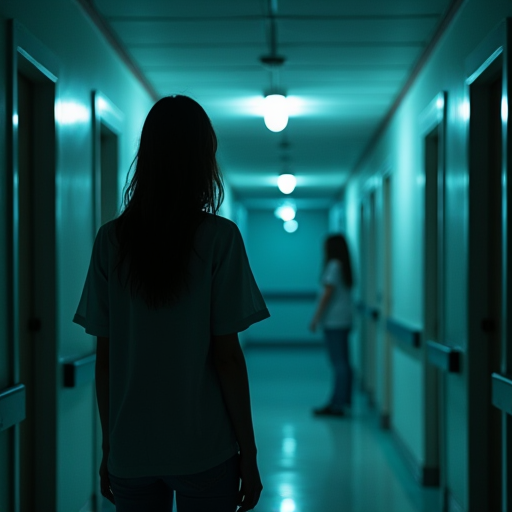
Inside, the place smelled of disinfectant, old fear, and cheap tile scrubbed too often.
He led me down one corridor, then another, as if he knew the building too well to be there innocently. The farther we went, the fewer people we saw. Waiting rooms emptied. Voices thinned. Fluorescent light became harsher rather than brighter.
At last he stopped beside a closed ward door with wired glass in the upper panel.
Through it I could see a row of narrow beds.
Girls in them.
Or what remained of girls being treated as patients.
Their faces were pale to the point of erasure. Tubes, bandages, open mouths, lashes resting on hollowed cheeks. Some looked asleep. Some looked as if sleep had become a weapon used against them.
On the nearest bed lay a girl who could have been my sister.
Or me.
Same age. Same build. Same shape around the eyes.
I turned to Sky. “What is this?”
He looked at me with something almost like pity.
“These are the girls who were taken.”
“Taken by what?”
His mouth twitched.
“Depends how much you still believe in ordinary answers.”
That was when I finally saw his eyes clearly.
They were wrong.
Not in color.
In depth.
Too dark, too still, as if the pupils led somewhere farther than anatomy should permit.
A memory flashed through me then—our chat window, his too-quick replies, the way he had dropped offline after saying he was afraid.
Not afraid of me.
Afraid for me.
Or of something using me.
“You’re not here to help me,” I said.
“No.”
“What do you want?”
He looked past me, over my shoulder.
“To see whether it had chosen yet.”
I turned.
The glass in the ward door had become reflective.
And in that reflection, standing just behind me, was a girl in ordinary clothes with my face.
My exact face.
Only emptied.
Her eyes were open too wide. Her smile arrived without emotion, like a line being drawn across paper.
I spun around.
No one there.
Back to the glass.
Still there.
The double lifted one hand slowly and placed it against the inside of the reflection, palm to palm with my own position in the corridor.
Then it mouthed something.
I didn’t hear it.
I read it.
Not yet.
⸻
I ran.
I don’t remember deciding to.
I only remember the sensation of fluorescent corridors stretching impossibly long, shoes slipping on polished floors, someone shouting behind me, and the certainty that if I reached the street before whatever had been using my face reached me, I might still belong to myself.
I made it outside.
The city was still there. Buses, horns, steam from food carts, phone booths, ordinary people with ugly shopping bags and ordinary unhappiness.
Sky did not follow.
When I looked back, he was standing just inside the hospital gate watching me with the kind of expression people wear at funerals when they know something you don’t.
Then he turned and disappeared into the building.
I never saw him again.
Not in person.
Online, yes.
That same night, when I finally got home and turned the computer back on, QQ opened without trouble.
My friend list was still mostly gray.
Except for one user.
Sky.
Before I could click, a message popped up from him:
Don’t answer anyone who looks like you.
Then his icon went black for good.
⸻
The next morning, Luna’s mother called.
Luna had collapsed during the night.
No explanation.
No fever.
No drugs in her system.
Just sudden unconsciousness and a face gone white with something nobody could name.
At the hospital she was placed three beds down from the girl I had seen in the ward.
Three more girls were admitted before the week ended.
All with similar faces.
All with similar eyes.
I stopped using chatrooms after that.
Stopped going to the market.
Stopped trusting mirrors after dark.
And once, two weeks later, while brushing my teeth, I glanced up and saw my reflection smile half a second before I did.
I smashed that mirror with the handle of the sink brush and spent the rest of the night sitting on the bathroom floor with my knees to my chest, waiting to see if broken pieces reflect less hunger than whole ones.
They don’t.
Not always.
Sometimes they just divide it better.