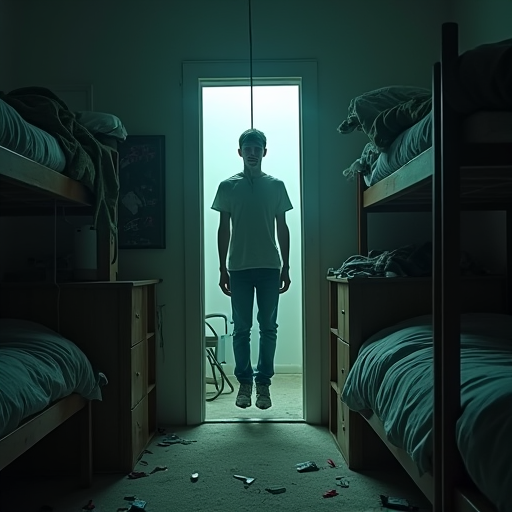
The Doorframe
That happened often enough.
The dormitory housed six male undergraduates in a room never intended for that many bodies, and by mid-semester the air itself had learned to smell like stale socks, instant noodles, cheap soap, and the slow collapse of ambition. Everyone slept badly. Everyone borrowed from everyone else. Everyone hated at least one other person in the room on a rotating basis.
So when Ben heard movement by the door and opened his eyes to see Aiden standing there, fully dressed, muttering under his breath, the first explanation that came to mind was booze.
“What time is it?” Ben mumbled, rolling toward the edge of the bed and squinting at the glow-in-the-dark hands of his watch.
Four o’clock.
He groaned.
“Aiden,” he said, “what the hell are you doing?”
Aiden smiled.
That was the first thing that felt wrong.
Not the fact that he was awake. Not the fact that he was dressed. The smile.
There was too much excitement in it. Too much private purpose. As if the morning had made a promise to him and only him.
“Come with me,” he said.
“Where?”
Aiden didn’t answer. He turned and moved away from the bed, still murmuring to himself.
Ben watched him go and, being nineteen and exhausted and not yet trained by experience to follow every instinct of dread, lay back down and went to sleep again.
The next time he woke, something was swinging in the doorway.
He sat up too quickly.
For a split second the mind did what it always does when reality presents itself in the wrong shape: it proposed alternatives.
A coat.
A blanket.
Someone hanging a bag from the frame as a joke.
Then the shape turned.
And he saw Aiden’s face.
He was hanging from the dormitory doorframe, neck stretched, eyes bulging, feet several inches off the ground, moving gently in the draft like a pendulum that had found something more interesting than time.
Ben’s scream woke the room.
⸻
The police came before sunrise.
By then the body had been cut down, the hall sealed off, and the room thick with the stunned misery unique to places where death has arrived too intimately to be abstract. No one wanted to look at Aiden’s bed. No one wanted to admit they had all slept in the same room while he prepared whatever it was he had prepared.
The officers took statements one by one.
Ben repeated the truth as best he could: Aiden had woken him at four. He had looked strange. He had asked him to come with him. Ben had gone back to sleep.
There is no version of that memory in which Ben does not hate himself.
The others were no better.
Marcus, heavyset and blunt, kept asking why anyone would choose to die there, in front of all of them, as if inconvenience were the final insult.
Eli—thin, dry-voiced, always too observant—said quietly that they all bore some responsibility.
“Responsibility for what?” snapped Ryan from the far bunk, already halfway to anger because anger was easier than grief. “He killed himself. That’s not on us.”
Eli looked toward Aiden’s desk.
“It might not be that simple.”
Aiden had a journal.
Everyone knew about it. A cheap hardbound notebook he guarded with ridiculous care, always shoving it into whichever drawer happened to be nearest whenever someone came too close.
The problem was, the drawer wasn’t even his. He had a habit of sitting at Ben’s desk whenever he wanted to write, and Ben—being less territorial than wise—had never made much of it.
Now, while the police moved in and out of the corridor and the room waited in that exhausted, invasive quiet that follows official questions, Eli crossed to the desk and pulled open the drawer.
The journal was still there.
Most of the pages had been ripped out.
Only one entry remained.
Ben took it because no one else wanted to be the first.
He read aloud.
⸻
I can’t go on like this. This life is empty. Nothing changes. Nothing means anything. There may be only one way to get what I want.
I need a stronger sensation. Something absolute. The stimulation of death.
The room went silent.
No one said what they were all thinking.
That it didn’t sound entirely like Aiden.
He had been moody, yes. Restless. Easily influenced. Hungry for novelty in the way some bored young men are when they mistake self-destruction for depth. But this voice in the notebook felt cooler. More deliberate. Less like despair than invitation.
Marcus was first to say what the others avoided.
“This reads weird.”
Ryan snorted. “What, like his ghost wrote it?”
No one laughed.
Ben turned the page over.
Blank.
No tear stains. No crossed-out sentences. No mess. Just that one entry, clean and centered, as though everything that came before it had been removed because it no longer mattered.
“Did any of you notice anything weird?” Eli asked.
Ben hesitated.
Then he admitted what he had seen at four in the morning.
The smile.
The voice.
The way Aiden had said come with me.
No one blamed him out loud for not going.
That made it worse.
⸻
The funeral happened quickly.
Campus administrations move fast when death threatens routine.
Counselors appeared. Professors made speeches about stress and mental health and the importance of reaching out. Aiden’s name became briefly sacred, then fragile, then awkward. Students lowered their voices when passing his empty seat in lecture halls. Within a week the room allocation office had already begun discussing who might eventually fill his bed.
And yet inside Dorm Room 314, nothing settled.
Ben noticed it first.
At night, just before sleep, he would hear a faint knocking on the doorframe above the lock. Never loud. Never urgent. Just a patient little tap, tap, tap, as though someone were testing the strength of the wood.
The others heard things too.
Marcus swore he woke once to see Aiden standing by the door, head tilted, rope mark dark around his neck, looking mildly disappointed.
Ryan developed the habit of sleeping with headphones on at full volume and still woke twice a week screaming.
Eli, who kept pretending to believe in nothing but evidence, started refusing to sit at Ben’s desk.
One rainy evening, a new detail emerged.
Ben was sorting through some of Aiden’s abandoned notes—mostly terrible class outlines and half-copied quotes from books he clearly had not understood—when he found, tucked between pages of a chemistry notebook, a thin scrap of paper.
On it, in Aiden’s handwriting, were only five words:
If one goes, one returns.
Nothing else.
No context.
No explanation.
Ben took it to Eli immediately.
Eli read it twice and said, “Maybe he joined something.”
“What kind of thing writes slogans like that?”
Eli didn’t answer.
But both of them were thinking the same word.
Cult.
Campus never lacks them. They just wear different clothes depending on the decade—spiritual societies, hidden study circles, experimental groups, philosophy clubs with bad boundaries and worse leaders. People will build churches out of boredom if you give them enough basement space and one charismatic liar.
Ben started asking questions.
Quietly at first.
Then less quietly.
The name that kept surfacing, never directly and never from anyone willing to say too much, was a senior called Luke Vance.
Brilliant in the theatrical way undergraduates confuse with real intelligence. A dropout once, then not. Always around campus, never formally in charge of anything, yet somehow at the center of circles that formed and dissolved without leaving documentation. He was rumored to hold midnight gatherings in disused classrooms. To talk about altered states, consciousness thresholds, and how close to death a person had to come before perception opened in useful ways.
Ben’s stomach turned cold when he heard that.
Because Aiden had always wanted stronger experiences. Stronger feelings. More sensation. More meaning. Anything that might prove he was alive in a way ordinary days never managed.
He would have followed a man like that.
Right up to a noose.
⸻
They found Luke three nights later.
Or perhaps Luke found them.
Ben, Eli, and Marcus were coming back from the library just after midnight when they saw a light on in one of the old language classrooms in the abandoned annex building near the rear athletic field.
There shouldn’t have been anyone there.
The annex was half condemned.
Naturally, they went in.
Young men mistake bad instincts for courage all the time.
The room at the end of the corridor stood open. Light spilled through it in a pale yellow rectangle across cracked tile. Inside, Luke Vance sat on a desk with one ankle crossed over the other, as though he had been expecting them all evening.
He was handsome enough to be trusted by the wrong people and ordinary enough to be forgotten by the right ones. That, Ben thought later, was probably his greatest talent.
“I wondered when one of you would come,” Luke said.
Marcus moved first, grabbing him by the collar and half-yanking him off the desk.
“What did you do to Aiden?”
Luke didn’t resist.
Didn’t even look surprised.
Instead he smiled the exact same way Aiden had smiled at four in the morning.
Ben felt his whole body go cold.
“What are you talking about?” Luke asked mildly.
Eli answered before Marcus could hit him.
“The meetings,” Eli said. “The death talk. The phrase in his notebook. Whatever game you were playing, it ended with our roommate hanging from a doorframe.”
Luke’s expression shifted—not into guilt, but something like pity.
“You think I killed him?”
“Didn’t you?”
Luke adjusted his collar after Marcus let go.
“No,” he said. “I only showed him the door.”
Ben took one step backward.
Luke looked directly at him then.
“Did he ask you to come with him?”
Ben couldn’t speak.
Luke’s smile widened just slightly.
“He wanted company. That was brave of him, actually.”
Marcus swung at him then.
The punch landed hard enough to split Luke’s lip.
He laughed.
Not because pain amused him.
Because the room behind them had just changed.
Ben saw it in Marcus’s face first.
Then in Eli’s.
Then he turned.
Aiden was hanging in the doorway.
Not a hallucination this time.
Not a dream-shape at the edge of waking.
The rope cut deep into his neck. His face was blotched and swollen. His feet turned slowly above the floor. And though gravity pulled him downward, his eyes looked forward with fixed, terrible attention.
At Ben.
His mouth opened.
The voice came out wet and broken, but unmistakable.
“You should have come.”
Marcus screamed.
Eli stumbled into a desk.
Luke only sat back down on the table and watched as though the scene were proving a point in a lecture.
Aiden’s body began to sway toward them in long, impossible arcs, rope creaking against nothing visible above.
Then the lights went out.
What followed survived only in fragments.
Splintering wood.
Someone falling.
A hand, cold as soaked rope, closing around Ben’s wrist.
Luke’s voice in the dark saying, very clearly: You don’t need to die to go through the doorway. You only need to want it enough.
When the emergency lighting came on thirty seconds later, the room was empty except for the three of them.
And Luke.
Aiden was gone.
The doorway was bare.
Only the beam above it showed a deep new groove, as though something under terrible strain had cut into the wood again and again.
⸻
Luke Vance vanished before the police could question him.
Of course he did.
Men like that rarely leave bodies behind when they can become rumors instead.
The university blamed drugs, hysteria, unresolved grief, collective trauma.
Ben did not argue.
By then he understood something worse than whatever official explanation they offered.
Aiden had not simply killed himself.
He had gone looking.
For the threshold.
For sensation.
For whatever came after the ordinary misery of being young and dissatisfied and easily persuaded.
And something had answered him.
Whether Luke had found it first or merely learned how to stand near it without being taken, Ben never discovered.
The room was reassigned the following semester.
Ben transferred out.
Marcus dropped out entirely.
Eli stayed, because some people would rather haunt a place from the living side than admit it beat them.
Years later, Ben still wakes sometimes around four in the morning with the certain feeling that someone is standing just inside the bedroom door, dressed properly, smiling patiently, waiting to ask one last time:
Come with me.
He never answers.
That, he has learned, is the only reason he is still here.