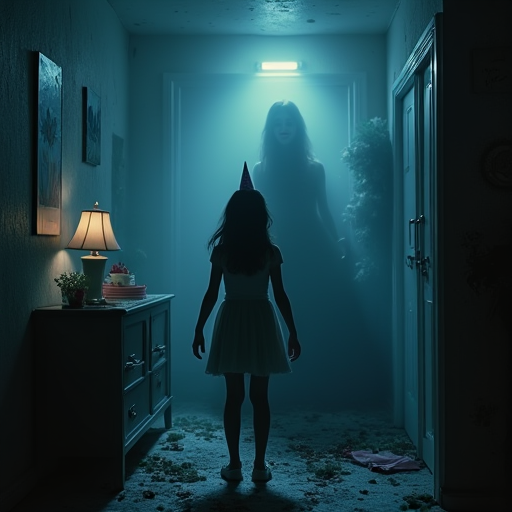
July Fourteenth
Not enough to refuse cake. Not enough to hide the date when filling out school forms or chatty little “about me” pages. Just enough to make every July feel faintly wrong, like a smile held too long.
She had been born on July fourteenth.
In her family’s old village calendar, that date overlapped every few years with the Ghost Festival—the night people said the gates of the underworld loosened and the dead were allowed a little air. Anna had spent most of her life insisting to herself that the superstition didn’t count. Different calendars. Different systems. Different worlds.
Still, the date stuck to her.
When she was little, she resented her parents for choosing such an unlucky day to bring her into the world, as though birth had been a scheduling error someone should have corrected out of courtesy.
By the year she turned eighteen, the feeling had grown worse.
Not childish now.
Heavy.
Because a week before her birthday, she wandered into a shop she should never have entered.
⸻
It stood halfway down a side street she could not later retrace properly.
A cramped little place between a shuttered herbalist and a store that sold phone cases and counterfeit jewelry. The sign over the door was faded to near illegibility. Inside, the air smelled of dust, incense, and rain-soaked paper.
The light was low.
Objects crowded every shelf—thread bracelets, old coins, paper talismans, little clay gods, mirrors clouded with age, brass bells, faded packets of joss paper, lacquered boxes with painted eyes, wind chimes that did not move though the door had just opened.
Anna should have left immediately.
Instead she heard a voice from the corner.
“Come here, child.”
An old woman sat behind a narrow table, so still that Anna had mistaken her at first for part of the room’s inventory. Her skin was thin and drawn tight over her face. Her eyes were bright and oddly merry.
Anna hesitated.
The old woman crooked one finger.
“I’ll tell your fortune for free.”
That should have sent her back into the street.
Instead, because youth confuses invitation with fate, Anna stepped closer.
The old woman took her wrist, asked her birth date, and at once stopped smiling.
Then, just as quickly, the smile returned.
“A dangerous birthday,” she murmured.
Anna tried to laugh. “That sounds dramatic.”
“It should.”
The old woman released her wrist and reached beneath the table, producing a little mirror set in tarnished brass.
“Look.”
Anna did.
At first she saw only herself—the pale oval of her face, dark hair tied back carelessly, the unease already forming in her eyes.
Then another face appeared beside hers.
Not behind her.
Beside her in the mirror.
Same features. Same age. Same mouth.
But colder.
Calmer.
Watching.
Anna jerked away and nearly knocked over the table.
The old woman did not move.
“You have had a shadow following you from birth,” she said quietly. “On the night you turn eighteen, it will want what it was denied.”
Anna backed toward the door.
“What does that even mean?”
The old woman only smiled again and slid a folded strip of yellow paper across the table.
“A name is a door. A date is a hinge. Keep this with you if you wish to know which side of yourself wakes after midnight.”
Anna snatched up the paper mostly because not taking it felt more frightening than taking it.
By the time she stumbled back into the street, the sky had darkened with storm clouds.
When she looked over her shoulder, she could not immediately find the shop again.
⸻
She told no one.
That, later, became one of her favorite ways to blame herself.
Not because anyone would have believed her. They wouldn’t have. But silence creates its own architecture of guilt.
At home, preparations for her birthday were already underway. Friends texting. Plans forming. A small party at her house. Nothing extravagant. Eighteen meant adulthood in the most technical, fraudulent sense of the word, and everyone around her seemed determined to celebrate it.
Her closest friend, Julia, insisted on helping with decorations.
Her friend May brought flowers.
Eric—charming, unreliable, and exactly the sort of boy eighteen-year-old girls mistake for complexity—promised he’d come late because he “had something special planned.”
Anna kept the yellow paper folded in her pocket.
Sometimes she touched it just to make sure it was still there.
By the afternoon of her birthday, she had almost convinced herself the old woman had been a bored charlatan and the mirror a trick of light.
Then the first strange thing happened.
She went into the bathroom to reapply lipstick and glanced at the large mirror over the sink.
For a split second, her reflection was not copying her.
It was already smiling.
Anna was not.
By the time she fully registered it, the image had caught up.
She stood frozen, one hand still raised near her mouth.
“Get a grip,” she whispered.
But the whisper shook.
The second strange thing came during photographs.
Everyone gathered around her—Julia laughing, May adjusting the candles, Eric not yet there, half the room warm with chatter and flashbulb energy.
A friend named Faye kept taking photos obsessively, determined to use up the entire disposable camera before the night was over.
At one point, annoyed to find she still had two exposures left, Faye grabbed the camera and disappeared into the bathroom joking that she might as well photograph herself in the big mirror.
Minutes later she came running out pale and breathless.
“What’s wrong with you?” Julia asked.
Faye held the camera to her chest and laughed too loudly.
“Nothing. Bad lighting.”
But she wouldn’t meet Anna’s eyes.
⸻
The party lasted until almost midnight.
Music. Cheap cake. Warm soda. Someone broke a glass. Someone else spilled punch. Eric showed up late with a grin too easy to trust and a silver bracelet he claimed he bought just for her.
Anna barely heard half the things people said.
The whole evening had developed that dense unreal quality some nights acquire before disaster, when every ordinary detail seems overlit, as if reality itself is waiting for its cue.
Julia sat on Anna’s right.
They smiled in photographs.
They cut the cake.
They opened presents.
And all the while, Anna felt the folded yellow paper in her pocket growing warmer against her thigh.
At five minutes to midnight, the power flickered.
Everyone groaned.
Then laughed.
A birthday ghost, someone said.
Anna didn’t laugh.
At exactly midnight, the hallway clock began to chime.
Once.
Twice.
The room fell strangely quiet by the fourth note.
By the eighth, Anna realized the others had gone still because she had.
By the twelfth, she could no longer feel her fingers.
At the fourteenth chime, every light in the house went out.
A scream rose from somewhere near the kitchen.
Another from the hallway.
Then a voice from the darkness said, almost conversationally:
“I’ve been waiting.”
Anna knew the voice.
It was hers.
⸻
The emergency light from the street came through the curtains just enough to turn faces into pale floating shapes.
Someone knocked over a chair.
Someone else began crying.
Julia found Anna by touch and grabbed her hand.
“It’s okay. It’s just the power.”
Anna wanted to answer.
She couldn’t.
Because across the room, outlined faintly in that thin gray spill of outside light, stood another girl.
Her height.
Her hair.
Her face.
Anna’s face.
Only composed differently—as if all her hesitations had been removed and the remaining self had condensed into something colder, cleaner, and far less afraid.
The double smiled.
“Finally,” it said.
Several people screamed at once.
Eric shouted something useless from the back of the room.
The thing wearing Anna’s face turned slowly toward the sound and then, with bored contempt, dismissed him.
Its attention returned to Anna.
“You had eighteen years,” it said. “That was generous.”
Julia was sobbing now, still clutching Anna’s arm. “What is that?”
Anna tried to move.
The yellow paper in her pocket burned suddenly hot enough to hurt.
The double’s smile vanished.
“Still carrying charms?” it asked softly. “How disappointing.”
Then it came forward.
Not running.
Not gliding.
Walking with that awful intimate confidence only something familiar can have.
Julia yanked Anna backward. May threw a vase. It passed through the thing and shattered against the wall. Eric finally lunged toward it, whether from courage or panic no one could later say.
The double turned and caught him by the throat with one hand.
Its fingers sank into flesh.
Eric gagged.
Anna found her voice then, though it tore her throat raw getting out.
“Stop!”
The double looked at her.
For a moment, its face shifted—not into a monster, exactly, but into a truer version of the thing beneath. Something starved. Something patient. Something that had spent eighteen years waiting in a mirror-dark crack just beyond naming.
“Why?” it asked. “He would never have chosen you for keeps.”
The cruelty of that landed because it was plausible.
Anna hated that most of all.
Julia shouted for her to do something with the paper.
Anna pulled it from her pocket.
The yellow strip had become damp, though her clothes were dry. Unfolding it with shaking fingers, she saw not a prayer or a sigil but a name written in dark ink.
Not hers.
The other one’s.
Or perhaps the one that should have been hers.
Before she could read it fully, the double snarled and threw Eric aside. He hit the cabinet hard enough to collapse in a boneless heap.
Then the thing lunged.
Anna did the only thing available to her.
She slapped the yellow paper against the center of its forehead.
For one instant, everything in the room became impossibly still.
Then the double screamed.
The sound seemed to come from behind walls, beneath floorboards, out of old mirrors, through drains and keyholes and all the narrow unseen seams where a house keeps its darkness.
The lights returned in one violent flash.
And the thing was gone.
Only Anna remained standing in the middle of the room, half-blind with tears, the yellow paper limp in her hand and a line of blood running from one nostril down to her lip.
Everyone stared at her like she was either saved or not entirely herself.
To be fair, she did not know which.
⸻
In the days that followed, the story fractured immediately into versions.
Power outage.
Mass panic.
A prank.
Stress.
Too much alcohol.
Someone had a breakdown.
Someone was attacked.
No one agreed.
Faye developed the photographs from that night and found, in the last frame taken in the bathroom mirror, two Annas standing side by side.
She burned the photo.
Eric recovered, though the bruises on his throat stayed a long time.
Julia refused to sleep over again.
As for Anna, she turned eighteen and never quite felt singular after that.
Sometimes, passing a mirror too quickly, she catches the faintest lag in her reflection.
Not much.
Just enough to remind her that adulthood is not always an arrival.
Sometimes it is a successful defense.
And every year, as July fourteenth approaches, she dreams of the little dark shop and the old woman smiling from the corner, as if birthdays are only doors and some of them open both ways.