The Cheating Case
He held the altered exam papers in one hand like they were contaminated evidence and barked loud enough for half the faculty office to hear.
“This is fraud,” he snapped. “Not cheating. Fraud.”
One by one, the other teachers gathered around.
Someone took a sheet from the pile and frowned. The grade had clearly been tampered with. A 58 clumsily turned into an 88. A 19 rewritten as a 79. More papers showed the same crude ambition, the same childish arrogance—as if whoever had done it believed numbers became true if they were only written hard enough.
Russell slapped another sheet down on the desk.
“And this,” he said, “is even worse.”
It was blank.
Completely blank except for a name written at the top in careful ink:
Kevin Nolan
The office went quiet.
“Do we even have a student by that name?” someone asked.
Russell had already checked.
“No. No such student.”
Across the room, Mr. Simon Shaw stood too fast from his chair.
The movement was so abrupt that everyone turned.
His face had lost all color.
“You all right?” Russell asked.
Simon forced a laugh that convinced no one. “Fine. Just startled.”
“Do you know the name?”
Simon swallowed. “No.”
He lied badly.
Russell, too occupied with his own indignation, either didn’t notice or chose not to.
“These students have gone too far,” he declared, gathering up the papers. “I’m going to find out who did this if it takes all week.”
He stormed out to class.
The office slowly settled back into its usual low murmur, but Simon did not move. He remained seated, staring past the desk as if someone invisible had just taken a place in the chair opposite him.
The name had reached into him and pulled open a door he had spent fifteen years trying not to touch.
Kevin Nolan.
He had told himself often enough that time softened everything.
It was a lie.
⸻
Fifteen years earlier, Simon had been a younger man.
That was part of the problem.
Young men often mistake cruelty for authority and volume for conviction. Young teachers do it too. Especially the insecure ones, the ambitious ones, the ones who fear mockery more than they fear injustice.
Kevin Nolan had been a terrible student.
Not wicked. Not lazy. Just hopeless under pressure. He failed exams with remarkable consistency, and when panic overtook him, he cheated in ways so clumsy they were insulting. Changed report cards. Altered marks. Tried once to copy answers directly from a grading key and got half of them wrong because he copied someone else’s test code instead of the responses.
Each humiliation made the next one more certain.
By the time Simon had him in class, Kevin had already become a joke among staff.
And one evening, after catching him altering his grades again, Simon lost his temper.
He said things that should never be said to a child by anyone, least of all by a teacher.
You’re a disgrace.
You humiliate this school.
You are too stupid even to cheat well.
If this is all you’re going to be, maybe the world would be better off without you.
He regretted it the moment the words left his mouth.
But regret is often the most useless emotion available.
That night, Simon received a note.
It was written in awkward, formal handwriting.
A goodbye letter.
Kevin called himself a fool. Said Simon was right. Said he had no place among decent students, decent people, decent futures. Said there was no point in continuing.
Simon ran.
He searched the dormitories, the side roads, the athletic field, finally the woods behind the school.
He found Kevin hanging from a tree.
The boy’s body turned faintly in the wind like a stopped pendulum. His face was bloated and pale. His tongue hung grotesquely from his mouth. Blood had dripped from the bitten tip and dried dark on his chin.
The eyes were open.
What Simon remembered most, even years later, was not the horror of the corpse.
It was the expression.
Not accusation.
Not rage.
Something emptier.
A look that said: You told me what I was worth, and I believed you.
Simon never forgave himself for that.
Not really.
He continued teaching. He aged. He buried the story under work and routine and polite silence. But certain autumn nights brought it all back with nauseating clarity—the cold, the trees, the swaying legs, the impossible stillness of the dead once their final argument with life has ended.
And now the name had returned.
On a blank exam paper.
As if the boy had remembered how poorly he performed in life and decided to submit one more unfinished answer.
⸻
The following evening, Simon was assigned overnight duty.
The school was a private institution with a reputation for rigor and no patience for scandal. State exams were scheduled for the next day, and the sealed paper packets had already been delivered and locked in Storage Room A.
Before leaving, Vice Principal Yu repeated the instructions twice.
“Check the room yourself. Recheck it later. If students are trying to steal the exam, tonight will be the night. And Shaw—if anything goes wrong, I don’t need to remind you what that will mean.”
No, Simon thought. You don’t.
By midnight the campus had emptied into that strange institutional silence peculiar to schools after dark. Hallways became tunnels. Window reflections became unreliable. Every small sound seemed to have walked a long distance to reach him.
Simon wrapped himself in his coat and left the duty office to inspect the storage building.
Outside, the wind was bitter.
Dead leaves scraped across the pavement like paper dragged by invisible hands. A thin yellow moon hung low over the courtyard, weak and sickly. Somewhere a night bird called once and then was silent.
The weather was too similar.
That was what unsettled him first.
The same wind.
The same moon.
The same sense that the world had become a stage for something already decided.
By the time Storage Room A came into view, Simon was sweating under his coat despite the cold.
The building sat low and square at the edge of campus. In the moonlight it looked less like a storage room than a mausoleum.
He actually stopped several yards short, heart thudding, because for one insane second he thought he saw a face looking out from the upper window—pale, swollen, tongue protruding.
Then he blinked.
Nothing.
Just shadow.
Hallucinations, he told himself.
Fatigue. Memory. Nerves.
He unlocked the door.
Inside, moonlight fell weakly across the table by the window. A stack of papers there seemed to stir as if a breeze were riffling through them page by page.
“That damn window,” Simon muttered.
He flicked on the light.
The papers stopped moving.
The window was shut.
He stared at it for several seconds.
Then he noticed the cabinet.
Its door was open.
The padlock hung loose.
A rush of cold flooded him that had nothing to do with temperature.
He lunged for the cabinet and saw at once that one of the sealed exam packets on the top shelf had been slit open.
For a moment he could barely breathe.
He checked the contents.
All the papers were still there.
That, somehow, made it worse.
Someone had opened the packet, looked inside—perhaps copied questions, perhaps failed to steal what they came for—and then left. Which meant the exam may already have been compromised. Which meant Simon, the man on duty, was already finished whether or not anyone could prove it.
Unless, of course, no one found out.
He stood there thinking with the swift, ugly clarity panic sometimes produces.
If the packet still contained every paper, then maybe nothing had been stolen.
If nothing had been stolen, then maybe the damage was only procedural.
If no one saw the cut seal, then maybe there was no damage at all.
He looked around the room, found glue, paper, and tape, and carefully resealed the packet himself.
Not perfectly.
But well enough, he hoped, to pass a casual inspection.
He put it back on the shelf. Closed the cabinet. Refastened the lock.
Then he sat down heavily on the spare chair by the wall, wiped sweat from his forehead, and let out one long exhausted breath.
Behind him, someone else sighed.
Not loudly.
Just enough.
Simon went rigid.
He turned slowly.
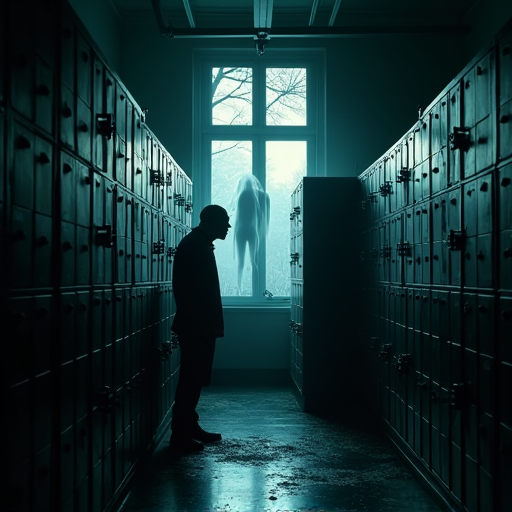
A man stood by the desk near the window with his back to him.
The figure turned.
The face was gray-white. The tongue hung long from the mouth, dark blood dripping from the tip. The eyes bulged slightly and shone with the dead fixity of a body that had swung too long from a rope.
Kevin Nolan smiled.
Simon made a choking sound and collapsed.
⸻
When he woke, the room was normal again.
The lights were on. The cabinet was shut. The desk stood empty. No hanging boy. No blood. No dripping tongue.
Simon dragged himself to his feet, shaking.
It was a hallucination, he thought. Had to be.
He locked the room, stumbled back to the duty office, and spent the remainder of the night staring at the wall with every light on.
Morning came anyway.
Morning always does, no matter how badly the night has gone.
In the examination hall, the invigilators opened the packets.
At first, everything looked fine.
Then one teacher found it.
A blank paper.
Name written neatly at the top:
Kevin Nolan
The forged seal on the packet was noticed almost immediately after that.
Vice Principal Yu was summoned.
Then the headmaster.
Then the rest of the story unraveled in minutes.
Why had the packet been tampered with?
Why had Simon not reported it?
Who had resealed it?
What, exactly, had happened during his watch?
He denied nothing.
By then, denial would only have made him smaller than he already felt.
When the disciplinary hearing ended, he packed his things into a single battered case and left campus by the front gate just after noon.
The autumn light was thin and colorless.
As he walked, he heard a voice at his shoulder—clear as if spoken by someone just out of frame.
Your cheating was always so pathetic.
You were a fool.
You had no right to live.
It was his own voice.
The voice he had used on Kevin.
Simon stopped for only a second.
Then, with a strange tired smile, he turned away from the road and began walking toward the woods behind the school.
Toward the place where the boy had been waiting fifteen years for someone to understand what failure really costs.