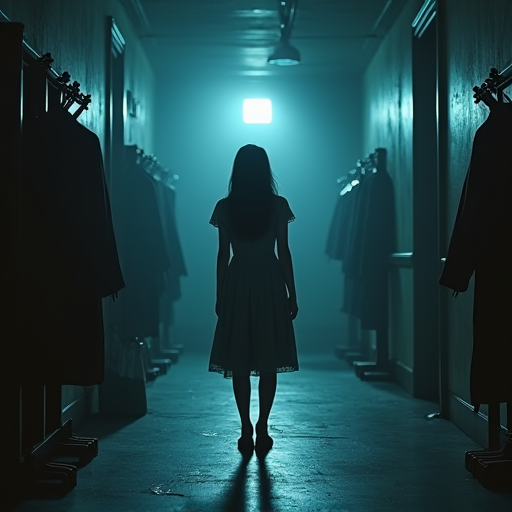
The Girl in Gray
The campus theater was still humming with after-performance excitement. The show had gone well—better than expected—and backstage everyone was flushed with relief, sweat, makeup, and the dazed joy that comes after surviving public failure by not failing at all.
Bao’er should have been happy. Most of the cast was. Her best friend, Yancy, was practically glowing. Someone suggested they take photos before anyone wiped off their stage makeup, and within seconds the whole dressing area dissolved into shrieking chaos and clattering chairs.
Then one of the girls looked around and asked, “Where’s Ray?”
Nobody knew.
A second later, something slammed hard against the corridor wall.
Heads snapped around.
Ray came stumbling toward them from the direction of the makeup rooms, face white, eyes wild, one hand outstretched as if fending off something only he could still see.
“Help…” he gasped.
One of the boys laughed and slapped him on the shoulder. “Cut it out, man. Show’s over.”
Ray collapsed without another sound.
That was when everyone understood something was wrong.
The girls screamed. Someone backed into a rack of costumes. Somebody else started crying immediately, as if tears were the only sensible thing in a world that had just turned sideways.
Bao’er moved before anyone else did.
She crouched beside Ray, checked his pulse, then stood up and said sharply, “He’s alive. Get him to the infirmary. Now.”
Without waiting for permission, she headed for the dressing rooms.
Yancy followed her. So did several others.
The makeup room door stood half open.
Inside, a girl was lying on the floor.
Dead.
Her face had already gone a dull bluish purple, and on her throat were two handprints—clear, red, unmistakable. Not bruises. Not scratches. Handprints, as though someone had strangled her with deliberate, furious force.
Bao’er stopped in the doorway.
For one terrible second, the room seemed to contract around that sight.
Murder, she thought at first.
Or something trying very hard to look like murder.
Because before her eyes, the marks began to fade.
Not quickly. Not dramatically. Just slowly enough to be undeniable.
It was like watching red watercolor sink back into paper.
Within moments the handprints had almost disappeared.
Bao’er felt something cold shift inside her.
No one else seemed to notice at first.
She did.
And once she had seen that, she could no longer make herself believe this was only the work of human hands.
⸻
That night she dreamed of a woman with long dark hair and a gray dress.
Not a modern dress. Something older. Looser. The kind of thing that seemed to belong to no one who was still alive.
The woman stood just beyond full view, smiling.
Bao’er could never see her face properly. It was always in shadow, always just a little blurred, as though the dream itself refused to let her focus. But she could see the mouth.
The smile was patient.
Amused.
And somehow deeply cruel.
In the dream, the woman moved in a circle around her, slow and unhurried, while a whispering laugh echoed from everywhere at once.
Bao’er woke screaming, drenched in sweat.
By then morning light had already filled the dorm room.
She checked her phone and swore aloud. Nine o’clock.
Everyone else was gone.
Yancy had left breakfast for her—milk, eggs, a note in neat handwriting telling her to rest, reminding her that she’d twisted her ankle the night before and should stay in bed.
The note was so kind that Bao’er almost cried.
Yancy had always been like that. The practical one. The gentle one. The one who noticed when Bao’er forgot to eat or hadn’t slept enough or was pretending to be braver than she felt.
Bao’er was halfway through the cold milk when someone knocked on the door.
It was Luke.
Luke Tate—older student, campus heartthrob, impossible smile, and the man Bao’er had loved with the private hopelessness of someone who already knows how the story ends.
He held up a paper bag. “Brought you breakfast.”
She laughed. “Yancy already beat you to it.”
Something flickered across his face, then was gone.
“I wanted to check on you anyway.”
He sat for a while at the edge of her bed, talking softly, asking about her ankle, the show, the dead girl, whether she had slept. Bao’er noticed he looked different somehow. More tired. More distant. As if he were speaking from farther away than the room itself.
When he stood to leave, he paused at the door.
“No matter what happens,” he said quietly, “I’ll stay with you. I’ll protect you. However I have to.”
Bao’er smiled, assuming he meant it in the ordinary way.
Only later did she remember that ordinary people don’t promise things like that.
Not with that expression.
Not as if they are already keeping a vow made after death.
⸻
Because Luke had died before any of this happened.
That was the part no one liked to discuss openly.
A month earlier, he had died in an accident everyone on campus described differently depending on how badly they needed it to make sense. Fall. Suicide. Structural failure. Drink. A bad step in the wrong place at the wrong time.
Bao’er had never believed any of it completely.
All she knew was that one day he had been there—laughing, leaning in doorways, carrying books for girls who pretended not to swoon—and the next day he had become flowers, memorial candles, and a framed photo in the student center.
And now he had sat on the edge of her bed, carrying breakfast.
By the second night after that, Bao’er no longer trusted herself to say what was real.
She stopped sleeping properly.
Whenever she did drift off, the girl in gray came back.
Sometimes she only stood there smiling.
Sometimes she whispered.
Sometimes Bao’er woke with the conviction that someone had been standing beside her bed, watching her breathe.
Then the attacks began.
A student collapsed in a hallway with bruising around the neck that vanished before help arrived.
Another was found unconscious near the auditorium.
Ray, who had been first to stagger out of the makeup room, refused to talk about what he had seen before he fainted. Whenever anyone asked, he burst into tears or trembled so hard he couldn’t hold a cup.
The faculty called it mass hysteria.
The students called it a haunting.
Bao’er said nothing.
Somewhere in her silence, she knew the second explanation was closer.
⸻
One morning, after another sleepless night, she woke to find Luke beside her again.
Not entirely solid.
Not transparent either.
Just… wrong in the way reflections are wrong when seen in dark water.
He was sitting in her chair, watching her as if he had been there for hours.
She should have been terrified.
Instead she started crying at once.
He crossed the room and held her. His arms felt cool, but not empty.
“I’m not here to take you with me,” he murmured into her hair.
That only made her cry harder.
He drew back enough to look at her. “You have to stay alive.”
“I don’t want to stay if you’re gone.”
His expression shifted—not surprise, not pleasure, but grief.
“Bao’er.”
“I mean it.”
He touched her cheek, and there was something unbearably gentle in it.
Then he said the strangest thing yet:
“This isn’t your fight. It never was.”
Before she could ask what that meant, he was gone.
⸻
The answer came later that night.
Bao’er had finally fallen into an exhausted half-sleep when she found herself standing in the administration building.
No rain. No footsteps. No one else around.
Just the long polished corridor and the dim institutional glow of emergency lights.
Dream, she thought immediately.
But it didn’t feel like one.
At the far end of the hall, a door stood open, and warm light spilled through it.
Bao’er moved toward it.
Inside, Luke stood by a filing cabinet, sorting papers. He looked alive this time—fully alive, as real as she had ever known him. She stopped in the doorway and simply watched him, not wanting to break the fragile miracle of it.
Then someone walked straight through her.
Yancy.
Bao’er turned sharply.
Yancy crossed the room, smiling.
“Working this late?” she asked Luke.
Luke looked up and laughed. “Trying to find something for Bao’er.”
The words hit Bao’er with a strange, bright tenderness.
Even here, even then, he had been thinking of her.
But Yancy had gone quiet.
“I envy her,” she said at last.
Luke didn’t seem to hear.
Yancy stepped closer. “Why is it never me?”
Luke frowned.
Bao’er felt the air thicken.
“What are you talking about?” he asked.
“I love you.” Yancy’s voice trembled. “Do you think you could ever love me?”
Luke looked stunned more than anything else.
“Yancy…”
“I’m serious.”
He took a careful step backward. “You’re a wonderful person. But that’s not—”
“Not what?” she snapped.
The room darkened at the edges.
Her expression changed.
Not into anger. Into something worse.
Humiliation sharpened into hatred so quickly it was almost beautiful.
“Why her?” Yancy whispered. “What does she have that I don’t?”
Luke said something Bao’er couldn’t hear.
Yancy began to cry.
Then laugh.
Then cry again.
The sound curdled into something inhuman before the dream tore sideways.
Bao’er saw motion—a push, a fall, a sickening impact she felt more than saw.
Then she was back in darkness, on her knees, with the girl in gray standing directly in front of her at last.
And this time Bao’er understood.
The girl in gray was not a stranger.
It was Yancy.
Or what remained of her after love, shame, jealousy, and death had stripped away everything else.
Only now did the dress make sense.
Only now did the smile.
Only now did the handprints.
⸻
Bao’er woke with a scream.
The dorm room was dark.
Yancy was sitting beside her bed.
Alive. Apparently. Quietly smiling.
“Bad dream?” she asked.
Bao’er could not answer.
Yancy leaned closer.
“You’ve been calling his name in your sleep,” she said softly.
Bao’er felt every hair on her body rise.
Yancy’s face looked normal.
Almost.
Only the eyes were wrong.
Too still. Too bright. Too aware.
From then on, Bao’er barely left her bed.
Everyone said she was traumatized. That the death backstage had pushed her over the edge. That Luke’s old death had never really left her, and now the new one had cracked her mind open.
Maybe that was even partly true.
But the real reason she stopped speaking was simpler.
She had begun to understand that Yancy knew Luke still came to her.
And Yancy would never forgive that.
⸻
The final attack happened in the old hall.
No one later could agree on why Bao’er had gone there, only that she had been found unconscious and sobbing, and that another student—Jeremy, one of the boys from the theater crew—had been thrown hard enough against a wall to crack two ribs.
Bao’er was the first to wake in the hospital.
When she opened her eyes, tears rolled soundlessly down into her hair.
She did not speak for days.
Yancy rarely left her side.
Everyone thought this was devotion.
No one understood that Bao’er spent every waking second wondering whether the thing sitting beside her bed was her best friend or the ghost of what jealousy had left behind.
One night, after the others had gone to sleep, Bao’er sat up in bed and whispered into the dark:
“Luke?”
He came.
Not through the door.
Not through the window.
He was simply there, as if he had been waiting just outside the edge of sight.
Bao’er threw her arms around him and clung so hard it hurt.
“I’ll go with you,” she said. “If that’s what it takes.”
He held her in silence for a long moment.
Then he said, very gently, “No.”
She shook her head against his chest. “I mean it. I would go to hell with you.”
“That’s exactly why you can’t.”
He pulled back, resting his forehead against hers.
“This is not where you belong.”
She was crying too hard to answer.
“All I can do now,” he said, “is keep her from taking you.”
“Yancy?”
His expression told her enough.
“Is she dead?”
He didn’t answer.
Which was answer enough.
“Did she kill you?”
Still silence.
Then, at last:
“Wake up, Bao’er.”
⸻
When she opened her eyes again, she was back in the dormitory.
Girls were crowding around her bed.
Someone was shouting for water. Someone else was crying. A nurse was pushing through the doorway.
Bao’er stared at the ceiling while tears ran into her ears.
After that, she lived.
That was the strangest part.
She didn’t recover, exactly. She simply continued.
She stopped going out alone at night.
She never again walked through the theater corridor without feeling hands at her throat.
She avoided mirrors in dim rooms.
And though Yancy still attended classes, still smiled, still brought her breakfast and asked if she had slept—Bao’er never once forgot what she had seen in the administration building.
Sometimes love does not die when the body does.
Sometimes it rots and stays.
Sometimes it waits beside your bed wearing the face of the person who once knew exactly how you liked your tea.
Years later, Bao’er still dreams of the girl in gray.
Always smiling.
Always circling.
Always just beyond the light.
And in the dream, somewhere behind that smile, another pair of eyes is watching too.
Luke’s.
Keeping his promise.