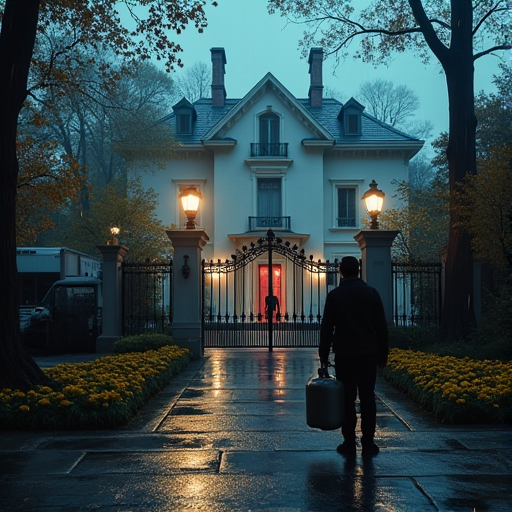
One Night on Lotus Lane
Back then, I made my living delivering propane tanks. It was dirty work, hard on the back, and in a big city most people wanted nothing to do with it. Which, oddly enough, made it decent business for people like me.
My wife, Laura, handled the phone orders. She answered calls, wrote down addresses, and kept the books in a school notebook with bent corners and grease-smudged pages.
It was a Saturday night in late autumn, and the rain had been falling for hours.
We were in bed watching television, the room dim and warm, the windows rattling softly under the wind. Outside, the city sounded washed out and far away. Inside, with Laura beside me in the yellow light, life felt small and safe and good.
Then the phone rang.
Laura muttered something under her breath, threw back the covers, and padded into the living room.
A moment later I heard her saying, “Could you repeat that? I’m writing it down.”
A pause.
Then: “Lotus Lane, number thirteen. Got it. We’ll be there in half an hour.”
Lotus Lane.
Even half-asleep, the name caught my attention.
It was the richest residential street in the city, the kind of place people mentioned with a mixture of envy and contempt. The houses were huge, the gates ornate, the lawns professionally trimmed. People said even their pets cost more than my van.
I sat up in bed.
Laura came back grinning, cheeks bright with excitement.
“You’re kidding,” I said.
“What?”
“It’s raining sideways out there. Let’s go tomorrow.”
She gave me the look she always used when she thought I was being lazy and knew she was about to win.
“It’s Lotus Lane.”
“That’s not an argument.”
“It absolutely is. Those people could become regular clients.”
“It’s almost ten.”
“So?”
“So normal people don’t need propane delivered in a storm at ten at night.”
She crossed her arms. “If you won’t go, I will.”
That was that.
Fifteen minutes later we were loaded and on the road.
⸻
The streets were nearly empty.
Rain glossed the pavement black. Streetlights reflected in the wet road in long yellow streaks that looked less like light than memory. Our windshield wipers beat out a steady rhythm, and Laura chattered the whole way, her excitement rising the closer we got.
For people like us, a street like Lotus Lane wasn’t a place. It was a fantasy.
The entrance was marked by a huge red lotus sculpture at the intersection, lit from below so that it glowed in the rain like something theatrical and vaguely obscene.
Beyond it, the road split in two directions.
We had no idea which side number thirteen would be on, so I turned left.
The houses there were monstrous in the way only expensive things can be—beautiful and somehow soulless, all stone and glass and ironwork. Warm light spilled from inside them, but they looked less like homes than polished exhibits behind glass.
The numbers began at one.
We rolled past one, then two, then three.
By the time we reached thirteen, Laura was nearly bouncing in her seat.
The house was white.
That was the first thing I noticed.
White walls, white trim, a sharply pitched roof, and a tall iron gate between two stone pillars. Light glowed from the first floor windows. Someone was definitely home.
I got out with an umbrella and buzzed the gate.
“We’re here with the propane delivery,” I said into the intercom.
Nothing.
I buzzed again.
Still nothing.
I checked the order slip. Number thirteen. No mistake.
Laura and I looked at each other through the rain.
“Maybe they left after calling?” she said.
That irritated her more than it did me. She hated wasted work.
We drove home with the two tanks still in the van while she grumbled the whole way about rich people having no manners.
At home, I unloaded the tanks in the driveway while she went to wash up.
I’d barely thrown myself back onto the bed when the phone rang again.
I picked it up this time.
A woman answered in a low, calm voice.
“Please bring two propane tanks to Lotus Lane, number thirty-one.”
For a second I thought Laura must have written it down wrong the first time. I was tired enough that I almost apologized on the spot.
“Sure,” I said automatically.
Then I hesitated.
She hadn’t asked why we were late.
She hadn’t asked where we’d been.
She spoke as if she already knew we had gone to the wrong house.
As if she had been waiting for us to understand the correction.
I should have found that stranger than I did.
But exhaustion is a powerful thing, and business is business.
When Laura came back out, I told her.
She frowned. “I’m sure I wrote thirteen.”
Then, just as quickly, curiosity overcame doubt. “Well, let’s get it right this time.”
So out we went again.
⸻
By the time we reached the lotus sculpture a second time, it was past eleven.
I turned left out of habit, but this time the road ended at number thirteen.
That was wrong.
Earlier, I could have sworn there had been lights farther down that side—more houses, more gates, more windows glowing in the rain. But now there was nothing beyond thirteen except darkness and a stretch of empty ground.
I slowed the van.
“What are you doing?” Laura asked.
“There wasn’t anything here before.”
She sighed. “Maybe you were tired. Go right.”
So I backed up, passed the red lotus again, and turned down the other side.
The first house on that side was numbered twenty.
We drove on until we reached thirty-one.
And there it was.
Another white house.
Same pitched roof. Same pale walls. Same iron gate.
Same dent in the gate I had noticed at number thirteen when I pressed the bell the first time.
A coldness passed through me so quickly it felt physical.
The rain had almost stopped, but the wind had picked up. Somewhere in the dark leaves were scraping against one another with a papery hiss.
Laura was already out of the van and heading for the gate.
She pressed the bell once.
The gate opened at once, just wide enough for a person to slip through.
No voice. No click on the intercom. Just the gate drawing back by itself.
Laura went in immediately.
I told myself that meant someone was home, and that should have reassured me.
It didn’t.
I hefted one of the tanks onto my shoulder and followed.
The garden smelled intensely of wet earth and crushed greenery. The path beneath my boots was made of smooth river stones. Even in the weak light, I could see clusters of yellow chrysanthemums blooming near the house.
When we reached the front steps, the light on the first floor went out.
Not dimmed.
Not flickered.
It simply died.
The entire property dropped into darkness so complete it felt staged.
I turned to Laura.
Her eyes were wide.
For a long moment all we could hear was the wind.
Then she whispered, “I can still see the TV.”
She was right. Through the broad front window, a television screen glowed with dead static—white, hissing snow.
“Maybe she went upstairs,” Laura said.
“She knows we’re here.”
“She opened the gate.”
That was exactly the problem.
We waited.
Nothing happened.
Finally Laura muttered, “Forget it. Let’s just put the tanks inside through the window and come back tomorrow for the money.”
It was a stupid plan.
At the time it sounded reasonable.
The front window wasn’t latched properly, and it was one of those large floor-to-ceiling panels. We could lift it enough to lower the tanks down inside.
So we did.
I eased the first one through.
Then the second.
When I finished, I straightened up, flexing my aching shoulder, and Laura said in a strained voice:
“Why didn’t they make any sound?”
It took my mind a second to catch up.
She was right.
Those tanks were heavy enough to crack tile if dropped wrong, but we hadn’t heard so much as a thud.
I crouched and listened.
Nothing.
No scrape. No roll. No impact.
Just the hiss of the television inside.
My skin prickled.
“I’m going in,” I said.
Laura grabbed my sleeve. “Why?”
“Because I want to know where the tanks went.”
It sounded ridiculous even as I said it, but by then the whole night had become ridiculous.
I climbed in through the low window.
The moment my feet touched down, I had the distinct sensation of stepping into tall grass.
Not carpet.
Grass.
It brushed my calves.
I jerked back instinctively, then forced myself still.
When I bent down and touched the floor, all I felt was fabric—thick rug, not grass at all.
A trick of the nerves, I told myself.
Laura hovered outside the window, pale with tension.
“You okay?”
“Fine,” I whispered. “I’m just checking.”
I crouched and ran my hands along the floor where the tanks should have been.
Nothing.
No metal.
No valve handles.
No cold curved sides.
Nothing.
A fresh wave of cold spread across my back.
“I can’t find them.”
“What do you mean you can’t find them?”
“I mean they’re not here.”
The static hiss from the television scraped at my nerves.
Then the screen went black.
I flinched so violently my shoulder hit the wall.
Laura reached through the window and seized my arm. She was trembling.
Everything inside and outside the house seemed to become the same darkness.
“Come out,” she whispered. “Please. Come out.”
Then, above us, footsteps.
Slow.
Measured.
Descending from the second floor.
High heels.
Every sound crisp against the silence.
I dropped into a crouch and motioned sharply for Laura to do the same.
Whoever it was came halfway down the stairs—
and stopped.
No more footsteps.
No rustle.
No breath.
Nothing.
Only then did I realize something else had gone wrong.
Since entering the property, I hadn’t heard any sound from the street.
No distant traffic.
No rain.
No city.
Just this house.
I rose slowly and turned toward the window.
“Laura?”
No answer.
I leaned out.
The space where she had been standing was empty.
For several seconds my mind simply stopped.
It didn’t jump to panic at once. It blanked.
Then it came roaring in all at once.
I climbed back out through the window and started searching the garden, calling her name in a low, frantic whisper.
No response.
The trees and hedges stood black and still around me, and every time I turned, I expected something to be there—something waiting just beyond the edge of sight.
I circled paths that twisted more than they should have, crossed the same beds of flowers twice, then three times, somehow losing all sense of direction.
Ahead of me, through the dark, I saw a figure.
Human-sized. Moving away.
“Laura!”
I hurried after it.
The figure stayed just far enough ahead to keep me chasing.
I quickened my pace.
Then ran.
I reached out.
Turned the corner—
and found myself back in front of the white house.
The moon slid briefly out from behind the clouds and washed the place in a pale, corpse-like light. The front door stood open now, a dark rectangle cut into the whiteness.
Then the clouds swallowed the moon again, and everything vanished.
I felt a sharp, inexplicable wave of grief so intense it nearly brought me to my knees.
But grief had no place there.
Fear did.
I told myself Laura must have gone inside.
So I went after her.
⸻
It was darker inside the house than outside.
Then I remembered the lighter in my pocket.
The tiny blue flame gave me almost nothing, but almost nothing was better than absolute black.
“Laura?”
My voice sounded wrong in the house. Smaller than it should have.
I found the staircase banister by touch. Its wood was smooth and cold.
Questions crashed through my mind one after another.
Who had opened the gate?
Who had come halfway down the stairs?
Who had turned off the TV?
Was anyone alive in this house at all?
Then I heard running overhead.
Fast footsteps, crossing from one side of the upper floor to the other.
I ran toward them without thinking.
The lighter illuminated fragments only—wallpaper, a narrow hall, a sliver of railing, darkness ahead as deep as a shaft.
I heard wind somewhere upstairs, as though a window had been left open.
“Laura,” I called again, softer now.
The flame flickered blue, shrank, sputtered.
Then went out.
At that exact instant, something brushed hard against my shoulder in the dark.
I lunged and grabbed for it.
My hand closed around another hand.
But the feel of it—
Even now, I don’t know how to describe it.
Not bone.
Not flesh.
It was rigid, wrapped in something dry and tight, as though skin had been stretched over wood.
I let go instantly.
Only after I let go did terror hit me.
Not Laura, I thought wildly.
Not Laura.
I ran.
No light, no direction, crashing down the stairs, slamming into walls, half-falling, half-running until I found the lower floor again.
I saw a dim square of gray where the window was and rushed toward it.
My foot struck something metallic.
A propane tank.
It rang out clearly in the dark.
Somehow the tanks had returned.
Or maybe they had never gone anywhere and the house had simply chosen when I could feel them.
I didn’t care.
I hauled myself toward the window and began climbing out.
As I reached the sill, a figure rose on the other side.
I screamed and fell backward.
“Hey! It’s me!”
Laura’s voice.
Her face emerged only faintly from the dark, but it was enough.
I climbed out and nearly collapsed with relief.
“Where did you go?”
“I was here the whole time,” she said. “I’ve been waiting for you.”
I didn’t believe that, not really.
But her hand was warm when I took it, and warmth was all I needed.
“Let’s get out,” I said. “Now.”
We left the tanks where they were.
I would have left the van too if it meant getting off that property.
But the garden refused to end.
Every turn led us back to the house.
Every path curved away from the gate at the last second.
The same stones underfoot, the same flowerbeds, the same looming white walls.
Laura said nothing.
She just let me drag her from path to path while panic built inside me like heat.
At last we stopped again near the front window.
Static glowed inside. The television was on once more.
“I’m going to look,” I told her. “Don’t move.”
I peered through the glass.
There, in the dead white glow of the television, crouched a woman.
She was facing the screen.
Her back was to me.
But I knew that back.
That hair clip.
That coat.
That shape of shoulders.
It was Laura.
Inside the house.
I turned slowly.
The woman standing beside me in the garden was barely visible, her face pale in the moonlight, expressionless.
My heartbeat became something violent and separate from me.
I looked back through the glass.
Laura was still inside.
I looked at the woman beside me.
Still there.
Still silent.
I shut my eyes.
Opened them.
The figure beside me was gone.
Inside the house, the static hissed on.
I think something broke in me then.
Not physically.
Something quieter.
Some last stubborn part that believed the world would make sense if I just pushed hard enough.
I sank to my haunches in the garden and covered my head with my hands.
I was done.
Done with searching.
Done with reasoning.
Done with fear.
I don’t know how long I stayed that way.
At some point, through the fog in my mind, I heard Laura’s voice again.
“Tom. Tom, get up.”
I looked up.
She was crouched beside me.
Or something wearing her shape was.
By then I no longer trusted my own eyes enough to care.
She slipped an arm under mine and pulled me to my feet.
“Come on,” she said. “Pull yourself together.”
Then, all at once, the world brightened.
I was standing at the gate.
My van was outside.
The streetlights were back, weak and yellow and ordinary.
The iron gate was shut fast.
Laura was nowhere in sight.
I pounded on the metal with both fists, screaming her name.
Then, behind the bars, the white house erupted into flame.
Not a flicker. Not a spark.
An instant inferno.
Orange fire tore upward through the windows. Smoke rolled into the sky. Somewhere inside, a woman screamed.
“Laura!”
I beat at the gate until my knuckles split and blood slicked the metal.
Then everything went black.
⸻
I woke in the hospital.
They told me they had found me unconscious on Lotus Lane.
I remembered almost nothing clearly after the fire started. The more I tried to think, the worse the pain in my head became.
Four days later, a doctor came to my bed and told me my wife was dead.
They had found her body ten yards from where I had collapsed.
Burned almost beyond recognition.
What made it worse—what made it impossible—was this:
There were no burn marks on the ground around her.
No scorched grass. No melted pavement. No sign of any fire at all.
Just her body.
As if the flames had chosen only her.
The doctors had no explanation.
By then I no longer wanted one.
I accepted it all with a calm so deep it frightened the nurses.
On the fifth day, they discharged me.
That night I dreamed of Laura standing between me and another woman—a woman burned black from head to toe. The two of them clawed and tore at each other while I crouched nearby, weeping like a child.
The next morning I found an old newspaper clipping in the kitchen drawer.
That was when I finally understood what had felt wrong from the beginning.
Months earlier, the white house on Lotus Lane had burned in a gas fire.
Its owner, a woman who had lived there alone, had died inside.
Lonely, the paper said.
Reclusive.
The article included a photograph.
White walls. Sharp roofline. Iron gate.
The same house.
After that, I stopped fighting what I knew.
I simply waited.
And on another rainy night, just after ten-thirty, the phone rang.
I answered it.
It was Laura’s voice.
Soft. Familiar. Patient.
I already knew where she wanted me to go.
This time, I went willingly.